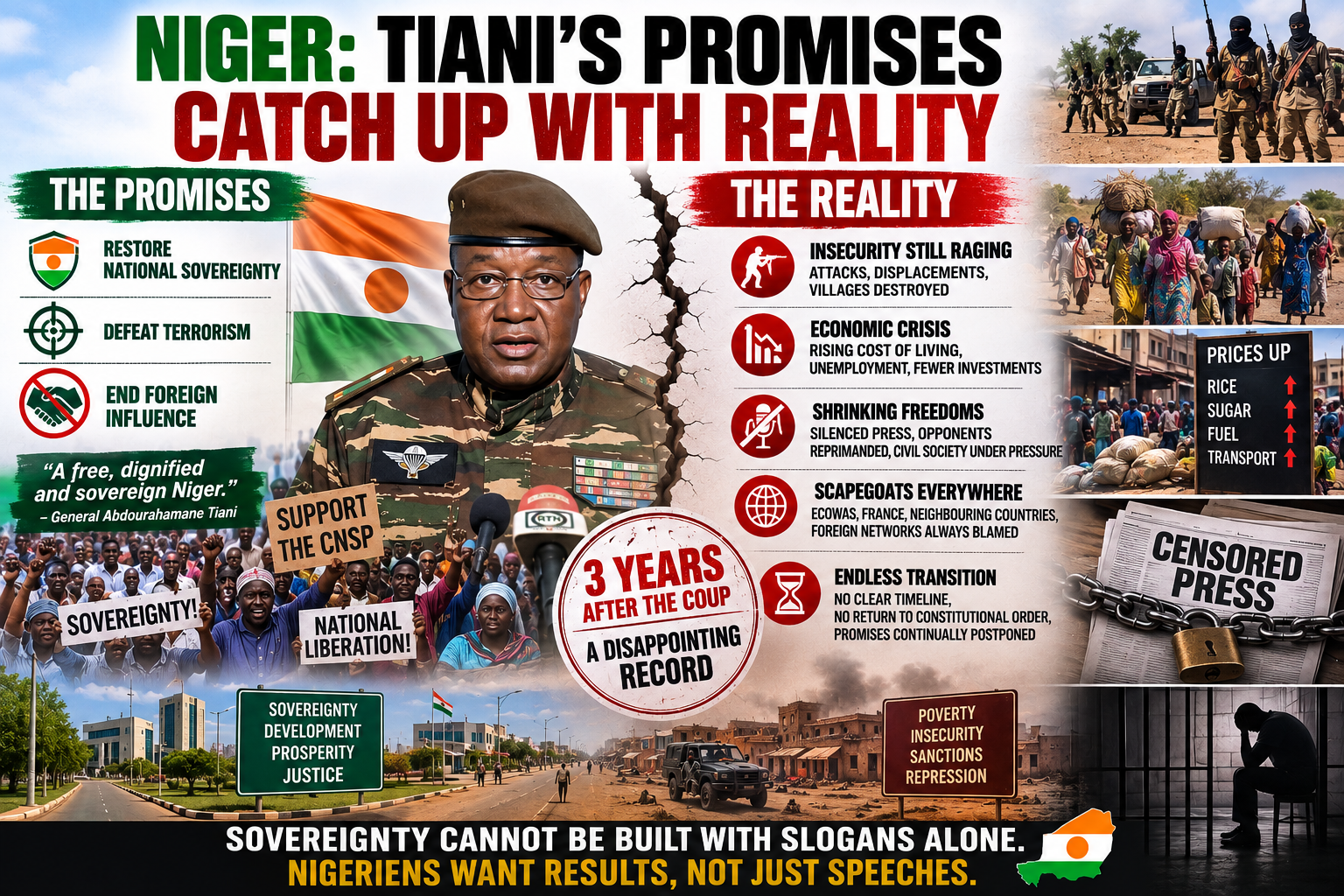
Niger after the coup: promises vs. hard realities three years on
When General Abdourahamane Tiani seized power in Niamey on July 26, 2023, he framed his military takeover as a national awakening. The new leadership pledged to restore Niger’s full sovereignty, crush the insurgency gripping the country, and free the state from foreign interference in its decision-making. A narrative of defiance resonated with many citizens weary of chronic insecurity and economic hardship.
Yet three years later, the gap between those bold promises and the daily realities facing Nigeriens has widened into a widening gap of public frustration. While official speeches continue to denounce what is called ‘neo-colonial domination,’ most families struggle with rising prices, shuttered markets, and the ever-present threat of armed attacks. The contrast between rhetoric and reality now fuels an increasingly sharp debate across the nation.
Defending sovereignty through confrontation
The National Council for the Safeguard of the Homeland (CNSP) has built its legitimacy on a single story: that Niger has regained its sovereignty by severing long-standing ties with Western partners. Every policy announcement, every diplomatic rupture, and every public statement is presented as proof that the country is finally charting its own course.
This strategy has allowed the regime to rally a segment of the population behind a narrative of national pride. It has also helped deflect domestic criticism by casting opponents as agents of outside interests. Yet sovereignty is more than a refusal of foreign alliances; it is measured by a government’s ability to protect its citizens, uphold institutions, preserve freedoms, and improve living standards. On these fronts, measurable progress remains scarce.
Patriotic rallies eclipse policy accountability
The junta has deftly tapped into deep-seated grievances rising insecurity, youth unemployment, gaping inequality, and soaring living costs to portray the coup as a historic turning point. Over time, however, the official narrative has shifted from announcing concrete reforms to sustaining a permanent climate of patriotic mobilization. Media coverage is dominated by pro-regime demonstrations and denunciations of foreign conspiracies, while serious evaluation of public policies rarely surfaces.
This shift has redefined political debate: instead of scrutinizing government performance, Nigeriens are increasingly forced to choose between loyalty and opposition. The result is a growing erosion of the culture of accountability that any functioning democracy or even a responsible transitional authority requires.
Security crisis deepens despite regime change
Crushing the jihadist insurgency was the central justification for removing President Mohamed Bazoum. Today, however, large parts of the country remain under siege. Civilians bear the brunt of relentless attacks, mass displacements, and paralyzed local economies. Military operations continue, but repeated raids on villages and army outposts reveal that armed groups still wield considerable firepower.
The absence of transparent, verifiable indicators on security gains fuels doubts about the effectiveness of the current strategy. Without credible data, the public is left to gauge progress through the number of funerals rather than through official reports.
Searching for foreign culprits, not fixing domestic flaws
Whenever crises arise, the regime points to external scapegoats: ECOWAS sanctions, former Western allies, neighboring states, or shadowy foreign networks. While regional tensions and geopolitical rivalries certainly shape the Sahel’s security landscape, they cannot alone account for Niger’s mounting troubles.
By framing every setback as a foreign plot, the authorities risk sidelining the need for self-criticism, institutional reform, and domestic governance improvements. Over the long term, this approach can weaken the very institutions that sovereignty is meant to strengthen.
Economic pain persists despite political rupture
Households continue to grapple with spiraling living costs, scarce commodities, and vanishing job prospects. The promised dividends of political change have yet to materialize for most citizens. International sanctions, plummeting investment, and trade disruptions have battered key sectors, from agriculture to energy.
True economic sovereignty demands resilient infrastructure, competitive industries, sound public finances, and a business climate that encourages growth. Yet these structural reforms require time, expertise, and stability resources that remain in short supply under the current transition.
Civic space shrinks as junta consolidates power
Independent voices journalists, civil society leaders, and opposition figures face heightened scrutiny. Criticism of the regime is increasingly met with administrative pressure or legal threats. The pattern mirrors that of other military transitions: as power becomes more concentrated, the space for pluralism and dissent narrows.
The absence of a clear political roadmap only deepens uncertainty. Without a defined transition timeline or a credible plan for restoring constitutional rule, many Nigeriens wonder whether the promise of democracy has been indefinitely deferred.
From words to deeds: the looming reckoning
Patriotism can unite a nation, but it cannot feed families, protect villages, or restore trust in institutions. Sovereignty is not proclaimed in speeches; it is earned through security, justice, transparency, and tangible improvements in daily life. The recent history of the Sahel shows that no government military or civilian can indefinitely anchor its legitimacy on denunciations of foreign enemies alone.
For General Tiani and the CNSP, the challenge ahead is no longer to convince Nigeriens that the country is sovereign, but to prove that this sovereignty delivers real benefits. Without such proof, the anti-imperialist rhetoric may come to be seen less as a transformative vision and more as a tool to prolong political control. The clock is ticking, and the people are watching.
