Morocco is deploying a sophisticated diplomatic chess game, leveraging both symbolic gestures and strategic pressure points to advance its sovereignty claims over Western Sahara. As tensions escalate along Spain’s Ceuta border, Rabat is sending unmistakable signals to Madrid and Washington, testing the limits of international support for its territorial ambitions.
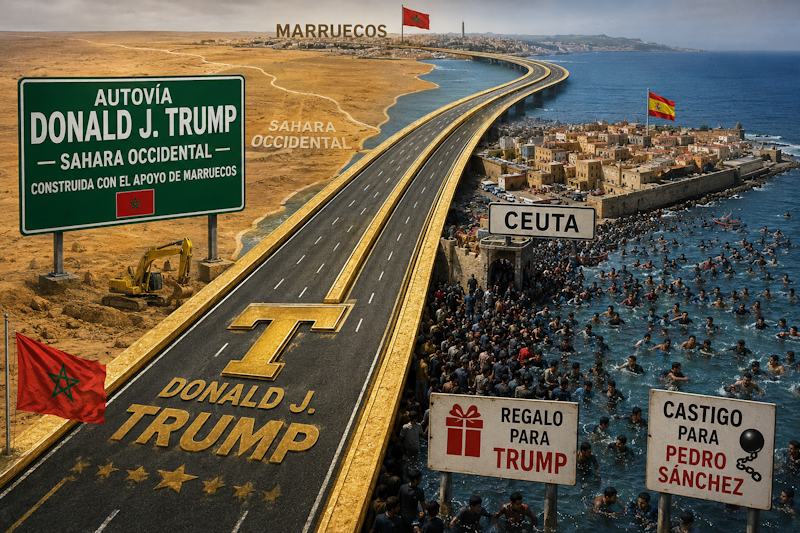
While the newly inaugurated Tiznit-Dakhla highway—now bearing Donald Trump’s name—dominates headlines, it’s the parallel migration crisis at Ceuta that may prove more decisive in reshaping regional power dynamics. Together, these moves form a calculated approach to break diplomatic deadlocks that have persisted for decades.
Symbolic tribute meets geopolitical leverage
In a bold diplomatic maneuver, King Mohammed VI has honored the former U.S. president by naming Morocco’s longest highway after Donald Trump. The 1,055-kilometer Tiznit-Dakhla corridor now carries the name Donald J. Trump, a gesture the monarch described as a tribute for Washington’s 2020 recognition of Morocco’s sovereignty over Western Sahara.
The highway, hailed as Africa’s longest road infrastructure, connects southern Morocco to Dakhla through key cities including Laâyoune, reinforcing Rabat’s claim to the disputed territory. King Mohammed VI emphasized the route’s strategic importance, noting it “binds Morocco’s north and south while linking Europe to the African continent.”
Trump quickly responded on Truth Social, calling the honor “tremendous” and expressing eagerness to one day drive the entire route.
Ceuta’s migration surge: a calculated provocation
The real pressure point, however, lies not on the renamed highway but at Europe’s southernmost border. In late July 2026, nearly 60,000 migrants surged into the Spanish enclave of Ceuta within hours, triggering a humanitarian catastrophe. Spanish authorities reported at least 57 deaths—mostly drownings and trampling incidents—while Morocco officially acknowledged 11 fatalities among those attempting the crossing.
Ceuta, one of two Spanish territories in North Africa, remains a flashpoint in Moroccan-Spanish relations. Rabat has long contested Madrid’s control over the enclave, labeling it an “occupied territory.” The timing of the crisis—just days after Spain’s prime minister visited Algeria to mend fences—appears deliberately calculated to apply pressure on European partners.
Echoes of past confrontations
This isn’t the first time Morocco has used migration as a diplomatic tool. In May 2021, a similar influx of 8,000 migrants forced Spain to rethink its stance on Western Sahara. Madrid abandoned its neutral position after treating Polisario Front leader Brahim Ghali for medical reasons, ultimately endorsing Morocco’s autonomy plan for the territory.
“Morocco seeks more than just Spanish support—it demands formal recognition of its sovereignty,” notes Carlos Ruiz Miguel, director of the Western Sahara Studies Center at the University of Santiago de Compostela. The current crisis arrives at a delicate moment, with Spain’s outreach to Algeria serving as a clear irritant to Moroccan interests.
A multi-pronged diplomatic offensive
Analysts identify three interlocking strategies in Morocco’s current approach:
- Symbolic diplomacy: The Trump highway naming reinforces U.S. backing for Morocco’s territorial claims while flattering Washington’s leadership.
- Migration leverage: By loosening border controls at Ceuta, Rabat reminds Spain—and through Madrid, Brussels—of its capacity to destabilize Europe’s southern frontier.
- International validation: Securing unwavering U.S. support becomes critical as stalled UN negotiations over Western Sahara drag on.
Washington’s unwavering stance
The Trump administration has repeatedly sided with Morocco. Secretary of State Marco Rubio affirmed U.S. recognition of Moroccan sovereignty over Western Sahara, while Trump himself praised Morocco’s autonomy proposal as the “only viable foundation for a lasting solution.” He dismissed alternatives as perpetuating an unacceptable status quo.
U.S. officials have also criticized Spain’s migration policies, with a White House spokesperson warning Madrid risks “undermining its own stability” through uncooperative border management.
Europe’s Schengen fracture
The Ceuta crisis has exposed deep divisions within the European Union. Italy temporarily suspended Schengen agreements with Spain, joined by Finland and Denmark. Belgian MR party leader Georges-Louis Bouchez has even called for a partial suspension of Spain from the Schengen Zone.
“Morocco has demonstrated its willingness to weaponize migration flows against Spain, leveraging the country’s vulnerability stemming from its North African enclaves,” observes Paul Melly, a researcher at Chatham House.
Clear signals and high stakes
The message from Rabat is unambiguous: Morocco holds significant leverage over Europe’s southern border. By combining grand symbolic gestures with targeted pressure tactics, the kingdom is weaving a diplomatic web designed to strengthen its position on Western Sahara. Spain and its EU partners now face a stark choice: concede to Morocco’s demands or risk escalating instability along one of Europe’s most contested borders.