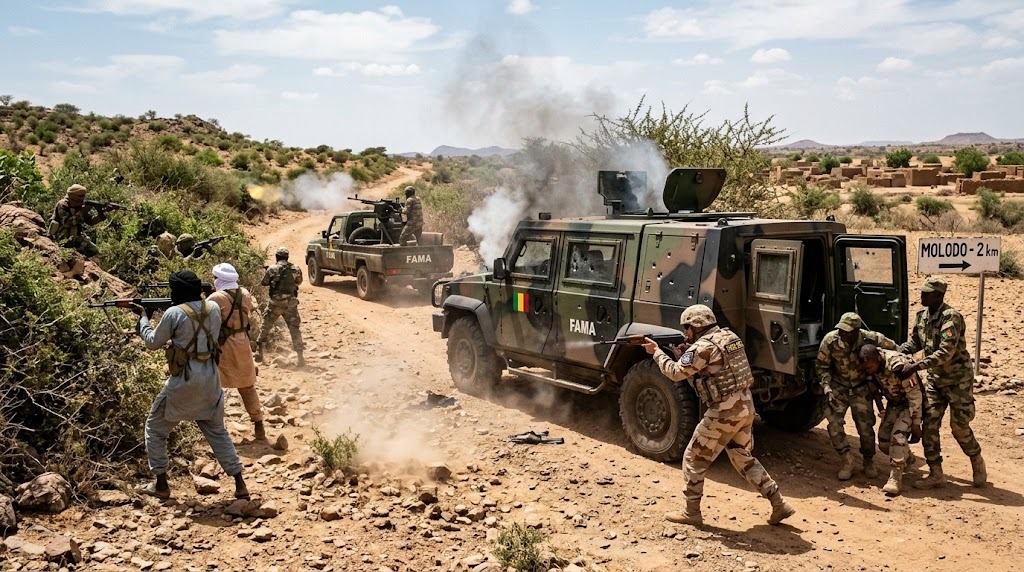
Molodo ambush shatters Mali’s Russian-backed security myth after Africa Corps retreat
The dusty road from Diabali to Niono in central Mali’s Ségou region has become a symbol of premature claims and failed promises. On September 20, 2026, what was supposed to be a routine joint patrol between Malian armed forces and Russian mercenaries of Africa Corps ended in chaos when the convoy was ambushed by jihadists linked to the Group for the Support of Islam and Muslims (JNIM). Within minutes, the Russian fighters—touted as the regime’s new security saviors—retreated hastily, abandonning behind three fully marked Africa Corps vehicles that now stand as a humiliating testament to a strategy in ruins.
The invisible cracks behind Bamako’s iron curtain
This wasn’t just another tactical setback. For Mali’s junta under Colonel Assimi Goïta, the collapse at Molodo exposed the raw, unfiltered truth about a partnership sold to a weary nation as the path to sovereignty and security. The narrative—once tightly controlled by state media—had already begun to fracture, but the retreat of Africa Corps from the battlefield revealed the deeper rot within the regime.
Since severing ties with France’s Operation Barkhane and pushing the UN’s MINUSMA mission out, Bamako has staked its legitimacy on a radical geopolitical shift: replacing Western support with Russian military backing. The promise was clear—Moscow’s “instructors” would do what Europe and the U.S. couldn’t or wouldn’t. But four years into this gamble, the results are catastrophic. Far from stabilizing the country, the Russian presence has fueled recruitment for Islamist groups, deepened instability, and turned central Mali into a war zone.
The illusion of control and the reality of retreat
The Molodo ambush didn’t happen in a vacuum. It was the culmination of years of mismanagement, propaganda, and a reliance on foreign fighters who view Mali not as a partner, but as a contract. While state broadcasts in Bamako continued to celebrate “victories,” rural communities were trapped between advancing jihadists and a government whose only real strategy was survival—itself.
- Unequal loyalty: Africa Corps fighters, often former members of Wagner Group rebranded under new legal cover, operate more as protectors of the regime than as liberators. Their loyalty is to Moscow’s interests—not Mali’s sovereignty.
- Tactical failure: Despite overwhelming firepower, the joint FAMa-Russia patrols have repeatedly failed to adapt to local terrain and guerrilla tactics, leading to civilian casualties and eroding trust in the army.
- Economic drain: Mali’s already depleted treasury now funds private militias linked to Kremlin-aligned mining firms—extracting wealth while offering no real security in return.
From propaganda to paralysis: the cost of silence and suppression
To maintain its grip amid growing public discontent, the junta has enforced an unprecedented crackdown. Independent journalists, civil society leaders, and even soldiers who voice doubts about the Russian alliance are silenced—labeled as traitors or tools of foreign interests. But censorship cannot bury the truth forever. When Africa Corps fled Molodo, leaving behind armored vehicles emblazoned with its insignia, the images spread instantly across local networks and social platforms. They tell a story louder than any state communiqué: this partnership is not working.
What began as a bold move to reclaim national dignity has instead trapped Mali in a cycle of dependence. The junta traded one external dependency for another—only this one is more volatile, less accountable, and deeply unpopular. The junta’s insistence on maintaining the alliance, despite its glaring failures, reveals a harsh reality: it fears losing Russian support more than it fears failing its people.
The road ahead: a nation adrift between war and silence
With no meaningful political reconciliation, no credible national dialogue, and an army increasingly viewed as a tool of foreign interests, Mali stands at a crossroads. The Molodo ambush didn’t just expose the weaknesses of the junta—it exposed the bankruptcy of its entire security doctrine. The Africa Corps retreat was not an isolated failure. It was a symptom of a system that values power over people, propaganda over progress, and survival over strategy.
For the people of central Mali, caught between armed groups and a government that cannot—or will not—protect them, the options are dwindling. Without a change in course—one that prioritizes national unity and credible defense—Mali’s slide into deeper chaos is no longer a question of ‘if’, but of ‘how fast’.
