
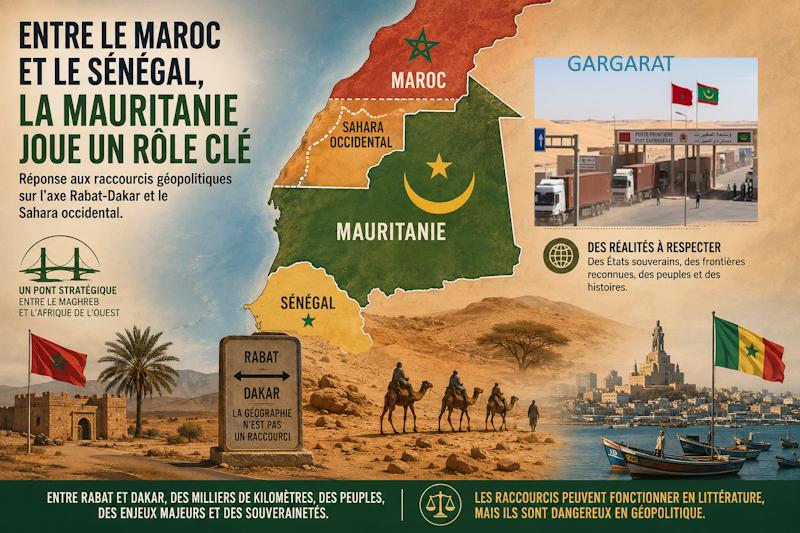

An explosive diplomatic incident in late July 2026 during a high-profile event in Dakar has thrust Mauritania’s delicate position on the Western Sahara conflict back into the spotlight. Between strategic ambiguity, economic imperatives and territorial sovereignty concerns, Nouakchott’s carefully calibrated neutrality is facing unprecedented pressure from all sides.
The controversy erupted when former Senegalese Foreign Minister Cheikh Tidiane Gadio made remarks during a Moroccan embassy event in Dakar, triggering immediate backlash. By suggesting that Morocco was perceived as being just « a few kilometers » away in Senegalese historical consciousness—a veiled reference to pre-colonial borders—Gadio’s comments were seen as challenging Mauritania’s very existence.
Mauritanian Ambassador Mohamed Ould Abdellahi Ould Ethmane swiftly cut short the speech, condemning what he termed an attempt to « rewrite history » that would erase Mauritania from the map. While Morocco’s envoy Hassan Naciri intervened to calm tensions, the episode laid bare the precarious tightrope Mauritania walks between maintaining relations with Rabat and preserving its own national interests.
Former Mauritanian Foreign Minister Isselmou Ahmed Izidbih escalated the controversy, publicly calling for Gadio to be declared persona non grata across Mauritania’s airspace, territorial waters and land. The outburst underscored how sensitive this issue remains for Nouakchott’s leadership.
Strategic neutrality under the microscope
The Dakar incident has exposed the contradictions in Mauritania’s official stance. While Nouakchott recognizes the Sahrawi Arab Democratic Republic (SADR) since 1984 and maintains dialogue with the Polisario Front, it simultaneously refuses to grant full diplomatic status to the SADR representation within its borders—a concession to Morocco’s position that views any recognition of the SADR as a provocation.
By participating in Moroccan commemorations while avoiding direct recognition of Rabat’s territorial claims, Mauritania attempts to satisfy both neighbors. This balancing act extends to avoiding any revival of historical Moroccan claims that once included Mauritanian territory, while keeping Algeria satisfied through maintained relations with the Polisario.
Guerguerat: the economic lifeline at the heart of tensions
Beyond political symbolism, Mauritania’s pragmatic economic interests are equally crucial. The Guerguerat border crossing, straddling Western Sahara and Mauritanian territory, has become the critical artery connecting Morocco to West Africa. Daily convoys of Moroccan trucks pass through this zone, supplying food and manufactured goods to Mauritania, Senegal and Mali.
With hundreds of commercial vehicles transiting daily, Nouakchott cannot afford to disrupt this flow that sustains its economy. While the border remains open to Moroccan trade, Mauritania stops short of formal recognition of Rabat’s control, maintaining a de facto acceptance of Moroccan influence while preserving legal ambiguity.
The calculated gamble of Mauritania’s dual approach
For regional observers, Mauritania’s « both sides » policy isn’t indecision but calculated survival strategy. Sandwiched between Morocco’s economic expansionism and Algeria’s geopolitical sensitivities, Nouakchott cannot afford to fully align with either side without risking retaliation or destabilization.
The Gadio incident serves as a reminder that this carefully maintained neutrality remains highly volatile. Whenever Mauritania’s territorial integrity appears threatened by neighboring ambitions, Nouakchott quickly abandons its reserve to assert its indispensable role as the sovereign linchpin of Maghreb stability.