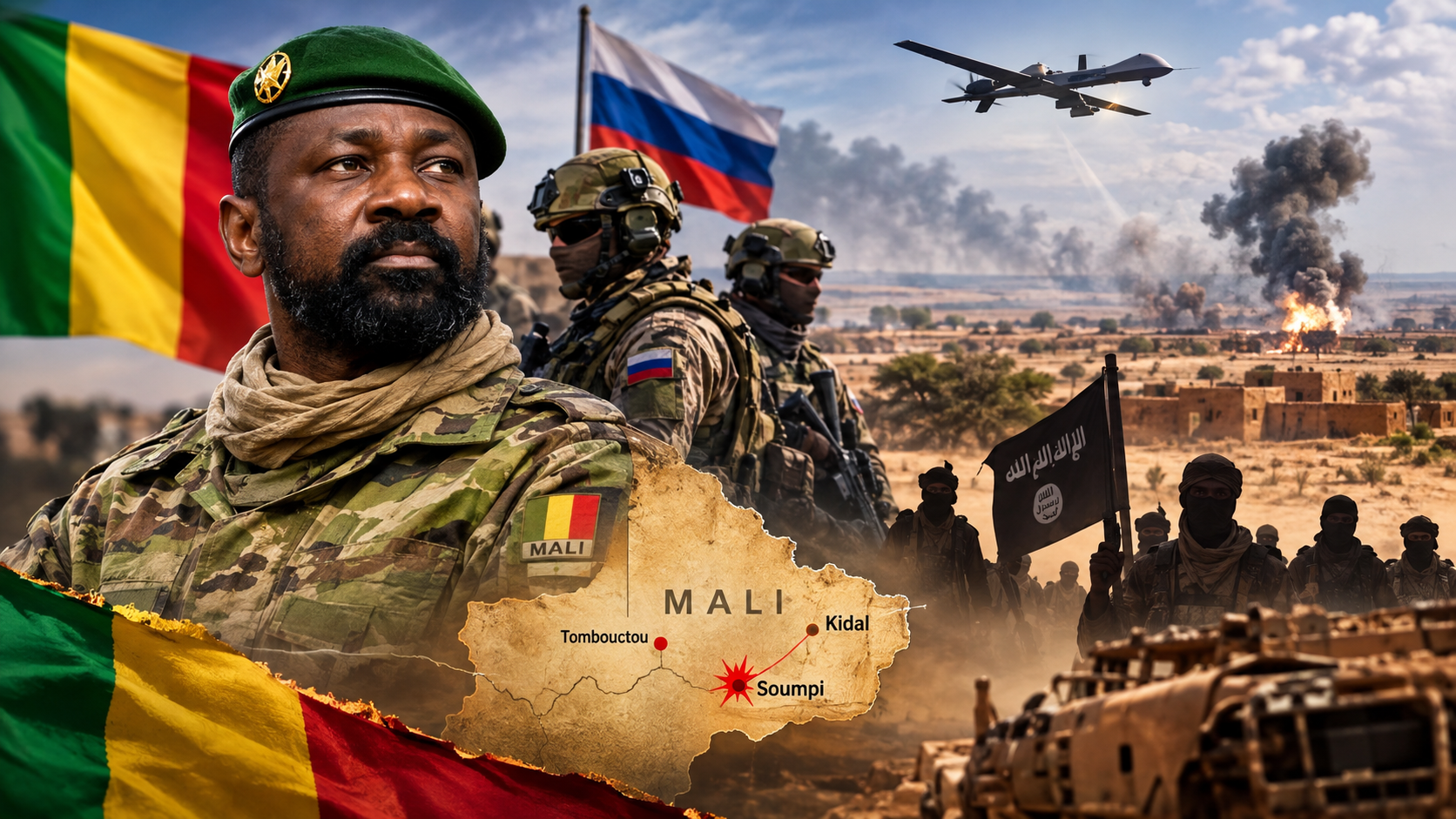
Mali’s Russian military partnership and the unending security crisis
On 10 October 2026, the Azawad Liberation Front (FLA) reportedly launched drone strikes against positions held by Africa Corps and the Malian army in Soumpi, located in the Timbuktu region. This incident brings a fundamental question back to the forefront: after more than four years of security crisis, can Mali realistically expect to achieve stability by relying primarily on its Russian military partners?
A strategic shift that has not delivered lasting security
Since assuming power, Assimi Goïta has made the realignment of military partnerships a central pillar of his security strategy. The departure of French forces and the rapprochement with Russia were presented as evidence of a new sovereignty and an enhanced capacity to defend the national territory. However, the persistence of attacks and the vulnerability of certain military positions raise questions about the concrete results of this orientation.
The reported attack in Soumpi is not sufficient on its own to draw a definitive assessment of Russian-Malian cooperation. Nevertheless, it underscores an unavoidable reality: the presence of foreign military partners does not, by itself, guarantee the end of an insurgency or the lasting restoration of security.
Can Russian operatives truly end Mali’s crisis?
Assimi Goïta must confront the situation directly: Mali’s problems will not be resolved simply by replacing a Western military partner with a Russian one. After more than four years of military rule, the population has the right to expect lasting results, not merely announcements of operations or isolated victories presented as decisive.
Recent events illustrate the complexity of the challenge. On 6 October 2026, the Malian army, supported by its Russian partners, retook Kidal following the announced withdrawal of the Azawad Liberation Front (FLA). This development represents a symbolic success for Bamako, but analysts assess that it does not constitute, on its own, a decisive victory in the fight against armed groups.
A few days later, the reported drone attack in Soumpi, in the Timbuktu region, serves as a reminder that the situation remains fragile. While the exact circumstances of this operation and its toll have yet to be established, one question persists: how can it be explained that, despite several years of military cooperation with Moscow, the positions of Malian forces and their allies remain exposed to attacks?
A military cooperation that must not become a dependency
The partnership with Russia can provide equipment, operational capabilities, and support on the ground. However, it does not relieve Malian authorities of the need to define a coherent national strategy, strengthen their own forces, and address the root causes of insecurity.
This is precisely where the debate should focus. Has Mali sufficiently strengthened its autonomous military capabilities? Do operations enable the lasting securing of recaptured localities? Can populations return to their villages without fear of new attacks? Can public services and administration function normally in the reconquered zones?
These questions are far more important than discourses on sovereignty or rivalries between foreign powers.
Economic interests and the risk of a self-perpetuating conflict
It is also necessary to examine with lucidity the economic interests surrounding this cooperation. The presence of Russian military companies in Mali is part of a relationship in which security issues and economic interests may intersect, particularly around natural resources.
However, it would be imprudent to assert, without verifiable evidence, that Russian forces deliberately wish to prolong the war to earn more money. Such an accusation requires documented elements on contracts, payments, and the interests at stake.
The real issue lies elsewhere: when a country’s security depends heavily on an external partner, it is essential to verify that this partner’s commitments primarily serve the interests of the Malian population. The transparency of contracts, the cost of cooperation, and the results obtained must be subject to evaluation.
A military partnership cannot be considered a success simply because it allows a government to remain in place. Its value must be measured by its capacity to protect civilians, durably reduce violence, and enable the country to return to normal life.
Assimi Goïta must rethink his strategy
Mali cannot afford to confuse the maintenance of power with the restoration of security. Sovereignty does not consist solely of changing partners or displaying a break with former alliances. It also presupposes having the means to defend one’s territory, protect one’s population, and make decisions without excessive dependence on a foreign power.
The Malian crisis demands a broader strategy: better-prepared national forces, effective intelligence, increased protection of populations, credible governance, and a political response to local conflicts. Military means are necessary, but they are not sufficient on their own.
The reported attack in Soumpi should therefore be regarded as a new warning, not as definitive proof of the failure of Russian cooperation.
Ultimately, Assimi Goïta must understand one thing: Russia can be a partner of Mali, but it cannot substitute for a Malian strategy capable of producing lasting results. If the authorities continue to measure their success solely by the presence of their foreign allies, they risk missing the essential question: when will Malians finally be able to live in security, without each new attack calling into question the promises of victory?
The priority must be Mali and its population, not the defense of the interests of any partner whatsoever.
