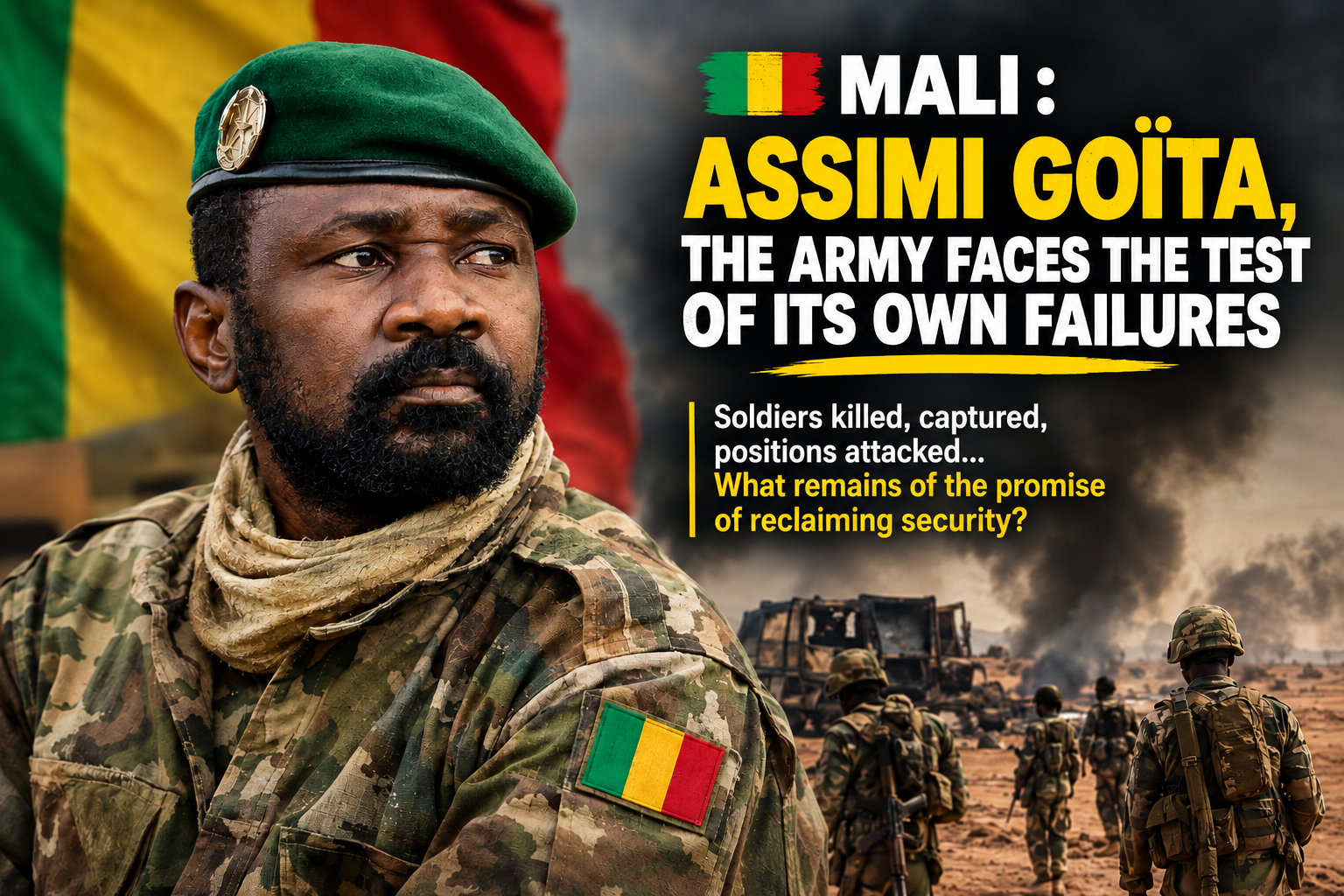
Mali’s military setbacks: dissecting the strategic failures behind Goïta’s security doctrine
Behind the battlefield losses and mounting casualties lies a critical question: what remains of Mali’s proclaimed security recovery under transitional leader Assimi Goïta? The gap between Bamako’s rhetoric of resilience and the harsh reality on the ground has never been wider. Months of repeated defeats at the hands of the Jama’at Nusrat al-Islam wal-Muslimin (JNIM) and the Front de Libération de l’Azawad (FLA) have exposed systemic weaknesses not deficiencies in soldierly courage, but in strategy, command, and operational preparedness.
Dioura 2026: a camp lost and the illusion of control
The September 10, 2026 attack on the Dioura military base in central Mali shattered the government’s narrative. What was meant to be a secure stronghold fell to coordinated assaults, resulting in at least 100 Malian soldiers and five Africa Corps personnel killed. The JNIM’s claim of higher casualties and 93 captives remains unverified, but the operational damage is undeniable: weapons, ammunition, and vehicles were seized a blow not just in human cost, but in tactical credibility. A lost camp is more than a statistic; it signals intelligence gaps, weak perimeter security, and an inability to sustain critical installations under pressure.
Tabrichat ambush: when convoys become death traps
On July 18, 2026, a Malian military convoy moving along the Anéfis-Bourem axis was ambushed near Tabrichat. Rebel sources reported over 50 fighters killed, along with unconfirmed captures of Malian soldiers. While the army claimed air support enabled escape, evidence later emerged verified through open-source analysis of at least 19 soldiers being executed after surrender. Such acts transcend tactical failure; they reveal systemic vulnerabilities in convoy protection, medical evacuation, and post-capture protocols. When soldiers are not just fighting, but being hunted and killed in captivity, the foundation of any military doctrine is called into question.
Kati under fire: the fall of a bastion
April 25, 2026 marked a turning point. Coordinated strikes by JNIM and FLA operatives hit multiple strategic locations: Kati, Bamako, Gao, Mopti, and Sévaré. Kati, home to a major garrison just kilometers from the capital, witnessed the assassination of Defense Minister Sadio Camara. The targeting of a senior official within a fortified military city exposed alarming intelligence penetration and operational failure. How could armed groups breach a high-security zone? What does this say about the state’s ability to protect its own leadership, let alone its troops? The answers point not to the bravery of soldiers, but to the fragility of command structures and intelligence networks.
Doctrine vs. Reality: from sovereignty to survival
Since seizing power in 2020–21, Goïta’s administration has framed military sovereignty and a pivot away from Western partners as pillars of national identity. The pivot toward Russian-affiliated Africa Corps was presented as a game-changer. Yet by 2026, jihadist violence surged across the Sahel, reaching unprecedented levels. The shift in alliances did not neutralize the threat it may even have complicated coordination, raised doctrinal ambiguity, and diverted resources. The failures at Dioura, Tabrichat, and Kati are not isolated incidents; they reflect a broader strategic drift where policy decisions outpace battlefield realities.
The question is no longer whether soldiers are brave enough. It is whether a national strategy exists that can protect them.
Accountability beyond the battlefield
An army is measured not by the volume of its weapons or the volume of its slogans, but by its capacity to anticipate attacks, safeguard movements, evacuate the wounded, and prevent atrocities. The images and reports from Mali tell a different story: soldiers encircled, convoys ambushed, ministers assassinated, and prisoners executed. These are not acts of courage; they are episodes of failure.
The soldier on the front line does not design the doctrine. He bears its cost. When defeats accumulate, the inquiry must shift from ‘how many died?’ to ‘why did they die? not under fire, but due to preventable failures in command, communication, and care. The people of Mali deserve protection. The men and women in uniform deserve leadership that values their lives as highly as their loyalty. Until that happens, the promise of security remains unfulfilled.
By Yacouba Ouédraogo — Investigative journalist
