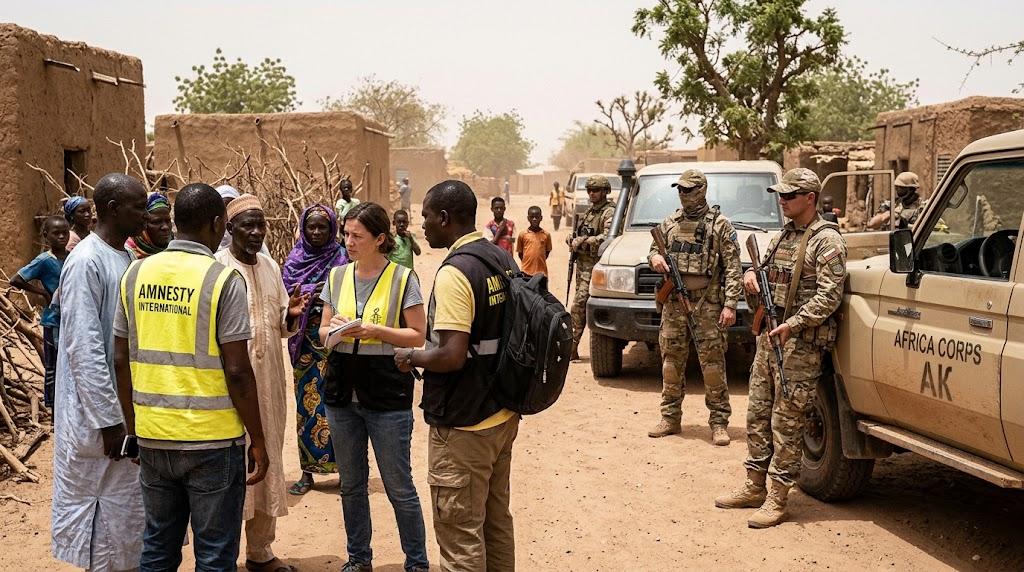
Mali’s Africa Corps faces fresh allegations of civilian abuses despite Wagner’s exit
New evidence has emerged of ongoing human rights violations in Mali, with Africa Corps—Moscow’s successor to Wagner—now under scrutiny for alleged war crimes. A recent investigation details extrajudicial killings, torture, and mass detentions, raising serious concerns about the new security force’s conduct and accountability.
Civilian casualties linked to military operations
Between June 2023 and December 2025, at least 34 civilians were killed in seven towns along the Mali-Mauritania border during joint operations involving Malian armed forces and Wagner personnel, a report reveals. Eyewitness accounts describe executions after arrests, throat slittings, and burnings—acts that, if confirmed, may constitute war crimes under international humanitarian law.
Drone strikes add to civilian toll:
- March 2025: A drone strike on a market in Ejdeir reportedly killed 16 people, with no visible evidence of armed fighters or military objectives nearby.
- November 2025: Another strike on a residential area in Tangata claimed seven lives, again without clear indications of combatant presence.
These incidents raise critical questions about adherence to the principles of distinction and proportionality, which require forces to avoid harming non-combatants and ensure attacks are directed solely at legitimate military targets.
Systematic torture and unlawful detentions reported
Testimonies collected by investigators document severe abuses in detention centers and during operations. Survivors describe:
- Suspending victims by their arms
- Waterboarding and electrocution
- Beatings with sticks, metal bars, and rifle butts
- Sexual violence against detainees
At least five deaths were attributed to torture or harsh detention conditions, while others were held for months without access to legal counsel or family contact. The report implicates Wagner-affiliated personnel in some cases, noting that Malian soldiers participated in interrogations despite witnessing violence.
Ethnic targeting and collective punishment
The investigation highlights the disproportionate impact on Fulani, Arab, and Tuareg communities, who face heightened risks of violence and property destruction. Survivors report being targeted under suspicion of collaborating with armed groups, particularly the Group for the Support of Islam and Muslims (GSIM).
Witnesses also describe systematic looting of livestock, cash, jewelry, and other valuables, along with the destruction of homes and agricultural assets. These actions exacerbate the humanitarian crisis, compounding the effects of displacement and disrupted livelihoods for already vulnerable populations.
Accountability remains elusive as Africa Corps takes over
Africa Corps, formally deployed in January 2025 and operational since June 2025 under Russian command, was expected to mark a shift toward more disciplined military conduct. Yet new allegations surfaced in July 2026 in Bombori, where approximately 80 Fulani men were reportedly rounded up, beaten, and interrogated about militant activities. Six who attempted to flee were shot, and three were executed.
The absence of credible investigations into past abuses—no prosecutions have been documented since 2023—undermines trust in the transitional justice process. Limited access to conflict zones further obstructs efforts to document violations comprehensively.
No security without justice: the way forward for Mali
International observers insist that military operations cannot be conducted at the expense of civilian protection. Key demands include:
- Independent investigations into all allegations of abuse
- Prosecution of perpetrators in fair and transparent court proceedings
- Full transparency regarding military cooperation agreements with Africa Corps
- Strengthened oversight mechanisms to prevent future violations
Without these measures, Africa Corps risks perpetuating the very patterns of violence and impunity that defined the Wagner era. The fight against armed groups must never become a justification for collective punishment or ethnic-based reprisals.
The international community and Malian authorities face a stark choice: either break the cycle of abuse or risk normalizing a security model that sacrifices civilian rights in the name of stability.
