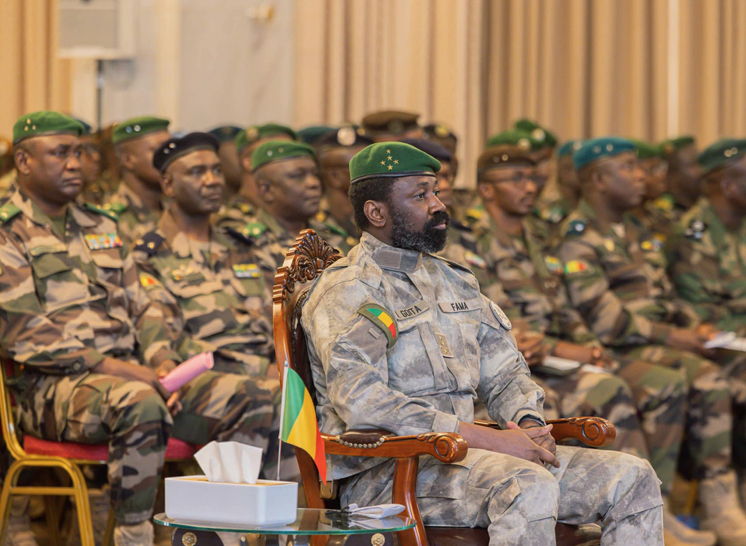
Mali revamps defense and security framework for modern threats
After more than two decades under the same national defense framework, Mali is rolling out a sweeping security reform to address evolving threats, including cyber risks and internal crises.
The overhaul, recently adopted by the National Transitional Council, replaces the outdated 2004 defense law and expands its scope to encompass homeland security, cybersecurity, and crisis management. With 125 voting members endorsing the changes, the new legislation is set to be enacted following official publication.
General Daoud Aly Mohammedine, Minister of Security and Civil Protection, outlined the reform’s necessity in response to over twenty years of shifting security dynamics. He emphasized that the preparatory phase involved extensive consultations with various security stakeholders to ensure a collaborative approach.
The 2004 framework, though initially focused on military defense, already addressed internal security, civil defense, and the roles of local governments, civil society, and communities. Under the former structure, the Chief of Staff of the Armed Forces led military operations and held operational authority over certain security forces during territorial defense scenarios.
Strengthening National Security Through Modernization
The reform builds on existing responsibilities while adapting them to contemporary challenges. Cybersecurity and internal security now stand as explicit pillars of national defense. The National Security Council and the National Defense Committee replace their predecessors to enhance strategic decision-making under the President’s leadership.
Operational command unity is reinforced under the Chief of Staff of the Armed Forces, streamlining responses to attacks, major crises, or cross-border threats. However, this does not mean the permanent subordination of the Police, Gendarmerie, National Guard, or Civil Protection to military control.
Since 2022, the National Police and Civil Protection have been militarized, facilitating their integration into a unified security apparatus while preserving their core public safety and emergency response roles.
The Minister highlighted three priorities: bolstering territorial administration, leveraging traditional authorities in counterterrorism efforts, and accelerating force recruitment and equipment upgrades. These goals align with the expanded mandate of the Ministry of Territorial Administration and Decentralization, which now oversees civil defense, inter-agency coordination, local governance involvement, and community mobilization. The initiative aims to ensure early threat detection at the municipal level without turning civilians into auxiliary security personnel.
Cybersecurity Takes Center Stage
A parallel reform targets cyber threats, with the government finalizing legislation in June to establish the National Agency for Information System Security (ANSSI). Aligned with the 2026–2030 National Cybersecurity Strategy, the ANSSI will coordinate responses to cyberattacks and safeguard critical infrastructure. While cyberdefense focuses on state-level protection, cybersecurity encompasses broader protections for government networks, communications, and essential services.
Coordination is already being tested in the field. On August 4, 254 ex-combatants from diverse armed groups completed training in Soufouroulaye and were integrated into the Armed Forces as part of the Disarmament, Demobilization, and Reintegration (DDR) program. The initiative plans to integrate 2,000 former fighters and reintegrate 1,000 others socioeconomically, fostering collaboration between defense, security, reconciliation, and local authorities.
The reform’s success hinges on execution. Clear procedures, intelligence sharing, local capacity-building, cyber expertise, reintegration tracking, and well-defined responsibilities will be critical. The new system’s effectiveness will be measured by decision speed, on-ground coordination, and trust among institutions, forces, and communities.
