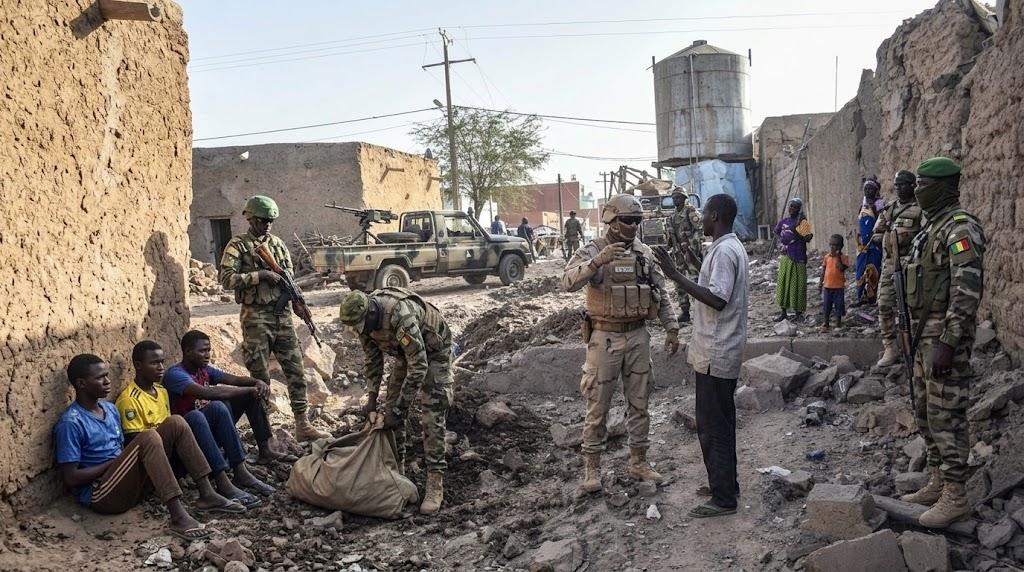
Mali: army admits civilian casualties but hides key details in deadly strike response
The Malian military has acknowledged a “tragic incident” involving deaths and injuries in an operational zone, yet provided no specifics on location, casualties, or timeline. This admission follows reports of deadly airstrikes in Zanakoro and amid growing documentation of alleged abuses by national forces and their Russian partners.
Military admits harm but offers zero transparency
In a brief statement issued on October 14, 2026, the Malian General Staff confirmed being informed of a “tragic incident in an operational area,” resulting in “loss of life and injuries.” The communiqué mentions victims traveling on high-capacity motorcycles between two localities but omits critical details: no date, no location, no casualty figures, and no explanation of the events.
The sparse communication arrives during a highly sensitive period marked by repeated accusations of human rights violations during military operations in central Mali. While the statement alone does not clarify the circumstances, it underscores a persistent concern: are civilians in Mali actually protected during armed engagements?
Zanakoro strikes: local accounts paint grim picture
Reports from residents, community leaders, and neighboring villages indicate that at least eight civilians—mostly women and children—were killed in airstrikes on October 12, 2026, in Zanakoro, a town in the Ségou region. Among the dead was a pregnant woman and three girls under ten years old. Several homes were damaged, and families fled into nearby bush and villages. Some local sources suggest the toll could be higher.
Witnesses describe multiple bombings targeting a community gathering following a baptism ceremony. The proximity of these events to the military’s October 14 statement raises serious questions: if the Zanakoro victims are those referenced in the communiqué, why does the army avoid naming the location and disclosing accurate numbers?
Systematic abuses amid shifting alliances
A growing body of evidence points to a pattern of alleged human rights violations by Malian forces and their foreign partners. A September 29, 2026 report by Amnesty International documented seven incidents between June 2023 and December 2025 along the Mauritanian border, involving 34 civilians allegedly killed in joint operations with Wagner Group fighters. Methods included shootings, throat-cutting, and burning. The report also details allegations of torture, arbitrary detentions, enforced disappearances, looting, and property destruction. Peul, Tuareg, and Arab communities were particularly affected, often targeted based on uncorroborated suspicions of ties to armed groups.
With Wagner’s gradual withdrawal and the rise of Africa Corps—a Russian-led structure operating under Moscow’s command since 2025—the cycle of abuse appears unbroken. Amnesty International warns that the transition has not brought meaningful safeguards for civilians. Human Rights Watch reported eight civilian deaths, including three children, in an Africa Corps airstrike on June 15, 2026, in Kyrnia, Mopti region. The attack hit near a village chief’s residence and a livestock market, with no clear military objective identified—raising concerns about indiscriminate bombing.
Anti-terrorism can’t justify war crimes
Mali faces severe security threats from jihadist groups such as the Group for the Support of Islam and Muslims (JNIM), whose attacks have caused mass displacement and economic disruption. Authorities have a duty to protect citizens, but this cannot justify disregard for international humanitarian law. Distinguishing civilians from combatants, taking feasible precautions, and avoiding indiscriminate or disproportionate attacks are non-negotiable obligations. When civilian harm occurs, full investigations must be conducted to identify causes, responsible parties, and pathways to accountability.
Transparency is not a political concession—it is the foundation of trust between the population and the institutions meant to protect them.
An admission without answers
The military’s acknowledgment of harm is a step forward, albeit a minimal one. Yet without concrete details—location, date, identities of victims, casualty counts, civilian status, or investigative status—it remains hollow. Families deserve clarity on what happened, why it happened, and who is responsible. A possible link to the Zanakoro strikes demands urgent official confirmation with verifiable evidence. Otherwise, the silence deepens mistrust and leaves grieving communities without closure.
For victims and survivors, truth is not a luxury—it is a right. Accountability is not optional—it is a duty. Until credible investigations are conducted and perpetrators held to account, the shadow of atrocities will continue to loom over military operations in Mali. The army’s admission must mark the beginning of a journey toward justice, not a conclusion.
