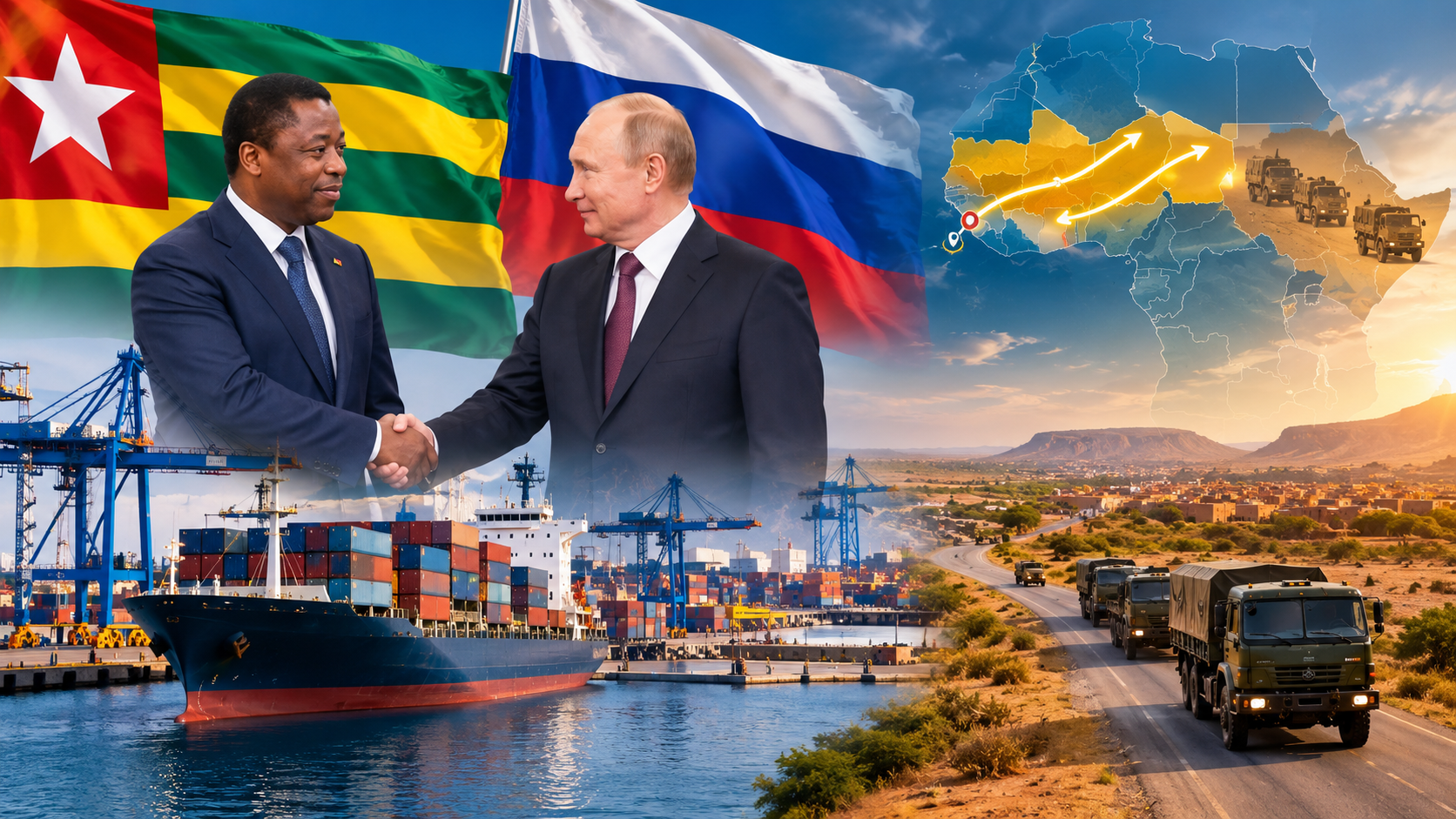
Lomé as Russia’s emerging logistical bridgehead into the Sahel corridor
The convergence between Lomé and Moscow has entered a new phase, one that signals more than just a commercial agreement. Behind the proposal to utilise the Port of Lomé as a transit hub for Russian goods destined for Togo and select Sahelian markets lies a deeper reconfiguration of regional trade, infrastructure and strategic pathways.
Why the Port of Lomé is now central to Moscow’s Sahel ambitions
The concept appears straightforward: accelerate the flow of Russian merchandise into West Africa and the Sahel by leveraging Togo’s coastal infrastructure. Yet the timing, location and prior events reveal a far more consequential agenda one that extends beyond routine commerce into logistical and, potentially, military domains.
During the inaugural session of the Russia–Togo intergovernmental commission held in Lomé from 29 September to 1 October 2026, Russian Deputy Transport Minister Alexei Chilo outlined a comprehensive framework for expanding bilateral logistics cooperation. A delegation of 29 Russian officials engaged with Togolese counterparts on modal shifts, cost optimisation, infrastructure upgrades and trade facilitation. Site visits included the Autonomous Port of Lomé, Gnassingbé Eyadéma International Airport and the Adétikopé Industrial Platform, underscoring the breadth of planned integration.
The Mikhail Britnev precedent: a dry run for military-civilian dual use
The strategic implications of Lomé’s emerging role were already evident on 9 July 2026, when the Russian cargo vessel Mikhail Britnev docked at the port despite being listed under US sanctions since 2024. Maritime tracking data confirmed the arrival, followed days later by the sighting of a military convoy in Bamako. Satellite imagery and open-source analysis aligned the convoy’s composition armoured personnel carriers, logistics trucks and utility vehicles with the consignment that had allegedly transited via Lomé. Independent assessments by Critical Threats estimated that approximately fifty military vehicles destined for the Africa Corps in Mali were offloaded in Togo, subsequently transported through Burkina Faso en route to Mali.
This sequence demonstrates that the Port of Lomé is already capable of bridging maritime routes from Russia to terrestrial networks penetrating the Sahel. While the new corridor is formally presented as a commercial initiative, the precedent raises legitimate questions about dual-purpose utilisation.
From trade gateway to logistical fulcrum
The novelty of Moscow’s approach lies not in its commercial ambitions deepening trade ties with West Africa is a long-standing objective but in the deliberate integration of logistics, energy partnerships and infrastructure access into a cohesive Sahelian strategy. The Mikhail Britnev episode illustrates how this mechanism can function in practice: Russian cargo arrives, is cleared, stored or transshipped, and then forwarded overland to Sahelian capitals.
The October 2026 announcement seeks to formalise and scale this process, transforming an ad hoc arrangement into an institutionalised framework. The question is no longer confined to whether Lomé can serve as a commercial gateway; it now includes whether the Togolese capital will evolve into a regional hub capable of receiving, consolidating, processing and redistributing goods civilian, industrial and, in certain instances, military across multiple Sahelian corridors.
Togo’s evolving partnership with Moscow
Bilateral relations have intensified since Togolese President Faure Gnassingbé’s November 2025 meeting with President Vladimir Putin at the Kremlin. The agenda has since broadened from conventional diplomacy to encompass energy, industry, transport infrastructure and security cooperation, with a particular focus on Sahelian stability. The 2026 commission sessions represent the next step: transitioning from dialogue to tangible project implementation.
The Togolese government’s engagement with Moscow appears strategic. Open-source monitoring indicates the presence of Russian military personnel on Togolese soil, suggesting that security collaboration may form part of the evolving partnership. This raises governance questions: to what extent is Lomé willing to align its logistical capacities with Russian regional objectives, and what trade-offs does this entail for Togolese sovereignty?
The industrial dimension: Adétikopé as a strategic asset
During their visit, Russian officials toured the Adétikopé Industrial Platform (PIA), a facility equipped with logistics warehousing, light manufacturing and distribution capabilities. This site could allow Togo not only to transship goods but also to process, store and re-export them across the Sahel and Gulf of Guinea. Such an evolution would shift the port’s function from a mere transit point to a regional redistribution node, significantly increasing its strategic value for Moscow.
The dual-track potential commercial flow management alongside limited industrial integration—positions Togo as a unique connector between Russian supply chains and Sahelian demand centres. Energy products, industrial equipment and processed goods could all be channelled through this corridor, making the Togolese logistics ecosystem an indispensable node in Russia’s West African outreach.
Regional realignment and corridor competition
The closure of the Benin–Niger border has disrupted traditional trade arteries, forcing Sahelian states to diversify supply routes. In this fluid environment, the Port of Lomé offers several competitive advantages: a deep-water berth, extensive container handling capacity, well-developed road links to the interior and the PIA’s multi-modal infrastructure. Moscow now appears intent on exploiting this combination to secure a durable foothold in Sahelian logistics.
The Mikhail Britnev case confirms that this corridor is not hypothetical. It already exists. The formalisation of a Russia–Togo logistics corridor would merely intensify and rationalise what is already occurring on an ad hoc basis. The broader question is not whether Russian goods will transit through Lomé, but which states will control the dominant corridors, how these routes will be financed and safeguarded, and what geopolitical consequences will ensue for West Africa.
What the future corridor means for Sahelian markets and regional stability
As the new framework moves from presentation to implementation, three scenarios emerge:
Commercial expansion: Increased flows of industrial goods, energy products and consumer items from Russia to West Africa via Lomé, reinforcing Togo’s role as a trade facilitator.
Dual-use logistics: The possibility that certain consignments particularly those linked to security cooperation may transit the same corridor, exploiting Togo’s infrastructure for strategic purposes.
Regional reshaping: A rebalancing of Sahelian supply chains, with Lomé competing against ports in Senegal, Côte d’Ivoire and Ghana for dominance in the Russia–Sahel trade ecosystem.
While no definitive implementation timeline has been disclosed, the trajectory is clear: the relationship between Togo and Russia is transitioning from political dialogue to operational logistics partnership. In a Sahel where alliances are fluid and corridors are contested, the Port of Lomé is poised to become a pivotal node one whose economic benefits must be weighed against its potential strategic risks.
By Maimouna Kaboré — Journalist
