Lomé accords on Burkina Faso refugees: cautious reactions as the hard part begins
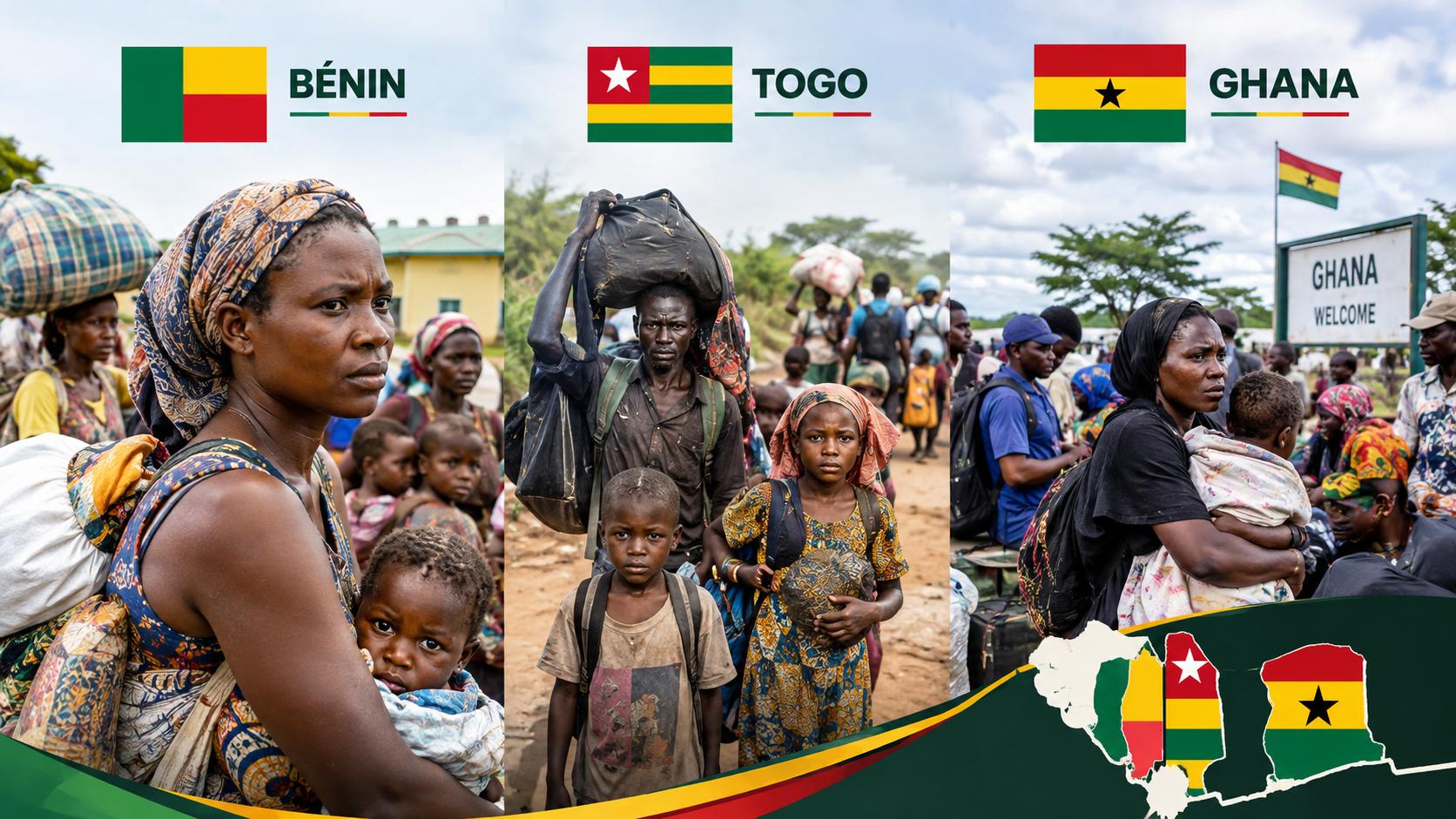
Three tripartite agreements signed in Lomé on 11 September have now set the terms for a possible return of Burkinabè refugees hosted in Benin, Ghana and Togo. The reaction across the region has been measured rather than triumphant: governments welcome a framework, humanitarian actors stress that no movement has been decided, and refugees themselves are asking a single, very practical question — what actually awaits them back home?
Formally, the texts commit Burkina Faso, the UN refugee agency (UNHCR) and each of the three host states to cooperate. In practice, they open a much longer conversation about protection, funding and timing. Here is what the agreements establish, what they leave unresolved, and what the months ahead will reveal.
What the three agreements set up — and what they leave out
Signing in Lomé is not a repatriation order. The documents create a cooperation framework between Burkina Faso, UNHCR and each host country, covering consultation mechanisms, monitoring, and the preparation of any future return and reintegration operations.
That distinction carries real weight in a Sahel region shaped by forced displacement. Announcing a “return” can quickly be heard as an instruction to pack up and leave. The principle UNHCR has defended is different: repatriation must be voluntary, safe and dignified, and refugees must be in a position to make an informed decision about their own future.
Three host countries, one crisis that ignores borders
Years of insecurity inside Burkina Faso have pushed thousands of people across its frontiers, leaving Benin, Ghana and Togo on the front line of a crisis they did not create. The scale of the displacement explains why the debate is so sensitive.
- Benin: more than 11,000 refugees from Burkina Faso were registered as of 31 May 2026.
- Ghana: around 13,368 Burkinabè refugees were counted in June 2026 — close to two-thirds of the country’s entire refugee population. Reception centres were opened in the border zones of Tarikom and Zini, and in February 2025 Burkinabè arrivals were granted prima facie refugee status.
- Togo: roughly 65,100 refugees and asylum seekers were hosted in June 2026, 86% of them originating from Burkina Faso.
Taken together, those figures push the Lomé agreements far beyond abstract population flows. Behind any future return operation stand families who left their villages, abandoned their belongings and, in some cases, lost loved ones.
The safety question refugees keep coming back to
This is where Burkina Faso’s own authorities move to the centre of the debate. The country has confronted an insurgency led by Islamist armed groups for years, alongside serious allegations about operations carried out by government forces and allied militias.
Human Rights Watch states that the human rights situation deteriorated further in 2025, documenting abuses attributed both to Islamist armed groups and to government forces and pro-government militias — including the killing of civilians, forced displacement, and tightening restrictions on the media, the opposition and civil society.
In a report published in April 2026, the organisation documented 57 incidents and collected testimony from hundreds of people in order to examine violence committed since 2023. It considers that Burkinabè forces and their allied militias, like Islamist armed groups, bear responsibility for grave abuses that may amount to war crimes or crimes against humanity, and calls for accountability through credible investigations.
Those allegations cannot be separated from the context in which refugees would be asked to go home. A repatriation programme cannot be treated as a solution simply because a diplomatic document has been signed.
A junta in charge, and few visible guarantees
Since the September 2022 coup, Burkina Faso has been governed by military authorities led by Captain Ibrahim Traoré. Human Rights Watch reports that the junta extended the transition period and narrowed political and civic space, through measures aimed at journalists, opponents and civil society organisations. It has also documented disappearances, forced conscription and restrictions on critical voices, and in May 2026 again denounced tougher measures against independent media and access to information.
For refugees, none of this is a secondary concern. The central question remains protection: can people return to their villages without fearing fresh violence? Will their homes and land still be accessible? Will they be able to obtain civil status documents, healthcare, schools and a means of subsistence? And above all, will a mechanism exist through which they can report violations if they occur?
UNHCR makes the same point from the opposite direction: a durable return presupposes that the root causes of displacement have been addressed enough for peace to hold, so that people are not compelled to flee a second time.
Host countries: from emergency welcome to long-term preparation
The stance of Benin, Ghana and Togo is a decisive part of this regional equation. By receiving people forced to flee, all three assumed a heavy humanitarian responsibility despite their own security and economic pressures.
The Lomé framework lets them prepare for the future without setting welcome against return, and without abandoning the principle of voluntariness. It is also a signal of regional cooperation: the Gulf of Guinea states absorb the consequences of the Sahel crisis directly, and population movements do not stop at borders.
Read that way, Benin, Ghana and Togo are not merely neighbours of Burkina Faso. They are actors in the regional response.
What comes next: the tests that will decide the argument
The agreements are better understood as a roadmap than as a repatriation calendar. Their worth will be judged in implementation and, above all, in the conditions that prevail inside Burkina Faso.
The message sent to refugees is clear: return should be voluntary and should take place only once safety and dignity are assured. That caution is justified for as long as armed violence and allegations of abuses involving several parties to the conflict persist.
For Benin, Ghana and Togo, the challenge is now twofold — keep protecting those who still need asylum, while working with UNHCR and the Burkinabè authorities to prepare the ground for a possible return.
Because a refugee only truly goes home when home is a place where safety can be taken for granted. The real measure of the Lomé agreements will not be how many people are sent back to Burkina Faso, but how many are able to return freely, rejoin their communities and rebuild their lives without being forced to flee again.
