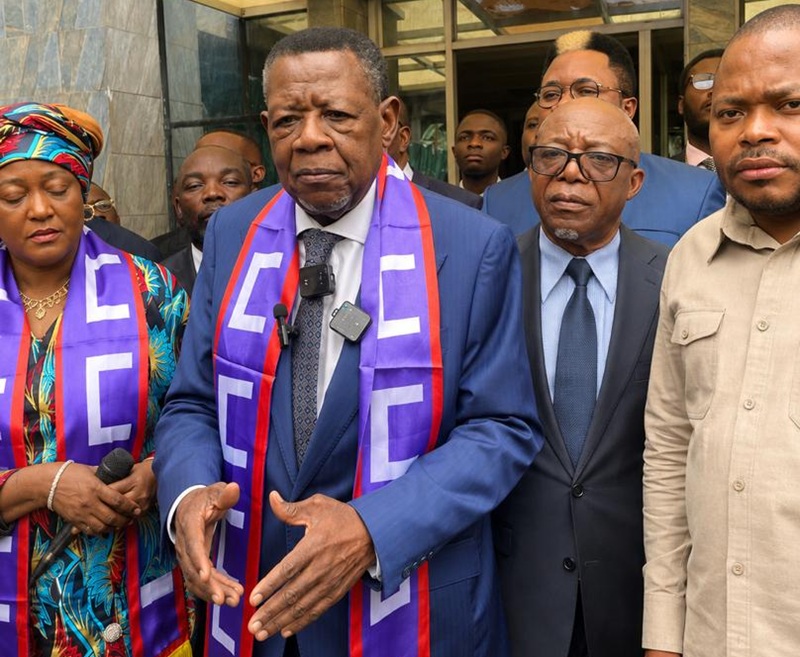
Lambert Mende: president tshisekedi must remain in power until rwandan aggression ends
At a political gathering of the Convention des Congolais Unis (CCU) on Monday, August 3, 2026, Lambert Mende Omalanga presented his analysis of the ongoing security and humanitarian crisis affecting the Democratic Republic of Congo. The CCU leader urged Congolese citizens to set aside their differences and unite against what he described as an existential threat to the nation.
“What will tomorrow bring?” This forward-looking question formed the core of Lambert Mende Omalanga’s address to CCU members.
This address, framed as a “message from the Lumumbists of the CCU to the Nation,” extensively covered the security crisis that has plagued Eastern RDC for decades.
Lambert Mende contended that global and regional geopolitical shifts have profoundly shaped the Congolese situation since 1996.
Kigali accused
Lambert Mende directly accused Rwanda of instigating the persistent instability across Eastern RDC. He asserted that numerous armed groups operating in the region are, based on evidence presented in his speech, proxies for Kigali.
He also recalled the various justifications put forward over the years by Rwandan President Paul Kagame for his country’s involvement in the RDC, including the purported presence of the FDLR and the protection of the Kivu’s Tutsi community.
Mende argued that these rationales have gradually transformed into territorial claims, which he deems irreconcilable with the territorial integrity of the RDC.
“Not all is irrevocably lost”
Despite the severe challenges, the CCU’s leader maintained an optimistic outlook. He believes that the diplomatic pressure exerted on Kigali offers a favorable development for the RDC.
He specifically mentioned American sanctions, viewing them as instrumental in intensifying pressure on the Rwandan regime.
Lambert Mende also commended the voluntary disarmament process of the FDLR, which he presented as a significant step forward that, in his view, removes one of Kigali’s primary justifications for its forces’ presence in Eastern Congo.
National dialogue: CCU outlines conditions
Regarding the prospect of an inclusive National Dialogue, Lambert Mende observed an emerging consensus among the government, opposition, and civil society concerning the necessity of such a forum.
However, the CCU insists that the priority must remain addressing the Rwandan aggression and strengthening national cohesion. This implies that the Dialogue should specifically facilitate the development and implementation of a mechanism for preventing and protecting against terrorism, “regardless of its origin.”
Nevertheless, Lambert Mende expressed reservations about the participation of individuals legally convicted or internationally sanctioned for colluding with the aggressor. He also believes that members of armed groups active alongside Rwanda who do not formally disassociate themselves from it should be excluded from this forum.
Constitutional reform: Mende urges perspective on controversies
The former minister and government spokesperson under Joseph Kabila emphasized the importance of distinguishing between enacting a referendum law and the actual organization of a constitutional referendum. He reiterated that a referendum is a popular consultation inherent to constitutional democracy.
Furthermore, he contended that states possess the flexibility to adjust their political and institutional calendars when faced with extraordinary circumstances. He cited examples such as the United States during major 20th-century crises and Ukraine amidst its ongoing conflict.
Tshisekedi’s mandate during aggression
Lambert Mende’s address also directly addressed the political future of President Félix-Antoine Tshisekedi.
The CCU firmly believes that President Tshisekedi should remain in office for as long as Rwandan aggression against the RDC continues. Lambert Mende positioned Félix Tshisekedi as the only one among the four heads of state to govern the RDC since 1996 who, in his assessment, has implemented significant political, military, and diplomatic measures against this aggression.
This stance emerges amidst widespread debate within the Congolese political class concerning constitutional reform and the nation’s institutional future.
“The common house is burning”
Continuing his advocacy for national cohesion, Lambert Mende urged Congolese citizens to downplay their political disagreements, which he suggested could be addressed at a later time. He emphasized that the immediate priority must be the security and survival of the Congolese state, especially within the current humanitarian context.
The CCU leader highlighted the evolving Ebola virus epidemic in areas along the frontline separating Rwandan and Congolese forces in the country’s East.
A call for strategic alliance with the United States
In his concluding remarks, Lambert Mende endorsed President Tshisekedi’s initiative to forge a strategic alliance between the RDC and the United States. He believes this partnership could bolster the resilience of the Congolese people and enable the nation to develop a robust power strategy against the threats it faces.
“Our common house is burning,” Lambert Mende emphatically stated, urging Congolese citizens to transcend political disputes and rally around the defense of territorial integrity and national sovereignty.
The message from the CCU’s Lumumbists thus serves as a powerful plea for national unity, cohesion, and a concentrated focus of Congolese efforts on resolving the security crisis.
“Long live the Democratic Republic of Congo, one and indivisible!” Lambert Mende Omalanga concluded.

