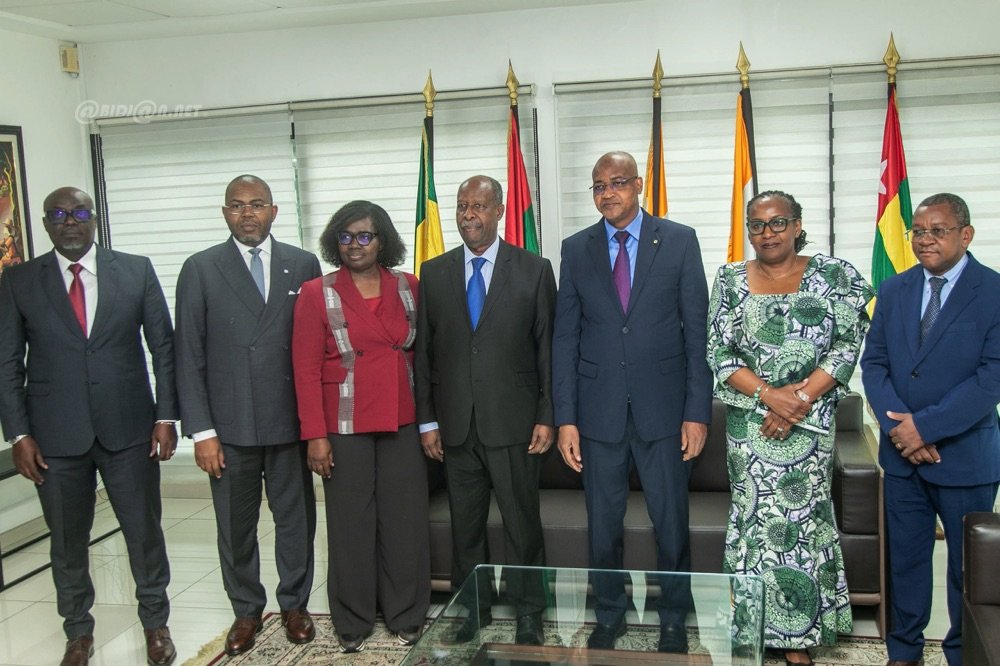
Inside West Africa’s peace architecture: why the Entente Council and UNOWAS formalised a three-year cooperation memorandum in Abidjan
When the Entente Council and the United Nations Office for West Africa and the Sahel (UNOWAS) put pen to paper in Abidjan-Cocody on Tuesday 29 September 2026, the signing was less a sudden diplomatic breakthrough than the formalisation of a relationship that had been quietly maturing for years. The three-year Memorandum of Understanding they sealed reflects a deeper logic: in a region where security, political, humanitarian and institutional pressures rarely stay contained within borders, two organisations with complementary histories decided that informal coordination was no longer enough.
The roots of a partnership that was waiting to happen
The agreement did not emerge from a vacuum. The Entente Council, created in 1959, predates both the Organisation of African Unity and the Economic Community of West African States (ECOWAS). That longevity gives it a particular kind of institutional memory — one that UNOWAS, as a UN political mission, can leverage but cannot replicate. For Leonardo Simão, the UN Secretary-General’s Special Representative for West Africa and the Sahel, this experience is not a footnote. It is the foundation on which new peace initiatives can be built.
“There are always threats to peace. We cannot treat peace as something definitive. We must always work to maintain peace where it already exists, but also to recover peace where it does not,” he said at the signing ceremony.
The choice of partner, in other words, was not accidental. It followed a logic of comparative advantage: UNOWAS brings convening power and a mandate that stretches across the region; the Entente Council brings a proven track record of state-to-state cooperation and a membership that straddles both Sahelian and coastal countries — a geographic mix that mirrors the region’s interconnected crises.
Three priorities that reveal the real fault lines
The memorandum is structured around three pillars, each of which points to a specific diagnosis of where West Africa’s peace architecture is weakest.
Preventive diplomacy and political dialogue
The first pillar covers preventive diplomacy, mediation and political dialogue, with provisions for strategic consultations, good offices initiatives and facilitation efforts. The emphasis here is telling: it suggests that the two institutions see early warning and quiet diplomacy as more cost-effective than crisis response.
Borderland peace and resilience
The second pillar focuses on peace and resilience in border areas. Conflict prevention, social cohesion, and the participation of young people and women in peace initiatives are all part of the plan. This is where the memorandum touches on the everyday realities of communities that live along frontiers where state authority is thin and armed groups have found room to operate.
Institutional strengthening and strategic analysis
The third pillar is dedicated to institutional capacity and strategic analysis, through information sharing, joint studies, advisory assistance and the development of the Entente Council’s own capacities. This is the less visible but potentially most consequential part of the agreement: it turns the Council from a recipient of support into a co-producer of analysis and policy.
What the Entente Council brings to the table
The memorandum explicitly recognises the Entente Council as a platform for dialogue, consultation and diplomatic facilitation. According to the text, the organisation could help bring states — and different regional configurations — closer together when circumstances require it. That language matters because it positions the Council as a bridge-builder in a region where institutional rivalries and overlapping memberships have sometimes complicated collective action.
For Idi Ali, deputy executive secretary in charge of the interim executive secretary role at the Entente Council, the agreement is an acknowledgement of the organisation’s relevance. “The Entente Council is today a privileged framework for consolidating peace in the sub-region,” he said, pointing to the presence within the organisation of both Sahelian and coastal countries. He welcomed the signing with UNOWAS, saying it would strengthen ties between the two institutions and boost their contribution to peace.
How the implementation will actually work
Beyond the signatures, the memorandum sets out a practical machinery. The two institutions will draw up annual joint work plans, designate focal points and hold regular follow-up consultations. Joint assessment missions, dialogue missions or diplomatic facilitation missions may also be conducted. The initial duration is three years.
This implementation architecture is where the agreement will be tested. Annual work plans and focal points are standard diplomatic tools, but they also create accountability mechanisms that can be monitored. The real question is whether the political will that produced the memorandum will be sustained through the inevitable changes in leadership, funding priorities and regional dynamics over the next three years.
The context that makes this cooperation necessary
The signing comes against a backdrop of persistent security, political, humanitarian and institutional challenges across West Africa and the Sahel. The memorandum’s preamble acknowledges this reality and states that the partnership aims to preserve and strengthen consultation spaces between states and regional organisations.
In that sense, the agreement is as much about process as it is about outcomes. By committing to regular consultations and joint analysis, the Entente Council and UNOWAS are betting that sustained engagement — rather than episodic crisis management — is the more durable path to stability. Whether that bet pays off will depend on how the three pillars are translated into action on the ground.
