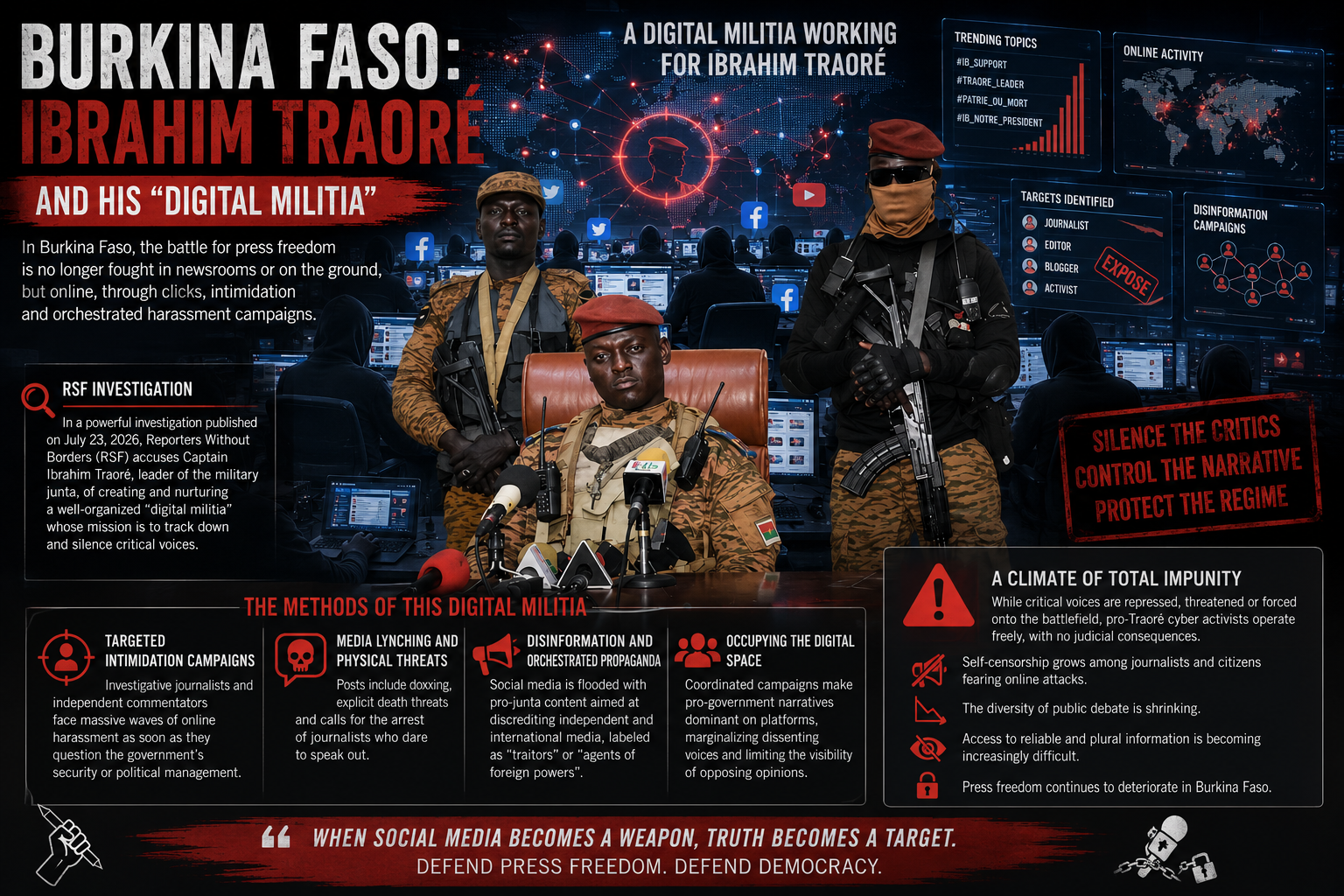
Ibrahim Traoré’s digital militia in Burkina Faso
Cyber warfare and repression of dissent in Burkina Faso
In Burkina Faso, the fight for press freedom has shifted from newsrooms and streets to digital platforms, where coordinated online campaigns are now the primary tool of repression. Investigations reveal a systematic effort to silence dissent through a network of pro-regime cyberactivists, accused of orchestrating harassment and disinformation campaigns against independent voices.
The BIR-C: A digital task force against critics
The cornerstone of this strategy is the Bataillons d’Intervention Rapide-Communication (BIR-C), a structured group of cyberactivists operating under a name evoking military rapid-response units. While their battlefield is the digital sphere, their impact is undeniable, as they work to dominate online discourse and suppress any challenge to the regime’s narrative.
According to detailed reports, the BIR-C does not merely engage in political activism; it employs a systematic approach to stifle criticism. Journalists, commentators, and critics face targeted harassment campaigns, often escalating to doxxing—exposing personal information—and explicit threats of violence or arrest. This coordinated effort extends beyond social media, infiltrating public discourse by drowning out dissenting opinions with pro-government propaganda.
Methods of suppression and control
- Targeted intimidation: Investigative journalists and independent analysts are subjected to relentless online harassment whenever they scrutinize the government’s security or political decisions.
- Threats and incitement to violence: Beyond verbal attacks, these networks frequently publish personal details of critics, accompanied by calls for their arrest or physical harm.
- Disinformation and smear campaigns: Pro-regime content floods digital platforms, labeling independent and international media as traitors or foreign agents to undermine their credibility.
- Digital occupation: Coordinated campaigns ensure that pro-government narratives dominate trending topics, pushing alternative viewpoints into obscurity and limiting public access to diverse perspectives.
A climate of unchecked impunity
One of the most alarming aspects of this phenomenon is the absence of accountability. While dissenting voices face repression—whether through censorship, forced conscription, or legal action—cyberactivists operate with impunity, shielded by tacit support from authorities. This environment fosters widespread self-censorship among journalists, bloggers, and citizens, who avoid addressing sensitive topics such as security, governance, or military operations to escape retaliation.
Consequences for democratic discourse
Experts warn that when digital spaces are monopolized by coordinated propaganda, public debate suffers. Diverse opinions fade into the background, while regime-friendly narratives dominate conversations. In a country grappling with persistent security crises, this polarization further restricts access to balanced information, essential for citizens to assess national policies and hold authorities accountable.
The tactics employed in Burkina Faso reflect a broader trend observed in authoritarian and hybrid regimes worldwide. Cyberactivist networks, often state-linked, are increasingly used to suppress independent media, discredit critics, and manipulate online narratives. International press freedom organizations now recognize these campaigns as a sophisticated form of repression, as effective as traditional censorship but far less visible.
An escalating pattern of restrictions
This digital repression does not exist in isolation. It compounds existing pressures on media freedom, including administrative bans on international outlets, intimidation of journalists, and cases of enforced disappearances. Together, these measures shrink the space for independent journalism, raising concerns about the country’s democratic trajectory.
International implications and a warning signal
The revelations underscore a troubling deterioration of democratic standards in Burkina Faso since the military takeover. By weaponizing social media, the current regime has transformed digital platforms into tools of political coercion, making independent journalism increasingly perilous. This shift also draws attention from international partners, who consider press freedom indicators when evaluating governance quality and institutional stability. A sustained decline in these metrics could impact Burkina Faso’s standing on the global stage.
Moreover, this phenomenon highlights a broader evolution in information warfare. Social media, with its algorithms and viral potential, has become a strategic battleground where narratives can be amplified—or suppressed—with unprecedented speed. For observers, this represents one of the most pressing challenges to safeguarding press freedom and democratic debate in politically unstable regions.
