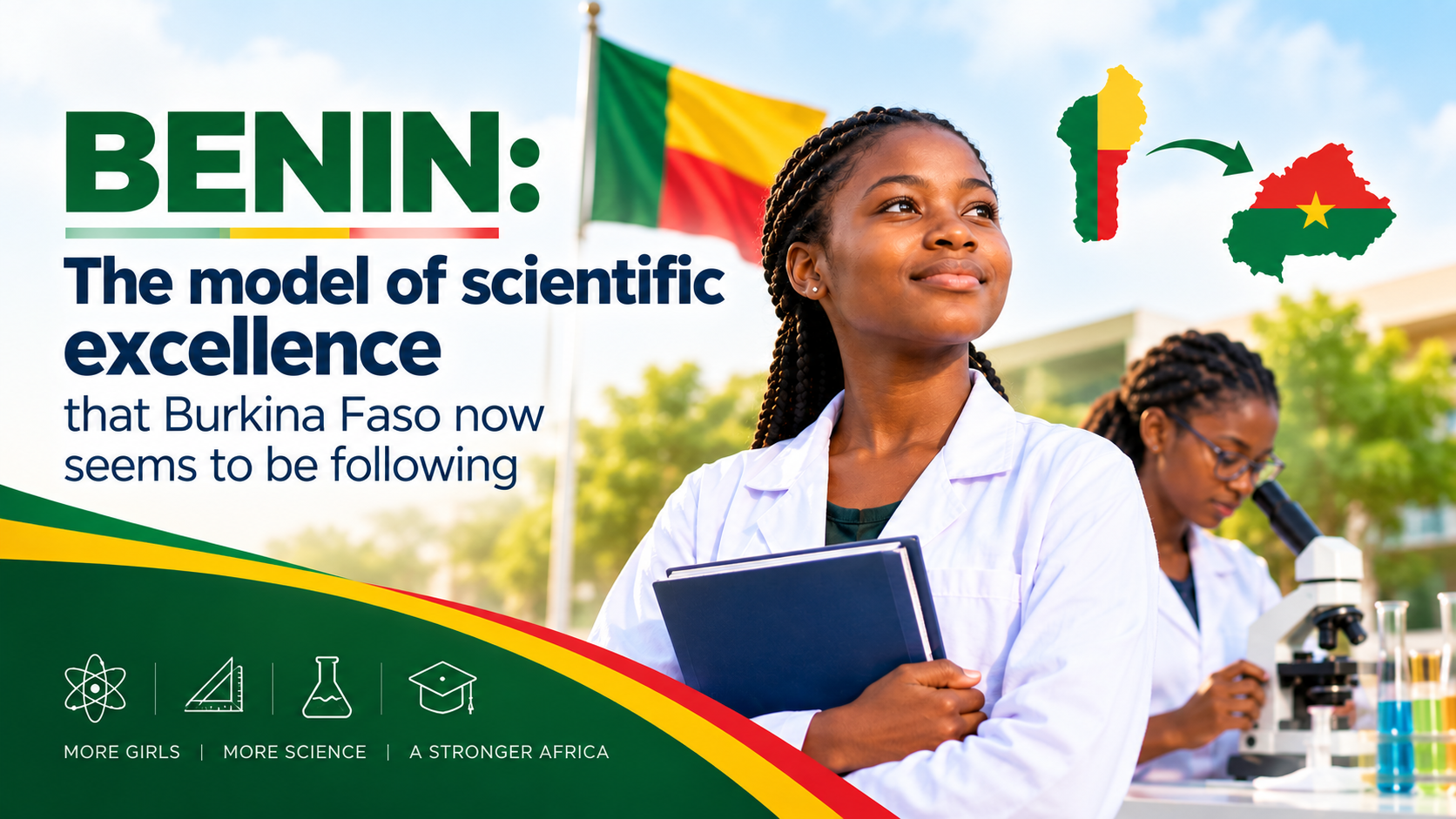
How Burkina Faso’s HAKILI Mousso initiative mirrors Benin’s scientific excellence model
Unpacking the regional shift in girls’ scientific excellence
The recent launch of Burkina Faso’s HAKILI Mousso initiative has sparked comparisons with Benin’s long-standing commitment to fostering girls’ excellence in science. While the two nations pursue distinct strategies, the underlying philosophy aligns: identifying latent talent, dismantling gender stereotypes, and cultivating a pipeline of future innovators. This parallel development underscores a broader regional movement toward redefining educational priorities, where scientific prowess takes precedence over mere academic performance.
Benin’s scientific ecosystem: a case study in deliberate talent cultivation
Benin’s approach to promoting girls’ scientific excellence is systemic rather than sporadic. The annual Concours général de mathématiques et de sciences physiques, now in its third edition, serves as a cornerstone of this strategy. Held in Djougou in 2026, the competition not only celebrates top performers but also integrates an accompanying excellence camp designed to nurture budding scientists.
The program’s breadth extends beyond competition. In June 2026, Benin introduced a sweeping policy: free tuition for all girls enrolled in public secondary and technical schools, effective from the 2026–2027 academic year. This measure addresses a critical barrier economic access ensuring that financial constraints do not curtail academic potential. The government frames this as an investment in human capital, recognizing that true scientific progress begins with equitable educational opportunities.
From access to excellence: a multi-layered framework
Benin’s model operates on three interconnected levels:
Identification: Competitions like the Concours général act as talent scouts, uncovering high-potential students.
Support: Excellence camps provide supplementary training, mentorship, and resources to accelerate skill development.
Sustenance: Policies such as tuition waivers remove systemic barriers, enabling sustained participation in scientific disciplines.
This holistic approach contrasts with isolated initiatives, positioning Benin as a regional benchmark for deliberate talent development.
HAKILI Mousso: Burkina Faso’s tailored response to a regional need
Launched in September 2026 under the auspices of Burkina Faso’s government, HAKILI Mousso represents a targeted response to a clear imperative: harnessing the untapped potential of girls in science. The inaugural edition saw 84 female high school graduates all from the 2026 scientific baccalaureate cohort compete in a national final focused on mathematics, physics, and chemistry. Winners received prizes including cash awards, computers, motorcycles, and scholarships, while their mentors were also recognized.
Unlike Benin’s general excellence framework, HAKILI Mousso zeroes in on gender-specific talent detection. The initiative’s messaging is explicit: it aims to dismantle the pervasive myth that scientific fields are the domain of boys. By spotlighting female achievement in traditionally male-dominated disciplines, the program redefines societal norms around women’s roles in STEM.
The power of narrative: shifting from beauty to brains
This strategic pivot is amplified by Burkina Faso’s simultaneous decision to suspend beauty pageants nationwide, pending new regulatory frameworks. While the two moves are not causally linked, they collectively signal a reorientation of public values. Where pageants once celebrated physical appearance, HAKILI Mousso celebrates intellectual rigor a cultural recalibration that aligns with Benin’s emphasis on meritocratic achievement.
Converging trajectories: lessons from Benin’s playbook
Though distinct in execution, Benin’s and Burkina Faso’s strategies share a core goal: transforming girls’ participation in science from a rarity to a norm. Benin’s systemic approach and Burkina Faso’s targeted initiative are not carbon copies but complementary responses to the same challenge.
Benin’s long-term investment in infrastructure such as excellence camps and tuition-free education creates an enabling environment where talent can flourish. Burkina Faso’s HAKILI Mousso, by contrast, leverages competition as a catalyst for cultural change, using visible recognition to challenge entrenched stereotypes.
The synergy between the two models offers a compelling lesson: sustainable progress in girls’ science education demands both structural support and societal recalibration. Benin provides the former; HAKILI Mousso demonstrates the latter.
Beyond medals and ceremonies: the economic imperative
The stakes extend far beyond individual accolades. Africa’s economic future hinges on its ability to cultivate a workforce skilled in energy, digital technology, agriculture, and health sectors where women remain critically underrepresented. By prioritizing girls’ scientific excellence, Benin and Burkina Faso are not merely ticking a policy box; they are laying the groundwork for innovation, entrepreneurship, and industrial progress.
For researchers, engineers, and technicians to emerge, the educational pipeline must be fortified at every stage. Benin’s tuition waiver policy and Burkina Faso’s HAKILI Mousso initiative are early steps in this direction, each addressing a different link in the chain access and visibility, respectively.
A regional movement gains momentum
What began as a localized experiment in Benin has evolved into a regional trend, with Burkina Faso’s adoption of a similar ethos. The message is clear: scientific excellence is not gendered, and talent is not confined to any one demographic. By making girls’ achievements in science undeniable, both countries are redefining what success looks like for the next generation.
The interplay between Benin’s systemic reforms and Burkina Faso’s targeted initiative illustrates a truth often overlooked in education debates: progress is not linear but iterative. Each nation contributes a unique facet to the broader mosaic of change.
The road ahead: collaboration or competition?
As both countries refine their approaches, opportunities for collaboration emerge. Shared best practices such as Benin’s excellence camps or Burkina Faso’s gender-specific talent scouting could amplify their collective impact. The question is no longer whether these initiatives will succeed, but how swiftly they can scale to meet the continent’s growing demand for skilled professionals.
The HAKILI Mousso initiative and Benin’s scientific ecosystem are not merely national successes; they are regional beacons. Their greatest value lies not in their individual achievements but in the precedent they set: a future where scientific excellence knows no gender, and where every girl with a passion for discovery has the opportunity to realize it.
By Yacouba Ouédraogo — Investigative journalist
