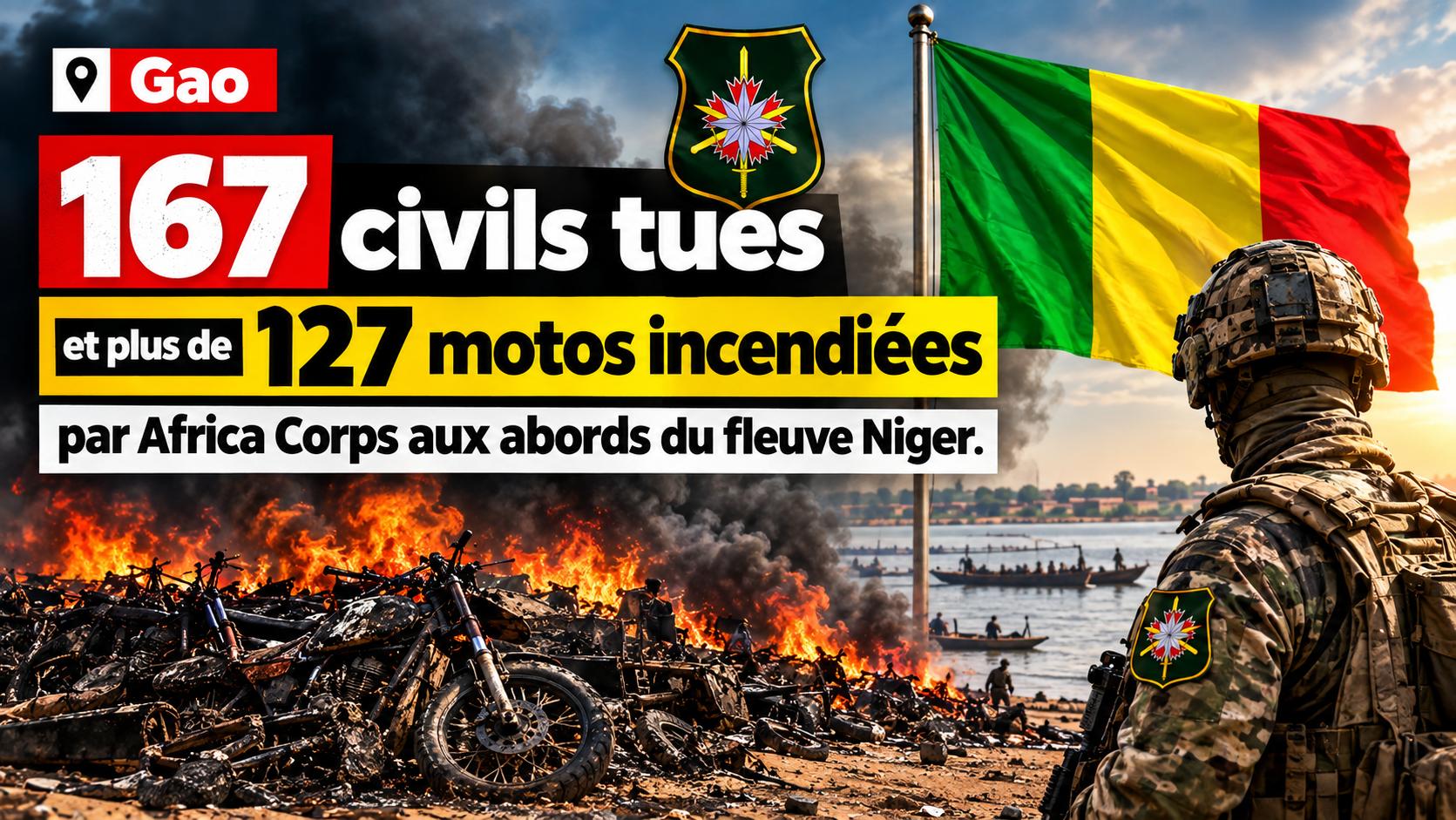
Gao: Africa Corps kills 167 civilians and burns 127 motorbikes by the Niger river
Dawn attack on the banks of the Niger river
Shortly after first light on Tuesday, September 15, 2026, the quiet gardens and fishing spots on the edge of Gao, in northern Mali, were torn apart by automatic gunfire. Dark columns of smoke rose over the Niger river. By the time the shooting stopped, 167 civilians had been summarily executed and more than 127 motorbikes had been rounded up and set alight.
The raid is attributed to Russian mercenaries of Africa Corps — the private structure that inherited the Wagner group’s mission across the continent. In a single morning, it pushed an already battered region past yet another threshold of terror and laid bare the security dead end facing the military regimes that hired it.
A survivor’s account: gunfire with no warning
“They shot at us without a single warning, then gathered our vehicles together and set them on fire. My brother is among the dead. Without him and without my motorbike, we have nothing left to live on and nothing to feed our children tonight.”
The man spoke on condition of anonymity, his voice hollowed out by grief. What he describes is a scene repeated across the riverbank that morning: workers cut down at the very start of their day, their tools turned to ash behind them.
Who was hit when the shooting began
Market gardeners tending their plots, fishermen coming back from the water and small traders loading fresh produce were among those targeted as they began their daily routine. The attack was deliberate, leaving behind a landscape of desolation and a community plunged into mourning, disbelief and outright fear.
Torching the motorbikes to strangle an entire economy
Beyond the horror of the human losses, the systematic destruction of transport equipment deals a fatal blow to the informal economy of the whole area. Fresh produce can no longer move from the river to the markets, and a serious food crisis now looms over the city, threatening to push hundreds of families into outright destitution.
In Gao, a motorbike is a livelihood, not a luxury
Here, a motorbike is not a minor possession. It is the basic working tool of young people, the only practical way to carry goods from the riverbanks to the marketplaces, and the financial backbone of dense networks of family solidarity. Burn one hundred of them and you do not weaken an insurgency — you suffocate the civilian population that depends on them.
The junta’s security gamble and its deadly outcome
What happened at Gao exposes the dramatic drift of the security alliances sealed by the region’s military regimes. In Niamey as in Bamako, the rapprochement between General Abdourahamane Tiani’s government, its partners in the Alliance of Sahel States (AES) and Moscow was sold as a sovereign answer capable of restoring order.
On the ground, the reality flatly contradicts the official narrative. The arrival of Africa Corps has not neutralised terrorist groups; it has instead introduced a predatory and uncontrollable force that kills local people at will.
An occupying force rather than a protector
Operating in complete impunity, the Russian mercenaries behave less like allies defending the nations they claim to assist and more like a blind, violent army of occupation. That absolute reliance on private fighters corrodes social cohesion and undermines the authority of the very states that signed up to it.
By staying silent in the face of 167 civilian deaths, the junta and its partners make themselves complicit in abuses that strip the last credibility from their talk of emancipation and security.
Fear settles over the riverbanks
In Gao, shock is giving way to a deep sense of abandonment and injustice. Residents watch daily as promises of order and stability translate into the brutality of armed men who answer to no national command and trample international humanitarian law without consequence.
Dread of another raid now paralyses life along the Niger river. Survivors hesitate to return to their workplaces, deserting the banks for fear of crossing the path of the death patrols once again.
Silence is no longer an option
Confronted with a slaughter of this scale, the transition authorities cannot fall back on their usual muteness. The people of Gao are not asking for geopolitical slogans. They are asking for the most basic right of all — the right to life and to dignity, a right that Africa Corps continues to trample in blood.
