Gabon’s un gambit: inside the strategy behind Libreville’s first vice-presidency
When Gabon was elected vice-president of the 81st United Nations General Assembly back in June, the decision drew little fanfare outside diplomatic circles. Yet the session that opened on 22 September in New York has turned that quiet elevation into something more consequential: a seat at the Bureau of the world body’s principal deliberative organ — and a rare platform for a small Central African state to shape the agenda rather than simply react to it.
Why this moment matters more than it appears
The dynamics at play here run deeper than a ceremonial title. For years, Libreville has pursued a deliberate strategy of embedding itself within multilateral frameworks, using international institutions as a counterweight to regional volatility and as a channel for economic partnerships. The vice-presidency of the General Assembly fits neatly into that playbook. It gives Gabon a structural role in proceedings — not just a speaking slot, but a voice in how debates are organised and which priorities rise to the surface.
That context explains why the delegation is being led at such a high level. Marie-Édith Tassyla-Ye-Doumbeneny, the minister of foreign affairs, cooperation, integration and diaspora, is carrying the mandate directly from President Brice Clotaire Oligui Nguema. Her presence in New York is not a routine diplomatic courtesy. It signals that Libreville views this session as a test of its new standing — and intends to convert procedural influence into tangible outcomes.
The groundwork before the speeches
Behind the public sessions, the real work has been methodical. Ahead of the general debate, a coordination meeting was held at Gabon’s permanent mission to the United Nations to align the delegation’s positions across multiple files. That kind of internal calibration is standard practice for larger powers; for Gabon, it reflects an ambition to speak with one coherent voice on issues ranging from climate and forest protection to ocean governance, public health, housing and digital transformation.
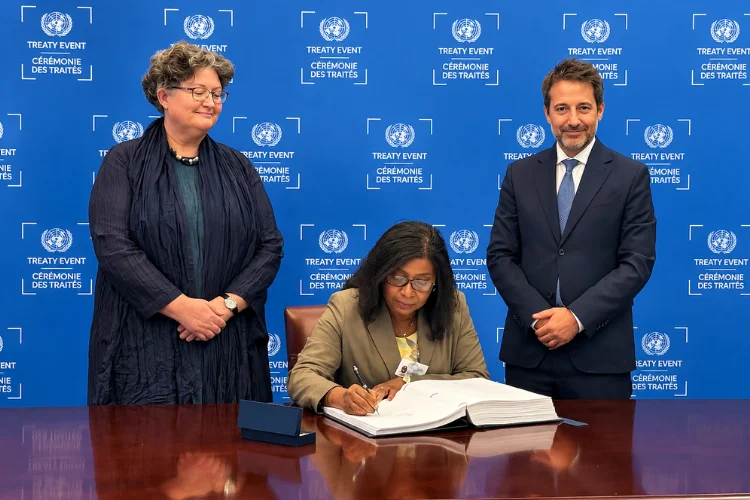
The signing of two major treaties — on the prohibition of nuclear weapons and on combating cybercrime — added substance to the week’s diplomacy. Several government ministries have been mobilised around these priorities, suggesting a whole-of-government approach rather than a purely foreign ministry exercise.
A first stress test for Libreville’s new role
What makes this session particularly instructive is that it represents the first real examination of the responsibility Gabon accepted in June. Bureau membership is not merely symbolic; it places the country inside the machinery that determines the rhythm and focus of Assembly business. For a state of Gabon’s size, that access is a strategic asset — one that can be leveraged to strengthen partnerships and defend national interests in forums where attention is scarce and competition for influence is fierce.
The coming days will reveal how effectively Libreville translates procedural positioning into diplomatic capital. The centrepiece arrives on 26 September, when Tassyla-Ye-Doumbeneny delivers Gabon’s official address before the Assembly, speaking on behalf of the president. That speech will be scrutinised not only for its content but for what it reveals about Gabon’s broader ambitions on the world stage.
What to watch going forward
The deeper story here is about how a mid-sized African state navigates a system dominated by larger powers. Gabon’s vice-presidency offers a case study in using institutional roles to amplify a national voice — and in the patient, often invisible work of turning a seat at the table into real influence. Whether that translates into concrete gains will depend on follow-through long after the New York session closes.
