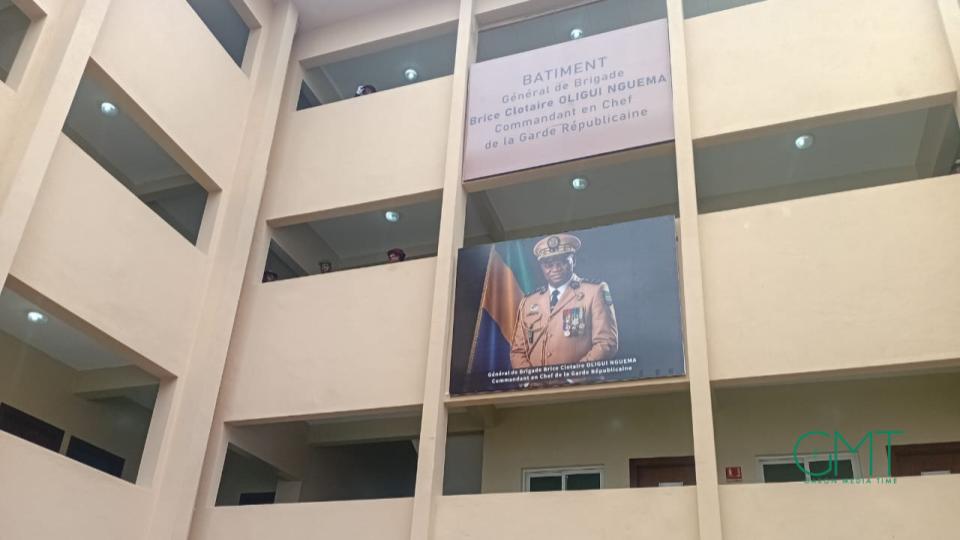
Gabon’s new prison security command building marks key reform milestone
The President of Gabon, Brice Clotaire Oligui Nguema, officially inaugurated the new annex building for the Chief Command of the Penitentiary Security on Thursday, August 13, 2026, in Libreville. This three-story structure, named the ‘General Brigade Building Brice Clotaire Oligui Nguema, Commander-in-Chief of the Republican Guard,’ features 38 offices and is designed to support the modernization of the country’s penitentiary administration. The inauguration event was attended by government officials, military leaders, and key figures from the defense and security sectors.
During the ceremony, President Oligui Nguema, who also serves as the Supreme Head of the Defense and Security Forces, cut the symbolic ribbon to mark the building’s official launch. The new facility includes dedicated spaces for operations, supervision, and conferences, aimed at enhancing the working conditions for personnel responsible for penitentiary security management.
In his address, the Minister of Justice and Human Rights, Augustin Emane, hailed the project as a ‘critical step forward in the modernization of Gabon’s judicial and penitentiary institutions.’ He emphasized that the building aligns with ongoing reforms within the autonomous Penitentiary Security Corps, reflecting the government’s commitment to restoring state authority while upholding the dignity of detainees.
Transforming governance through modern infrastructure
Emane highlighted the broader vision behind the new building, stating that it represents a tangible effort to build a state capable of maintaining its authority while ensuring the rights and dignity of individuals under its custody. The project was developed under the leadership of the Chief Command directed by General Jean Germain Effayong Onong, whose dedication to the initiative was recognized by the minister.
The infrastructure is expected to streamline administrative processes and improve coordination within the penitentiary security sector. However, Emane noted that while the new building is a significant achievement, it addresses only one aspect of a much larger challenge.
Beyond offices: addressing systemic challenges in prisons
The Minister of Justice made a candid acknowledgment of the ongoing difficulties within Gabon’s prison system. He stressed that modernizing administrative offices alone cannot resolve the deeper issues plaguing the country’s detention facilities. Emane called for a closer look at the realities of Gabon’s prisons, where critical needs include upgraded dormitories, technical monitoring systems, intervention equipment, and enhanced security measures.
The next phase of reform must focus on transforming the conditions inside prisons, ensuring safer environments for both detainees and staff. This dual approach—improving administrative structures alongside prison infrastructure—is essential for a truly modern penitentiary system. The government’s stated goal is to balance ‘unwavering enforcement of penalties with the humanity owed to every detainee,’ ensuring that prisons meet international legal standards.
Balancing security with humane detention standards
Emane reiterated the government’s commitment to a penitentiary policy that goes beyond mere surveillance and escape prevention. A modern approach, he argued, must prioritize the dignity of detainees, the safety of prison staff, and the eventual reintegration of former inmates into society. This vision was echoed during the ceremony, which began with an inaugural prayer led by military chaplain Serge Obame Mihindou.
Following the ribbon-cutting, President Oligui Nguema toured the facility, gaining firsthand insight into its operations. Ali Adiahéno, representing the construction firm Abnia Gabon, expressed gratitude for the opportunity to contribute to the project. While the new building marks progress in administrative efficiency, the true test of success will lie in how effectively these improvements translate into better conditions for both prison personnel and the individuals they oversee.
