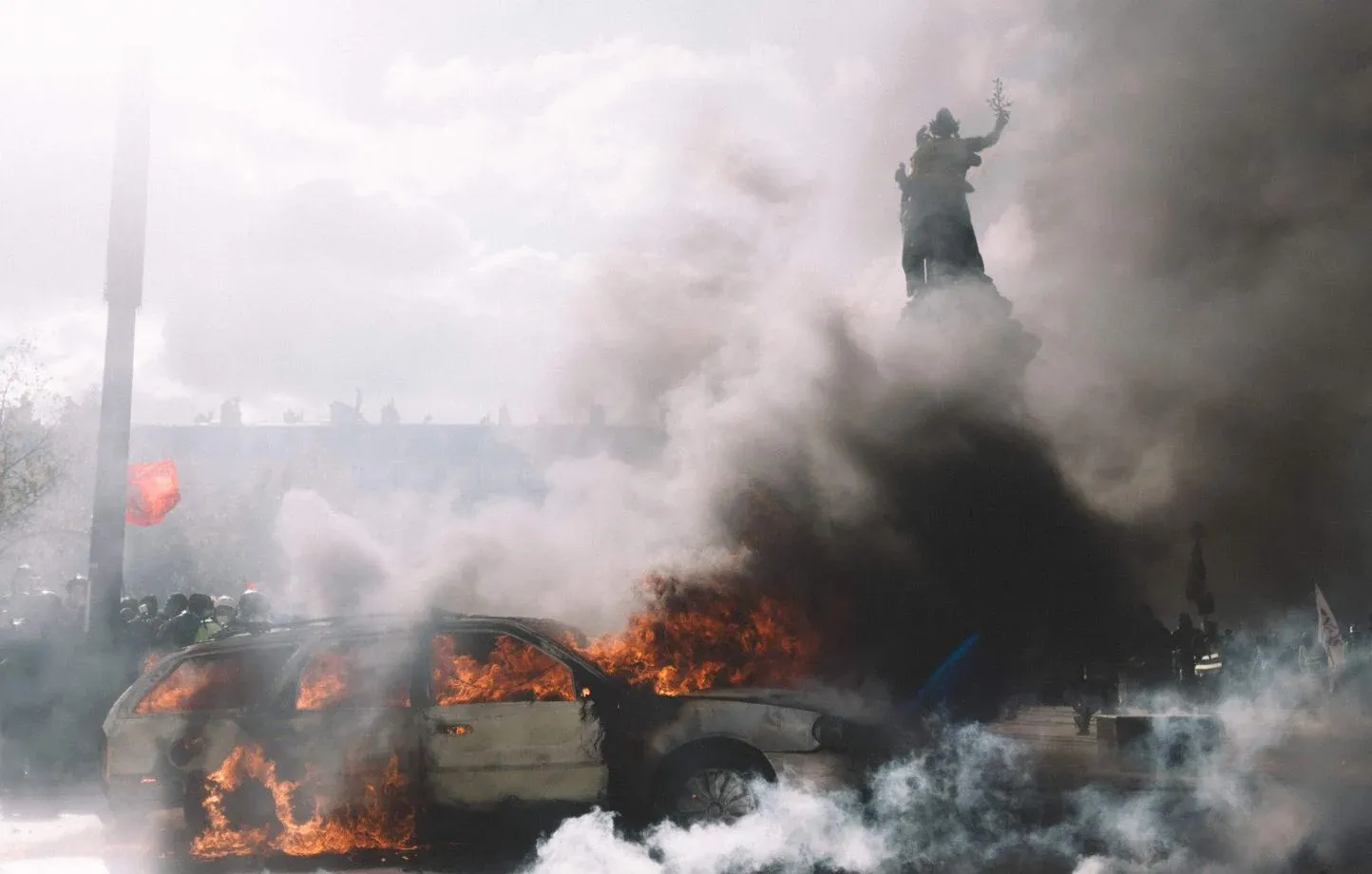
France’s urban riots fuel anti-West narratives in Sahel’s military states
Images of shattered storefronts, riot police clashes, burning trash cans, and tear gas clouds have become a recurring spectacle across France. But in Bamako, Ouagadougou, and Niamey, these same scenes serve a different purpose: they are ammunition for Sahel’s military juntas to dismantle Western narratives and shore up their own legitimacy.
From social unrest to political leverage
The Alliance of Sahel States (AES) has seized on France’s domestic turmoil as a rare strategic opportunity. Where Western media frames the chaos as a domestic crisis, pro-junta media outlets recast it as an overdue reckoning—proof that the former colonial power’s moral authority is crumbling.
Since the wave of coups in Mali, Burkina Faso, and Niger, the AES has not only distanced itself from France politically but also waged a relentless information war. In this battle of narratives, every image of French unrest becomes a rhetorical weapon—one that the juntas deploy with precision.
Two weights, two measures: the hypocrisy argument
For years, Paris tied its diplomatic support to democratic principles, human rights, and freedom of assembly. Now, junta-aligned activists and influencers highlight what they call a glaring double standard. They juxtapose France’s heavy-handed policing—including bans on protests, use of flash grenades, and bypassing parliamentary votes—with its criticism of transitional governments in the Sahel. The message is clear: if France can’t manage its own democracy, how can it lecture others?
The three strategic goals behind the narrative shift
The instrumentalization of French unrest isn’t just schadenfreude—it serves concrete objectives:
- Undermining democratic legitimacy: By portraying liberal democracy as unstable, chaotic, and failing, the AES portrays military rule as the sole guarantor of national sovereignty and order.
- Distracting from local crises: While Sahel populations grapple with soaring insecurity, inflation, and power cuts, the juntas redirect public anger toward France, dominating media cycles and deflecting attention from their own shortcomings.
- Accelerating the Western decline narrative: Amplified by pro-Russian networks, images of French disorder feed the idea of a declining West—justifying the AES’s pivot toward alternative partners like Moscow, Ankara, and Tehran.
The mirror’s deception: why the comparison fails
Independent analysts caution against taking the parallel too far. They point to a critical paradox: France’s ability to protest, strike, and openly criticize its leaders is a hallmark of a free society—one that is unimaginable in regimes where dissent is swiftly crushed or labeled “subversive.”
Yet on the ground, perception trumps nuance. Each riot in Paris chips away at France’s diplomatic credibility across the Sahel as juntas leverage the imagery to promote their anti-Western agenda. What was once France’s strongest soft-power asset—its democratic model—is now visibly fractured.
A geopolitical gamble with high stakes
The AES’s gamble hinges on a dangerous assumption: that the erosion of France’s image will translate into lasting loyalty among Sahel populations. But as the juntas weaponize disorder abroad to solidify power at home, they risk deepening internal fractures and alienating citizens who bear the brunt of economic collapse and insecurity.
The chessboard is set. And in this game, every burning barricade in France becomes a pawn in a larger struggle for control.
