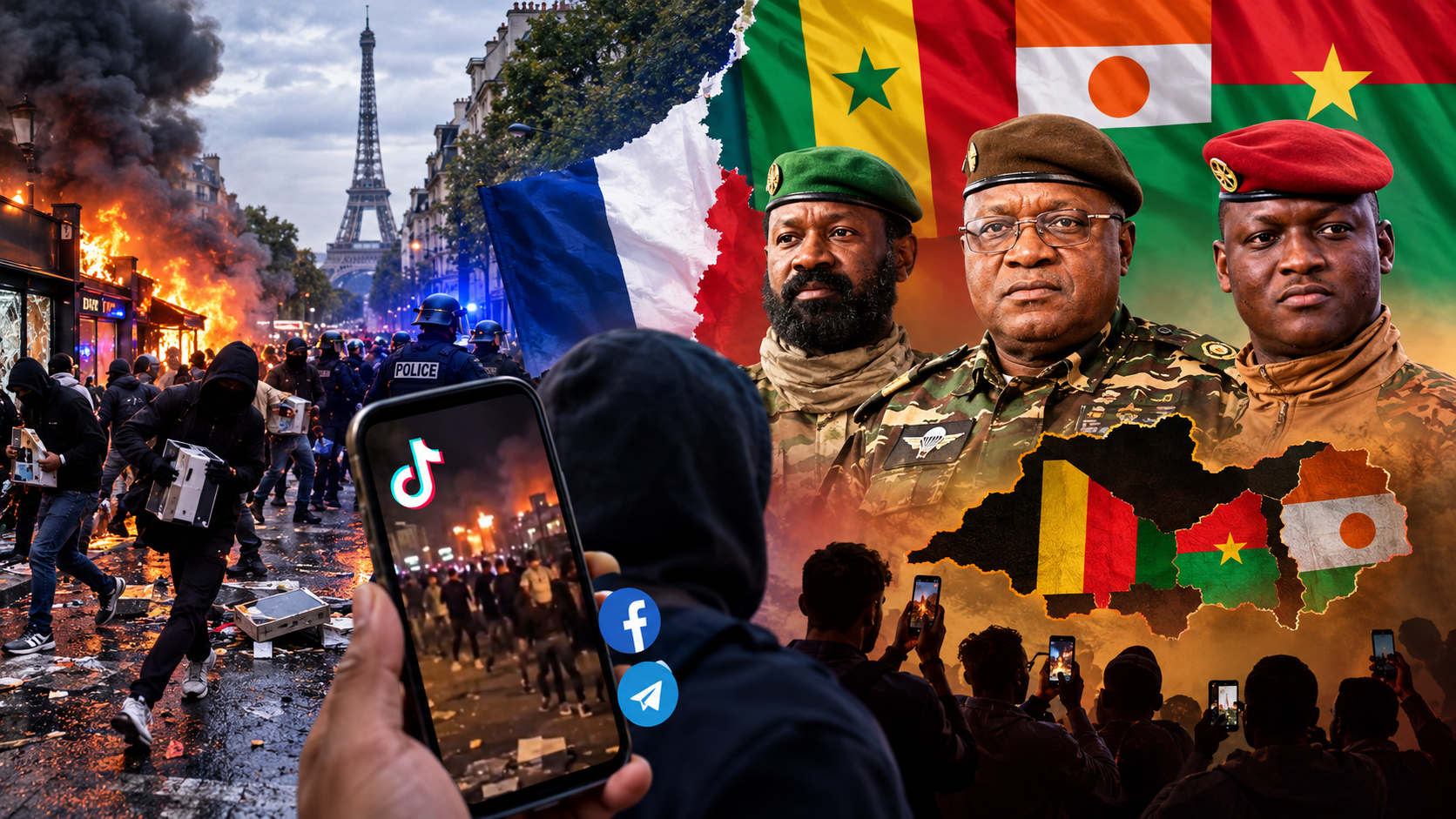
France’s unrest fuels political narratives in Sahel as judicial scrutiny intensifies
Escalating violence in France triggers cross-regional political debates
The recent urban unrest in France has extended beyond its borders, sparking intense political discussions across the Sahel region. In Mali, Burkina Faso, and Niger countries where relations with Paris have deteriorated sharply under military rule the images of looting, destruction, and clashes with law enforcement are being rapidly disseminated to fuel anti-French sentiment. On platforms such as TikTok, Facebook, and Telegram, these visuals are repurposed to challenge France’s credibility on democracy, security, and the rule of law.
Judicial investigations take center stage as foreign nationals implicated
Amidst the propagandistic use of these events, a critical question emerges: the legal accountability of those involved. Investigators have gathered evidence suggesting that some individuals from Sahel nations potentially including migrants in irregular situations may have participated in acts of violence and destruction. If their involvement is confirmed, these individuals will face the full weight of French justice, just as any other accused within the country’s legal framework.
Establishing individual responsibility under French law
The judicial process hinges on establishing precise roles, collecting evidence, and determining individual culpability. For those found guilty, nationality does not confer immunity. Foreign nationals, including Malians, Burkinabès, and Nigeriens, will be held to the same legal standards as French citizens. Irregular administrative status may further complicate their legal situation, but it does not exempt them from accountability.
Propaganda tactics exposed: when images become weapons
The exploitation of France’s unrest by Sahelian military regimes extends beyond mere rhetoric. In digital spaces favorable to the Alliance of Sahel States (AES), these events are framed as proof of systemic French failure. Yet, isolated incidents even when real do not substantiate claims of nationwide collapse or imply superior governance by Sahelian juntas. The challenge lies in distinguishing authentic depictions from manipulated narratives, whether through outdated footage, misattributed events, or exaggerated captions.
Coordinated disinformation campaigns: separating fact from fiction
To substantiate allegations of a coordinated propaganda effort, concrete evidence is required: identifying originating accounts, cross-referencing publications, and tracing networks that amplify identical falsehoods. While prior verifications have exposed misleading content in pro-AES digital ecosystems, they do not conclusively prove a centralized disinformation campaign linked to the unrest. Rigorous fact-checking remains essential to maintain journalistic integrity.
Justice, not collective blame: upholding legal principles
Critically, the debate must not devolve into blanket accusations against entire nationalities. The vast majority of Malian, Burkinabè, and Nigerien residents in France bear no responsibility for the actions of a few. Nationality alone is not evidence of guilt or political affiliation. Rather, accountability must rest on individual conduct, determined through fair judicial proceedings.
Moreover, political figures and media personalities who exploit these events must uphold consistency. They cannot simultaneously decry external criticism of Sahelian regimes while ignoring the legal obligations of foreign nationals suspected of breaking French law. Sovereignty arguments ring hollow when applied selectively.
A clash of narratives: dismantling propaganda with legal evidence
Following the diplomatic ruptures between Paris and Sahelian military governments, the ideological battle unfolds across both digital and diplomatic arenas. While France grapples with internal challenges, Sahelian regimes seize the opportunity to advance a narrative of Western decline. Yet, the true measure of governance must be based on verifiable outcomes security, public welfare, and institutional performance not on isolated acts of violence.
The ongoing judicial inquiries into the unrest will determine the facts. Their conclusions, rather than social media narratives, will define the legal and moral consequences for those involved. France’s judicial institutions remain the arbiters of justice, ensuring that responsibility is assessed impartially and the law is applied without prejudice.
By Maimouna Kaboré — Journalist
