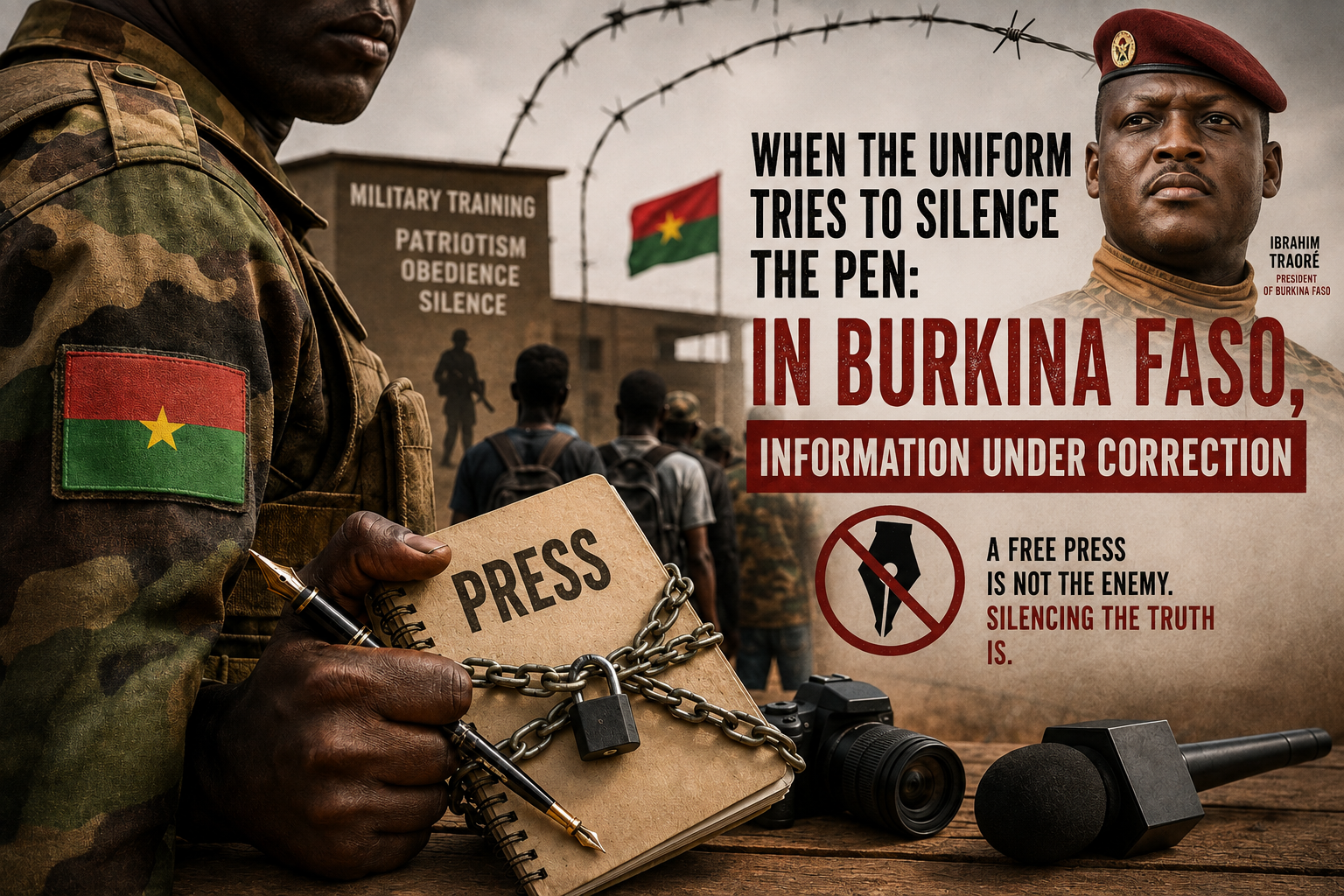
Forced patriotism training for journalists in Burkina Faso sparks freedom of speech concerns
In a move that has sent shockwaves through defenders of fundamental freedoms, over forty Burkinabè journalists recently completed several days of military-led training near Ouagadougou. Marketed as a civic education program, this initiative conceals a far more troubling agenda: an attempt to re-educate and subjugate independent journalism under the guise of patriotism.
The implications for press freedom are profound. When a reporter is compelled whether through direct coercion or subtle pressure to attend a military camp to learn what may or may not be reported, the very essence of free expression is undermined. Investigative work and the accurate portrayal of public suffering are now treated as acts of defiance. Exposing security failures, civilian abuses, or humanitarian crises risks being labeled as treason or a lack of national loyalty.
Rather than fostering an informed citizenry, these so-called re-education sessions appear designed to produce compliant mouthpieces for state propaganda. This approach signals a dangerous shift not merely toward military governance in a time of crisis, but toward the consolidation of unchecked authoritarian control. By monopolizing public discourse and suppressing independent reporting, the regime positions itself as the sole arbiter of national truth.
When the Fourth Estate Becomes a Propaganda Arm
Journalism that aligns with official narratives ceases to be journalism at all. Silencing reporters or forcing them to adopt a state-sanctioned worldview does not resolve national crises; it exacerbates them. When the press is gagged, citizens are left adrift, vulnerable to misinformation and arbitrary rule. True patriotism cannot be measured by silence in the face of injustice. It is demonstrated through the courage to hold power to account, to document hardship, and to demand accountability.
This raises a fundamental question: who owns the right to information during a crisis? The state has a legitimate interest in protecting sensitive military operations and classified intelligence. However, this duty cannot justify the suppression of facts that affect civilians. There must be a clear boundary between necessary security measures and political censorship disguised as national interest.
A government facing terrorism may ask journalists to exercise caution to withhold troop movements, protect identities, or respect operational secrecy. These are professional obligations, not invitations to abandon critical inquiry. Yet when the state conflates national security with regime security, it crosses a perilous line.
Patriotism Does Not Mean Blind Allegiance
The term patriotism is being weaponized. True love for Burkina Faso is not expressed by parroting official statements but by investigating the challenges facing its people. A journalist devoted to the nation’s well-being may report on mass displacements, question official decisions, or expose systemic failures not out of disloyalty, but out of a commitment to prevent deeper crises.
In a democracy, the press is not a public relations tool for the government. It is a check on power, a guardian of transparency, and a voice for the voiceless. The state may rebut a story, present counter-evidence, or pursue legal recourse but it must not dictate what journalists can or cannot investigate before the facts are established.
The Paradox of a Controlled Narrative
Attempts to dominate public discourse rarely succeed in erasing dissent. When credible media outlets refrain from publishing certain truths, the void is quickly filled by unverified rumors, social media speculation, and clandestine narratives. Ironically, the harder a regime tries to control the narrative, the more it undermines public trust.
Trust is not built on decrees or indoctrination. It is cultivated through transparency, openness to scrutiny, and the freedom to verify official claims. When citizens know they can rely on independent reporting, they are better equipped to distinguish fact from fiction. But when truth becomes dangerous to tell, doubt takes root and with it, instability.
The Military Mindset vs. the Journalistic Ethos
The very premise of this training imposing military discipline on journalists reveals a fundamental contradiction. The military operates on hierarchy, obedience, and confidentiality. Journalism thrives on skepticism, verification, and editorial independence. Blurring these roles risks transforming reporters into extensions of the security apparatus rather than watchdogs of it.
The need for independent journalism has never been greater. In a climate marked by armed violence, mass displacement, and economic hardship, citizens require reliable information more than ever. They need journalists who can verify facts, amplify marginalized voices, and scrutinize decisions made in their name. When the state demands that reporters adopt military reflexes, it risks producing propagandists not professionals.
A Dangerous Precedent
Today, it is journalists who are scrutinized for their patriotism. Tomorrow, which other sectors might face ideological conformity tests? Academics, judges, artists, activists, researchers could they too be deemed insufficiently patriotic for questioning government actions?
A resilient democracy is not measured solely by its ability to rally citizens behind a single narrative. It is measured by its capacity to withstand criticism without branding dissent as treachery. History shows that regimes that attempt to erase dissent rarely succeed in erasing reality. Facts have a way of resurfacing through testimonies, diaspora networks, social media, and international outlets.
The Path Forward: Protecting Truth, Not Stifling It
The real challenge is not how to enforce a single version of events, but how to create an environment where reliable information can flourish. In a nation at war with armed groups, the role of journalists is indispensable. Yet the state’s responsibility is equally critical: it must safeguard citizens without weaponizing security as a justification for perpetual censorship.
Patriotism should never be a license to censor. It should never serve as a litmus test to separate “good” citizens from those who ask questions. A journalist who exposes a state weakness does not betray Burkina Faso; they may help prevent that weakness from becoming catastrophe.
This is not merely a debate about press freedom. It is a defining question for the nation’s future: Will Burkina Faso build a society where information must first be approved by those in power? Or will it embrace a model where the state accepts that truth however uncomfortable must be confronted, not suppressed?
