
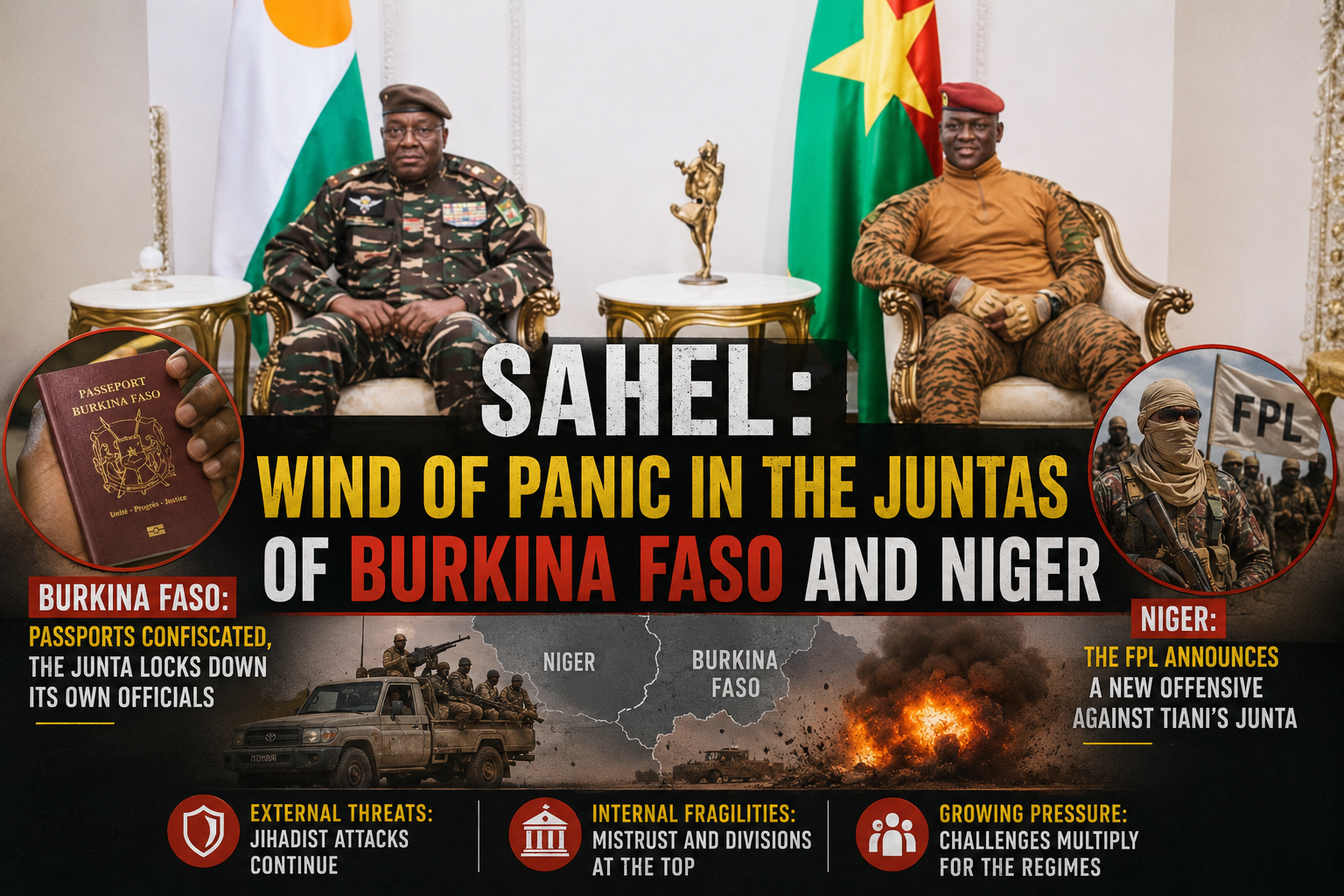
Military regimes face mounting internal and external challenges in the Sahel
The security and political landscape in the Sahel-Saharan region continues to deteriorate, with the military juntas of Burkina Faso and Niger now confronting dual pressures—both from armed opposition and internal fragility within their own ranks.
Burkina Faso tightens grip on state apparatus
In Ouagadougou, an atmosphere of deepening suspicion has taken hold. Reports indicate that the transitional authorities have implemented an unprecedented measure: the seizure of passports belonging to government officials.
This sweeping restriction extends beyond the ministerial level, encompassing senior military officers as well. The move signals a tightening of control not only over the executive branch but also over the security apparatus itself. By preventing key figures from leaving the country, the regime appears determined to mitigate risks of unauthorized departures, intelligence leaks, or unauthorized engagements with foreign actors—tactics often employed when trust within leadership circles erodes.
The decision comes at a time when Burkina Faso remains engulfed in persistent insecurity. Despite intensified military operations and the deployment of civilian defense auxiliaries, jihadist attacks continue to target both security forces and civilian communities. This persistent threat environment has heightened tensions at the highest levels of government, reinforcing the authorities’ resolve to consolidate decision-making authority within a tightly controlled inner circle.
Analysts suggest these measures also reflect the structural challenges faced by military-led governments in maintaining cohesion. The more power is centralized, the greater the risk of internal divisions, rivalries, or defection—factors that can undermine regime stability from within.
Niger’s opposition intensifies with call for regime change
In Niger, the political crisis has taken a more militarized turn. Following his release in late June 2026—facilitated by Libyan forces under Khalifa Haftar as part of a sensitive hostage exchange—Mohamed Salah, Secretary-General of the Patriotic Front for Liberation (FPL), has adopted a notably aggressive posture.
The exchange had required the release of Barkadine Mahamat Rifi, a leader of the Libyan katiba “Ahrar Fazzan” sought by Haftar’s forces. Now free, Mohamed Salah has declared preparations for a large-scale operation aimed at toppling the military junta led by General Abdourahamane Tiani.
The FPL positions itself as a movement seeking the restoration of constitutional order and the immediate release of former President Mohamed Bazoum, whom it recognizes as the country’s only legitimate leader following a democratic election. This declaration marks a significant shift in the conflict dynamic, introducing an armed opposition that openly challenges the legitimacy of the current regime.
For the authorities in Niamey, already stretched thin by the fight against jihadist insurgencies, the emergence of a declared adversary seeking regime change adds another layer of complexity. The diversion of security resources to counter internal threats risks weakening the national response to external security challenges.
Dual crises test the resilience of Sahelian juntas
These developments underscore a critical reality: the crises facing Burkina Faso and Niger are no longer confined to the battlefield against terrorist groups. Instead, they now encompass internal vulnerabilities, political opposition, and growing public discontent—challenges that threaten the long-term stability of regimes born from coups d’état.
The Burkina Faso junta, in particular, is grappling with the erosion of trust among its own elite, prompting drastic measures to prevent fragmentation. Meanwhile, in Niger, the rise of an armed opposition movement signals a dangerous escalation, one that could force the junta into a prolonged confrontation with both domestic and external adversaries.
As these pressures converge, the Sahel faces a precarious moment. Military governments, despite their stated commitment to restoring sovereignty and security, are now forced to navigate multiple fronts—armed insurgencies, political dissent, economic hardship, and internal power struggles. The cumulative effect of these crises may determine not only the fate of the two nations but also the broader trajectory of regional stability in the coming months.