Drones strike Moscow: how Ukraine’s long-range tactics expose Russia’s vulnerabilities
The Ukrainian drone strikes on Moscow mark a critical inflection point in the war, revealing deeper vulnerabilities within the Russian war machine. Kyiv’s precision attacks on oil infrastructure and logistics hubs were not merely tactical strikes—they were a calculated challenge to Russia’s ability to sustain its military campaign. This escalation underscores a harsh reality: after years of conflict, the war has not only failed to subside but has fundamentally altered Russia’s own territory.
The night of September 19-20: a coordinated assault on Moscow’s defenses
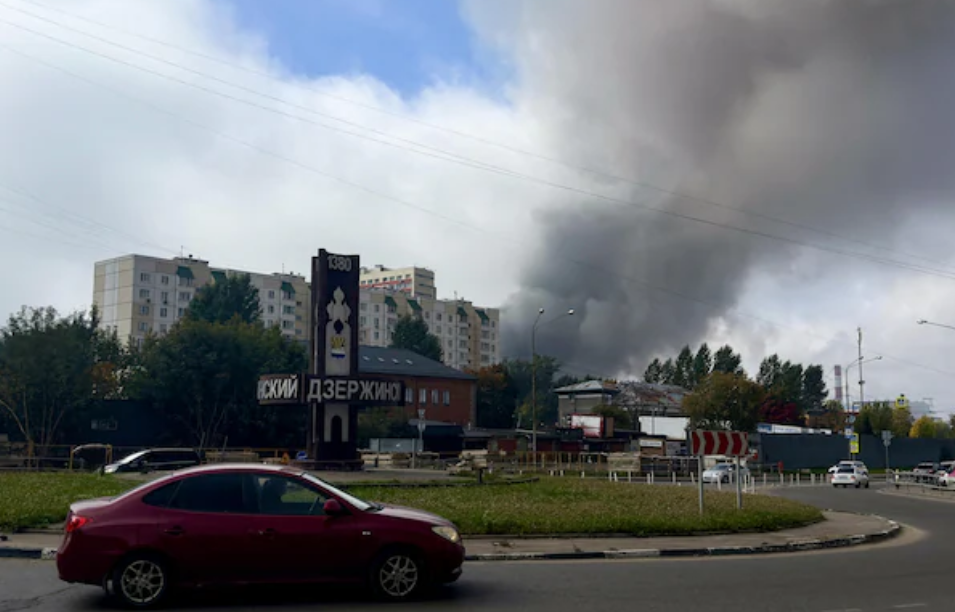
In a bold operation, Ukrainian forces launched a barrage of long-range drones and other weapons targeting the Moscow region. Russian authorities claimed to have intercepted over 1,600 drones nationwide, with approximately 450 directed toward the capital. Despite these interceptions, critical infrastructure was struck, including the Moscow refinery in Kapotnia, a facility capable of processing 12 million tons of oil annually. Officials reported multiple fatalities and dozens of injuries.
The strikes occurred just as Russia was holding tightly controlled legislative elections—a timing that has fueled speculation about political intent. While Moscow accused Kyiv of attempting to disrupt the vote, Ukraine framed the attack as a legitimate strike against key components of Russia’s military-industrial base. The dual narratives highlight the propaganda war that now accompanies the physical conflict.
Why oil infrastructure became the focal point of this strike
The choice of oil refineries and logistics centers as targets is no coincidence. These facilities are the lifeblood of Russia’s war economy, generating revenue and fueling military operations. By striking them, Ukraine seeks to shrink the financial and logistical support that sustains Russia’s prolonged invasion. Analysts and military observers note that the damage to the Moscow refinery—confirmed by geolocated imagery—disrupts one of Russia’s most critical energy hubs, potentially forcing costly repairs and temporary reductions in output.
Ukraine’s stated objective is clear: to degrade Russia’s ability to sustain war. This strategy reflects a broader shift in the conflict’s dynamics. What began as a conventional invasion has evolved into a prolonged war of attrition, where distance no longer guarantees safety for Russia’s hinterland.
The evolution of warfare: long-range strikes redefine security calculations
Technological advancements have given Ukraine the capability to strike deep into Russian territory. Systems such as the FP-1, RZ-100, and MICH-2000—alongside domestically developed weapons like the Palianytsia, Vendetta, Liutyi, and Bars—represent a new phase in the war. While some systems remain shrouded in uncertainty, their existence signals a turning point: Ukraine no longer relies solely on frontline combat. It can now project force hundreds of kilometers inside Russia, targeting the very resources that underpin Moscow’s military machine.
This shift has shattered Russia’s long-held perception of territorial invulnerability. For years, the Kremlin assumed that its vast geography would shield critical infrastructure from direct attack. That assumption has been dismantled. The Moscow refinery fire is not just damage to a facility—it is evidence that the war has come home to Russia.
Political timing and the election controversy
The timing of the strikes, coinciding with Russia’s elections, has been seized upon by both sides to advance their narratives. Moscow framed the attack as an attempt to undermine democratic processes, while Kyiv emphasized the military logic behind targeting oil infrastructure. The reality is more nuanced. While the simultaneous timing is striking, it does not alone confirm a deliberate electoral sabotage. Instead, it reflects a broader strategy: in a war of attrition, every strike is both a military and a psychological gambit.
The refinery attack, in particular, reveals the dual nature of modern warfare—where civilian risks and military objectives often intersect. Though the primary target was an oil facility, the proximity to populated areas means civilian casualties become an inevitable consequence, even if unintended.
The paradox of escalation: Russia’s dilemma at home
These strikes present Russia with a paradox. The Kremlin launched this war under the banner of “denazification” and “security,” promising protection to its citizens. Yet, over two years later, the war has brought destruction not only to Ukraine but to parts of Russia itself. The Moscow attack is not an isolated incident—it is part of a broader trend in which Ukraine has repeatedly demonstrated that it can penetrate Russian airspace and strike essential infrastructure.
Moscow’s response has been predictable: vowing intensified strikes on Kyiv and warning of further escalation. But this cycle—attack and retaliation—only deepens the crisis. Each new strike begets another, pulling both nations deeper into a spiral of violence with no clear exit.
What these strikes reveal about the future of the war
The Moscow refinery fire is more than a tactical setback—it is a symbol. It signals that the war, which began as a distant conflict, has now become a shared burden. Russia can no longer shield itself behind geography. Its own population is now directly affected by the consequences of its decisions.
Ukraine’s long-range strikes reflect a strategic adaptation: when traditional fronts fail to yield results, new methods emerge. The ability to strike deep into enemy territory is not just a military advantage—it is a geopolitical statement. It demonstrates that aggression, once unleashed, cannot be contained to a single battlefield.
The question now is not whether Russia can retaliate—but whether it can prevent the next strike. And more critically, whether it can end a war that has already begun to consume its own heartland.
