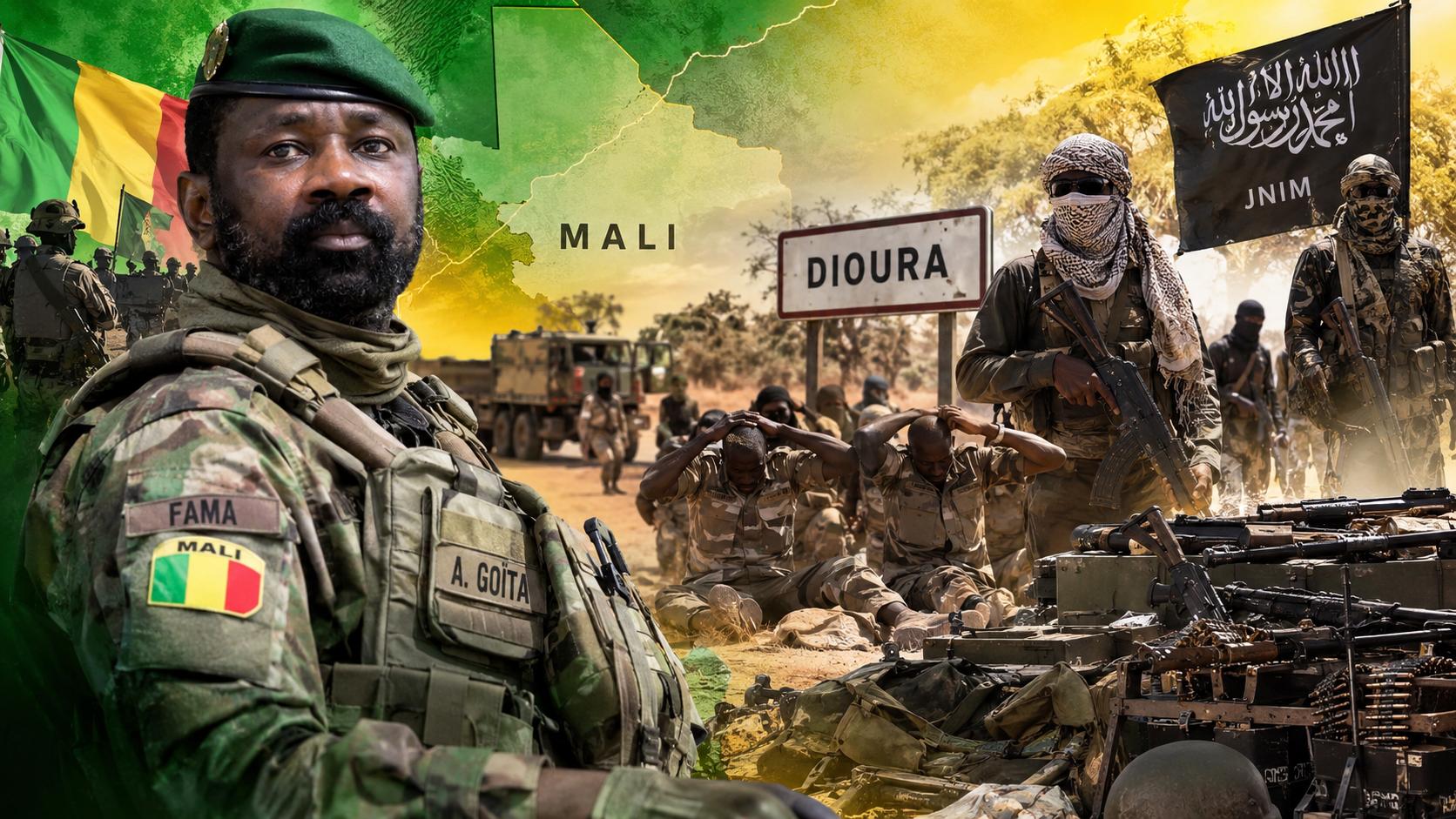
Dioura assault: 130 Malian soldiers killed and 70 taken prisoner in JNIM’s deadliest strike
The military base at Dioura, a town in the Tenenkou circle of central Mali, was overrun in the early hours of Thursday 10 September 2026. Fighters of the Group for the Support of Islam and Muslims (JNIM), Al-Qaeda’s Sahel branch, breached the compound, pounded it for hours and then pulled out with captured hardware and a long column of prisoners. By any measure, it ranks among the gravest setbacks the Malian army has absorbed in this conflict.
The human cost is staggering. Around 130 soldiers are believed to have been killed, while some 70 others were marched away alive. Footage released soon afterwards by the jihadist group shows rows of young recruits, visibly terrified, alongside stockpiles of rifles and ammunition seized from the garrison.
How the assault on the camp unfolded
The attack began before first light, catching the garrison unprepared. Assailants converged on the position from several directions, overwhelmed the outer defences and then spent hours inside, setting vehicles ablaze and emptying the armoury. When they finally withdrew, the base — a forward position built to shield the surrounding district — had been stripped to its bones.
Silence in Bamako as the scale of the loss sinks in
As has become routine after disasters of this kind, the Malian armed forces and the transitional presidency have said almost nothing. No detailed statement, no casualty list, no accounting of what went wrong. That vacuum has been filled by grief and rumour in the villages around the camp, where families have waited days for news that never comes.
What does circulate is a picture close to apocalyptic: bodies left in the open, weapons hauled away, and a defence line that simply ceased to exist. For the relatives of the missing, the uncertainty is compounded by the sense that nowhere in the chain of command is willing to speak plainly.
The Russian partnership tested on the battlefield
Dioura cuts straight to the heart of the security doctrine championed by the military government of Colonel Assimi Goïta. After taking power and turning away from Western partners towards Moscow, the junta pledged to rebuild the army and wipe out the insurgency with Russian support.
Reality has been far less obliging. With MINUSMA gone and Operation Barkhane long since withdrawn, Malian units are left to hold enormous stretches of territory alone — thinly spread, poorly supplied and easy prey. Forward bases such as Dioura, once meant to project state authority, now sit as isolated targets for highly mobile armed groups that strike when and where they choose.
Civilians in Mopti pay the price of a failing strategy
For the communities of the Mopti region, the fall of the camp is no abstract military statistic. It announces reprisals, flight and abandonment.
“Whenever the camp falls or the soldiers pull back, we already know what comes next: revenge, fear and total emptiness,” a resident of the area says, asking not to be named. “In Bamako they talk about sovereignty on television. Here we have no protection, no administration, no future.”
Closed markets, severed roads and a widening exodus
Traders describe an economy at a standstill. Weekly fairs have been called off, insurgents have cut the main roads, and even staples now arrive by chance. After the assailants pass through, the fear of reprisals — or of being mistaken for collaborators — drives families towards the larger towns, swelling the ranks of the displaced with little notice from the outside world.
A political gamble running out of road
Dioura amounts to a blunt warning for the transitional authorities. By investing more in messaging than in operations, the junta is boxing itself in. Shrinking troop numbers, sagging morale and the steady erosion of control across the centre and north pose an uncomfortable question: how much longer can the rhetoric of recovered sovereignty conceal a collapsing security situation?
Without a serious rethink of alliances, battlefield tactics and engagement with local communities, Mali risks sinking deeper into a cycle where soldiers and civilians alike keep paying for political blindness.
