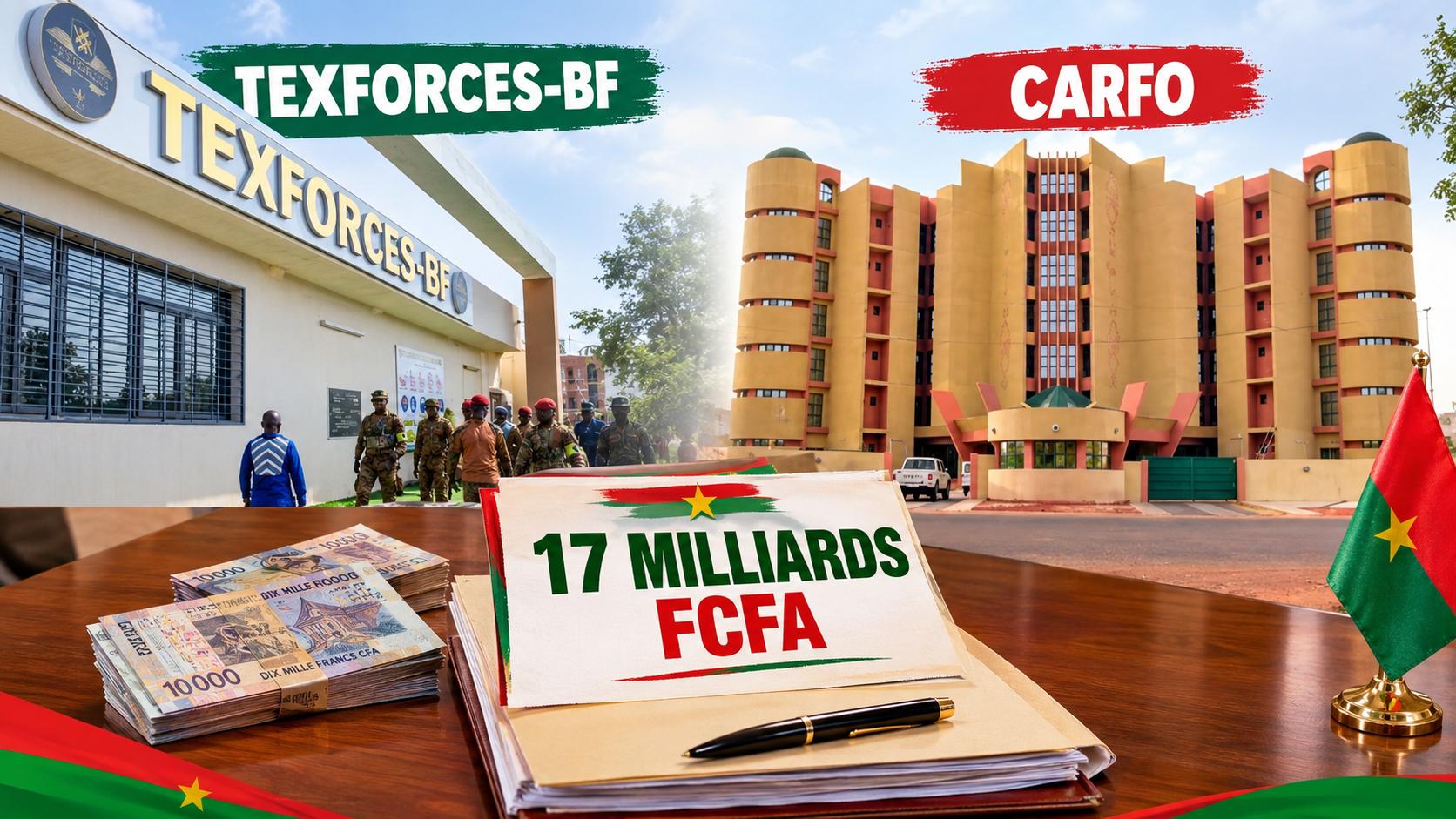
Burkina Faso’s Texforces-bf: how Ibrahim Traoré is gambling with retirees’ money
Texforces-bf: an industrial flagship built on borrowed confidence
Touted as a pillar of economic sovereignty and a driver of Burkina Faso’s industrialisation, the TEXFORCES-BF textile scheme enjoys unmistakable official enthusiasm. Yet beneath the determined rhetoric, the project’s financial architecture and the terms of its implementation invite hard questions. Taken together — levies on pension reserves, thousands of beneficiaries still waiting for their money, an unrelenting terrorist threat and no visible industrial upkeep strategy — this flagship venture starts to look like a bet with very little room for error.
Retirement money repurposed as industrial capital
At the heart of the financing model sits one decisive choice: public savings, and in particular the incapacity and retirement funds administered by the national social security bodies, are being mobilised. Converting long-term savings into productive investment is not a new idea in itself, but here it takes on a very particular character.
The initial push does not come from conventional private capital or from foreign direct investment. It comes from the contributions of workers and former civil servants. The state has opted to channel the liquidity of pension institutions into an ambitious textile plant, banking on future returns to shore up those same institutions’ balance sheets.
A break with the prudence that governs pension money
The arrangement raises a fundamental question: is it defensible to expose money meant for social protection to major operational and industrial risk? Pension management normally follows a strict rule of caution, favouring liquidity and maximum security for placements. By pouring these sums into a manufacturing business, the state shifts operating risk directly onto the community of contributors and beneficiaries.
Who ends up carrying the losses
Should the plant underperform, the consequences would not land on a private shareholder’s balance sheet. They would be absorbed by the very people whose retirement income depends on those reserves. That transfer of risk, rarely spelled out in public debate, sits at the crux of the controversy.
Pensions in arrears while billions flow into industry
One of the most striking features of the file is the gap between the scale of the sums committed to TEXFORCES-BF and the daily reality of many users of the social security system. On the ground, claiming what you are owed remains an obstacle course for thousands of households.
Claimants, orphans and widows still struggle to obtain their pensions or survivors’ allowances. Administrative delays, files stuck in the system and recurring cash shortages at payment windows produce visible social distress. Watching the same institutions commit billions of CFA francs to industrial projects while basic social obligations go unpaid or are handled at a glacial pace fuels a growing sense of injustice.
For those waiting, the number one duty of a pension fund is to pay what is due, on time and in full. The argument that industrial investment will keep the funds solvent over the long term struggles to convince households squeezed by the rising cost of living and cut off from the income they need to survive month to month.
Producing under the shadow of armed groups
Beyond financial and social fragilities, TEXFORCES-BF is being launched in an extremely complex security environment. For several years Burkina Faso has faced a deep security crisis, marked by the presence and incursions of armed terrorist groups across a large part of the country.
A supply chain exposed on every side
Standing up and running an industrial complex of this size requires uninterrupted logistics: moving raw cotton, securing energy, transporting workers and shipping finished goods. The vulnerability of road corridors and the constant threat of sabotage add a risk factor that few comparable production units have to face.
No safety net if the worst happens
An arson attack, a direct strike on the facilities or a blockade of supply routes by armed groups could bring the plant to a halt within hours. If that happened, it would not only be a production tool going up in smoke — it would be capital built from retirees’ contributions. With no explicit public guarantee and no international insurance capable of covering the full extent of terrorism risk in this zone, a heavy question mark hangs over the investment’s long-term viability.
The technical blind spot: no durable upkeep strategy
Even setting finance and security aside, a textile mill survives on mastery of its equipment. Spinning and weaving are precision industries, hungry for spare parts, stable power and specialised technical skills.
So far, little convincing detail has emerged about a comprehensive preventive maintenance and equipment upkeep plan for TEXFORCES-BF. The region’s industrial record is littered with promising ventures that fell idle after only a few years of operation, because maintenance costs, spare-part availability or skills transfer had never been anticipated.
Running a textile unit is not about buying modern machines for an opening ceremony. It demands rigorous planning for equipment renewal, upkeep of spinning and weaving lines and a constant supply of industrial consumables. Without a clear strategy from day one on how that maintenance will be funded and executed, the plant risks quick drops in output, followed by long breakdowns that would erode the asset at accelerating speed.
Transparency is the only way this bet can hold
TEXFORCES-BF embodies the full complexity of today’s development policies: the legitimate wish to process raw materials such as cotton at home runs straight into the harsh constraints of financial, security and operational reality.
If the project is not to become a financial black hole for social security funds, firm guarantees need to be put on the table. Authorities and project managers owe the public complete clarity on how retirees’ money will be protected, how sites will be secured and what the plant’s technical cost structure actually looks like. Only at that price can industrial ambition be reconciled with social justice and the safety of savers.
