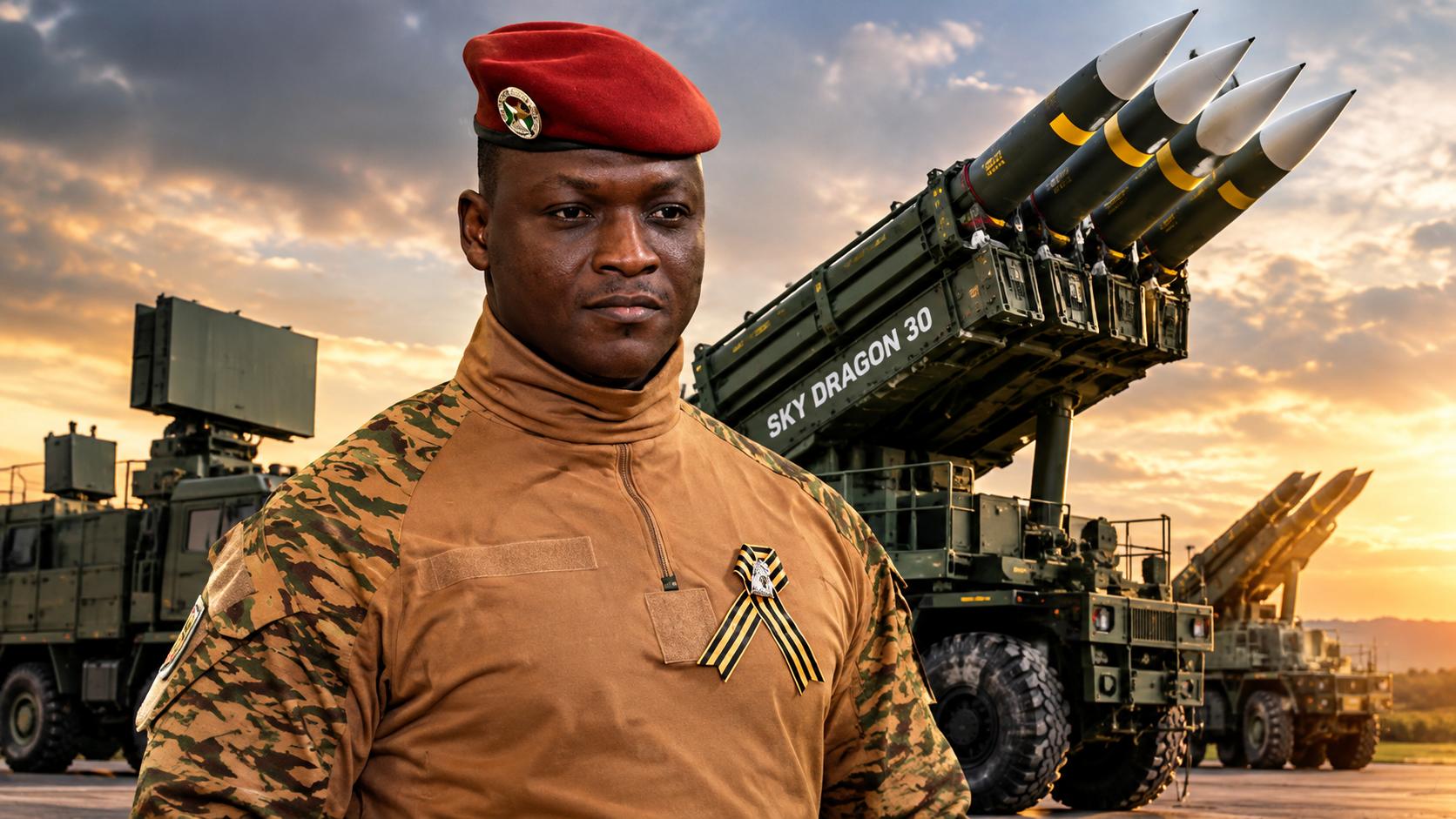
Burkina Faso’s Sky Dragon 30: a high-cost illusion in the war against ground realities
The carefully staged spectacle orchestrated by Burkina Faso’s transitional government communications teams was designed to project strength: high-definition cameras, sweeping shots of gleaming armored vehicles, and rousing speeches about the nation’s « rising military might. » Yet beneath the polished imagery and narrative of an invincible defense force lies a glaring strategic misstep—the unveiling of the Sky Dragon 30 air defense system. This Chinese-made missile, acquired under the leadership of Captain Ibrahim Traoré, is a symbol of misplaced priorities in a country under siege not from the skies, but from the ground.
With villages emptied by relentless attacks from armed groups on motorcycles, allocating millions of dollars to intercept phantom targets in the clouds reveals a dangerous detachment from reality. The Sky Dragon 30’s acquisition isn’t just an investment in the wrong technology—it’s a deliberate propaganda exercise masquerading as defense strategy.
The Sky Dragon 30: a high-tech mismatch in a low-tech war
Developed by China’s state-owned NORINCO, the Sky Dragon 30 (DK-10A) is a long-range surface-to-air missile system with one glaring limitation: it is engineered exclusively for engaging aerial threats. A closer look at its technical specifications exposes the absurdity of its deployment in Burkina Faso’s current conflict.
Key technical features of the system include:
- Target scope: The Sky Dragon 30 is designed to lock onto and destroy conventional aircraft, including fighter jets, combat helicopters, large attack drones, and cruise missiles.
- Range and altitude: It can engage targets flying up to 18,000 meters in altitude within a 30-kilometer radius.
- Radar infrastructure: Equipped with a 3D IBIS 80 radar, it can detect aircraft at distances exceeding 130 kilometers.
Given these capabilities, a fundamental question emerges: what aerial threat does the Burkina Faso government believe it must neutralize? The answer becomes clear when examining the actual security crisis gripping the nation.
From drones to dirt roads: why the Sky Dragon 30 misses the mark
The terrorist groups wreaking havoc across Burkina Faso—besieging towns like Djibo and forcing residents of Boussouma into mass displacement—rely on one thing: mobility. Operating in small, fast-moving convoys on motorcycles, they exploit the vast, sparsely populated Sahel terrain to launch ambushes, plant improvised explosive devices (IEDs), and conduct night raids on villages.
This is a war fought on the ground, not in the air. A Sky Dragon 30 missile, with its radar tuned for high-altitude interception and its warhead designed for supersonic jets, is utterly incapable of detecting, tracking, or neutralizing a trio of insurgents on motorcycles concealed in the bush. Deploying such a system against this threat is like trying to swat mosquitoes with a fishing net—comically ineffective and entirely misaligned with the battlefield reality.
Weaponized optics: how symbolism trumps security
If military logic fails to justify the Sky Dragon 30’s presence, political theater certainly does. The transitional government, under pressure to restore public confidence amid territorial losses and mounting civilian casualties, has turned defense procurement into a public relations campaign.
Mounted on an armored truck and paraded before cameras, the Sky Dragon 30 becomes a powerful visual—an emblem of « regained sovereignty » and technological progress. It feeds the narrative that Burkina Faso is not just fighting a war, but defending itself from an invisible external enemy, thereby justifying a climate of heightened security paranoia and political control.
Meanwhile, on the front lines, soldiers lack basic mine-clearing equipment, real-time intelligence, and even fuel to patrol critical roads. The funds poured into the Sky Dragon 30 do not translate into protection for citizens—they fund a costly illusion of security that reveals a deeper strategic failure.
The human cost of a misplaced defense strategy
The Sky Dragon 30 is not just a waste of public funds—it’s a betrayal of public trust. Every dollar spent on air defense could have been invested in training, equipment, and intelligence operations directly relevant to the fight against motorcycle-borne insurgents.
As the military parades its latest acquisition, farmers abandon their fields, children are pulled from school, and entire communities live under the shadow of terror. The government’s choice to prioritize symbolic firepower over practical solutions underscores a dangerous disconnect between leadership and the realities faced by Burkinabè citizens.
In the end, the Sky Dragon 30 is not an asset to Burkina Faso’s defense—it is a liability. A missile designed for skies that will never come, paid for in blood and suffering on the ground.
