Burkina Faso’s security strategy under strain as JNIM tightens grip near Dédougou
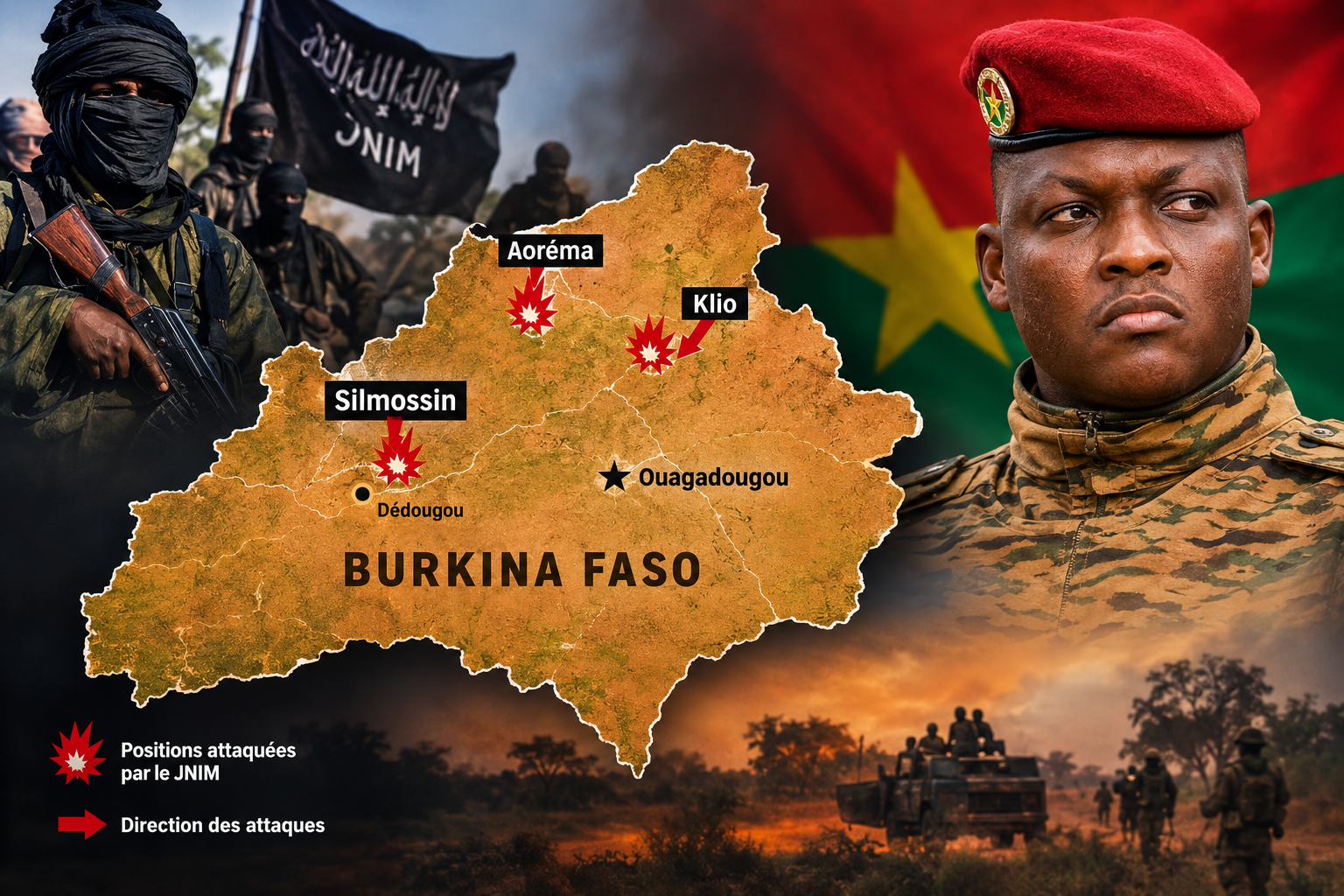
In a fresh challenge to Burkina Faso’s counterinsurgency efforts, the Group for the Support of Islam and Muslims (JNIM) claimed late Friday, September 25, 2026, to have seized multiple militia positions near Silmossin, a strategic area close to Dédougou. The jihadist group also asserted control over two other military outposts in Aoréma and Klio, both located north of the country.
The hidden costs of repeated claims: why Burkina Faso’s security doctrine is being re-evaluated
The frequency of these claims occurring within hours of one another raises a critical question: how effective is the security strategy that Burkina Faso’s military leadership, under Captain Ibrahim Traoré, has championed since taking power in 2022? While official narratives emphasize territorial recovery and the mobilization of local defense forces, the reality on the ground tells a different story.
The cornerstone of Traoré’s approach has been the rapid expansion of the Volunteers for the Defense of the Homeland (VDP), alongside ambitious military operations aimed at reclaiming lost territories. However, experts and analysts argue that true security extends beyond the mere seizure of positions. It requires sustained control, reliable intelligence, robust logistics, and the uninterrupted functioning of civilian institutions in recovered areas.
Beyond declarations: the gap between military recapture and lasting stability
For a security strategy to be considered successful, it must demonstrate more than the ability to dislodge armed groups temporarily. It must ensure that:
Civil administration resumes operations in reclaimed zones;
Markets, schools, and public services function without disruption;
Agricultural activities resume safely;
Internally displaced persons (IDPs) can return home without fear;
Freedom of movement is restored along key transportation routes.
Observers note that while Burkina Faso has invested heavily in troop numbers, equipment, and local militias, the ability to hold terrain remains inconsistent. The JNIM, by contrast, has shown remarkable adaptability deploying advanced tactics, relying on local informants, leveraging financing networks, and increasingly utilizing unmanned aerial systems to evade detection. This operational sophistication has repeatedly tested the resilience of national forces.
Signals from the ground: what the latest JNIM claims reveal about systemic vulnerabilities
The latest offensives near Dédougou are not isolated incidents. They are part of a broader pattern in which the JNIM maintains pressure on both military and civilian targets. Reports indicate that the group has intensified its use of drones for reconnaissance and attack coordination, further complicating counterinsurgency efforts.
These developments occur against a backdrop of rising civilian casualties and persistent insecurity. For Traoré’s administration, the challenge is not only to counter jihadist forces but to justify the sustainability of a military-first approach that has yet to deliver consistent peace. Even government officials have acknowledged the need for broader reforms, with the Minister of Foreign Affairs publicly stating on September 25 that lessons must be drawn from what “has not worked so far” an implicit recognition that repression alone cannot resolve the crisis.
From slogans to substance: the metrics that will define success or failure
The debate over Burkina Faso’s security trajectory is increasingly shifting from political rhetoric to measurable outcomes. Key indicators that will determine the legitimacy of Traoré’s strategy include:
Sustained control over reclaimed territories without recurring attacks;
Reduction in civilian casualties and displacement rates;
A decline in jihadist recruitment and influence in rural areas;
Restoration of essential public services in conflict zones;
Improved coordination between national forces, VDPs, and allied militias.
Without transparent, verifiable data on these fronts, the gap between official messages and ground realities will continue to fuel public skepticism and erode confidence in the state’s ability to protect its people.
What comes next: does Burkina Faso need a strategic pivot?
As the JNIM tightens its grip in northern Burkina Faso, the question is no longer whether the military can regain ground but whether it can keep it. The coming months will reveal whether Traoré’s doctrine, built on mobilization and sovereignty, can evolve to meet the adaptive, decentralized threat posed by JNIM.
The stakes are high: the future of Burkinabè security does not depend on slogans, but on results. And until those results materialize, the shadow of the next attack will loom over daily life across the country.
By Maimouna Kaboré — Editor-in-Chief
