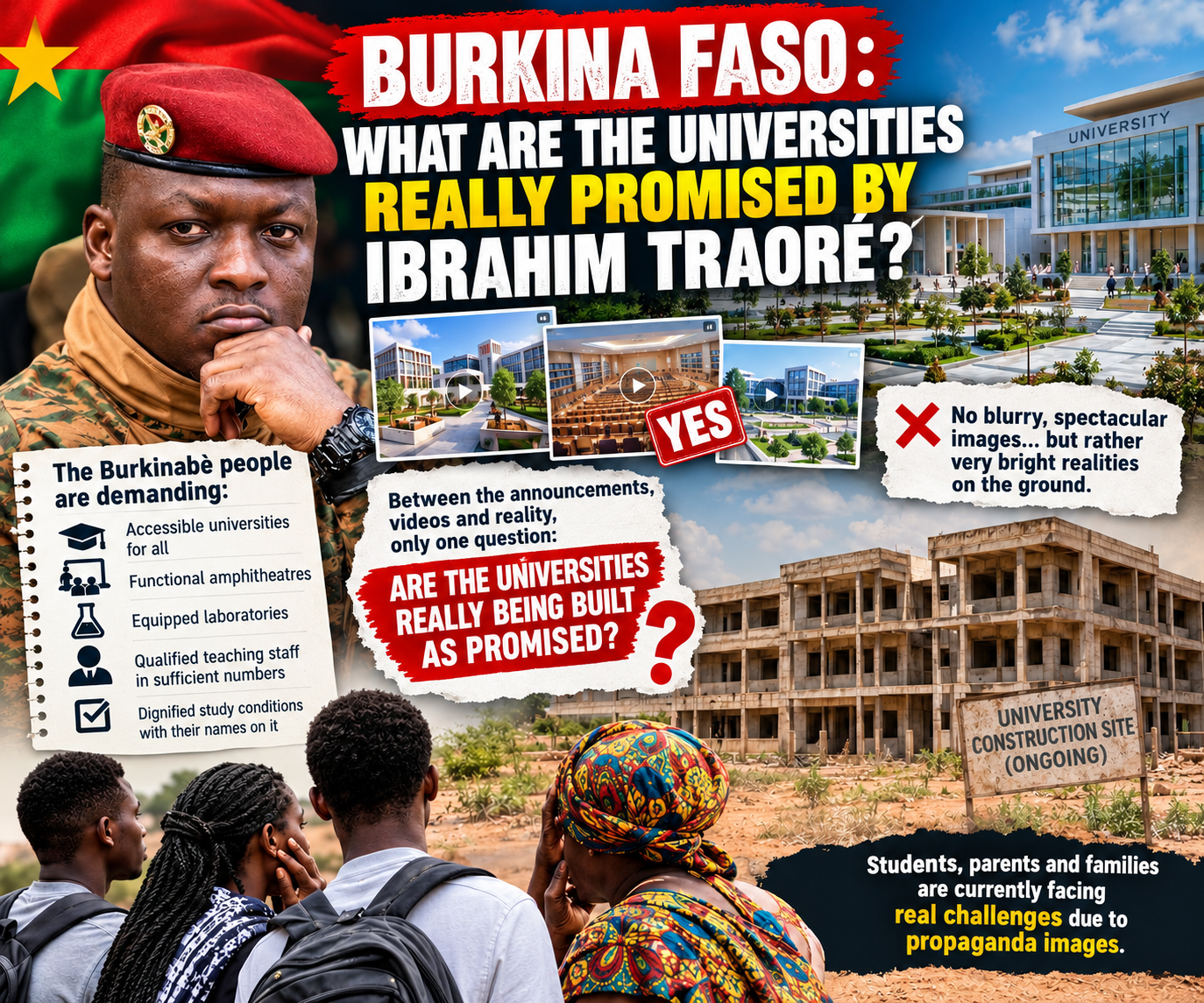
Burkina Faso’s promised universities: progress, skepticism, and unmet expectations
As Burkina Faso’s political narrative increasingly relies on digital imagery, a pressing question emerges: what tangible progress has been made toward the country’s promised state-of-the-art universities, and how do these developments align with the expectations of students and families?
From digital images to concrete realities: the education gap
While social media showcases striking visuals of modern infrastructure and educational advancements, families and students remain skeptical. They seek more than just visually impressive images they demand functional classrooms, equipped laboratories, sufficient faculty, and dignified learning conditions. The burden of proof now rests on demonstrating that the announced university projects have moved beyond digital propaganda to tangible, operational realities.
How fake images distort the education narrative
The rise of AI-generated content and manipulated media has blurred the line between genuine progress and fabricated achievements. Investigations have exposed videos falsely attributed to Burkina Faso’s development projects, including imagery sourced from unrelated international locations. A prominent 2025 case revealed a viral video claiming to depict a construction site under Ibrahim Traoré’s leadership, later traced to Algeria. While these examples primarily involved real estate rather than universities, they underscore a critical issue: in an era where visual content can be fabricated, how can citizens differentiate between authentic progress and artificial propaganda?
This does not dismiss the possibility of genuine university projects, but it demands rigorous verification. Without on-the-ground corroboration, digital imagery risks becoming a substitute for real accountability.
Announcements vs. achievements: the education sector’s credibility test
The timeline between a political announcement and the opening of a fully operational university is long and complex. An announced project may remain unbuilt, a completed building may lack essential facilities, and an inaugurated institution might struggle with understaffing or inadequate student capacity. Families investing in their children’s futures cannot afford to rely on rhetoric alone they need verifiable evidence of completed, functional, and accessible educational infrastructure.
What the official records claim
According to government communications, progress includes the inauguration of a 1,200-seat amphitheater, four 210-seat mini-lecture halls, and six fully equipped laboratories at the Nazi-Boni University in Bobo-Dioulasso in September 2026. Additional projects under the Presidential Initiative for Quality Education for All have also been announced. While these developments represent tangible steps, their real-world impact remains under scrutiny.
The role of AI in shaping public perception
The proliferation of AI-generated videos and deepfake content has intensified concerns over misinformation in political communication. Africa-based fact-checking organizations have documented multiple cases of deceptive media attributing non-existent achievements to Burkinabe authorities. While not all such content is directly linked to the government, its circulation complicates public understanding of what has actually been accomplished.
The critical test for any administration lies not in suppressing criticism but in transparently addressing it. Authorities must provide accessible, verifiable data and allow independent assessments to validate their claims.
What students and parents are asking for
Beyond the visual spectacle, Burkinabè families prioritize practical outcomes: Are the announced universities open? Do they have sufficient enrollment capacity? Are laboratories and libraries operational? Are teachers hired and compensated? Without clear answers to these questions, the gap between political messaging and lived experience widens.
The credibility of Burkina Faso’s higher education push hinges on more than just inauguration ceremonies. It depends on measurable, independently verified progress that students can access and benefit from. A university is not defined by viral videos but by functioning infrastructure, qualified faculty, and meaningful educational opportunities.
The path forward: beyond images to accountability
The debate surrounding Burkina Faso’s university projects is not about dismissing progress outright. It is about demanding evidence, transparency, and tangible results. For a policy to be credible, it must withstand scrutiny not through polished digital presentations, but through open access to construction sites, equipment inventories, enrollment records, and student testimonials.
Until then, the question remains: are these universities a reality for Burkinabè students, or are they merely symbols of a communication strategy detached from ground-level truth?
By Yacouba Ouédraogo — Journalist
