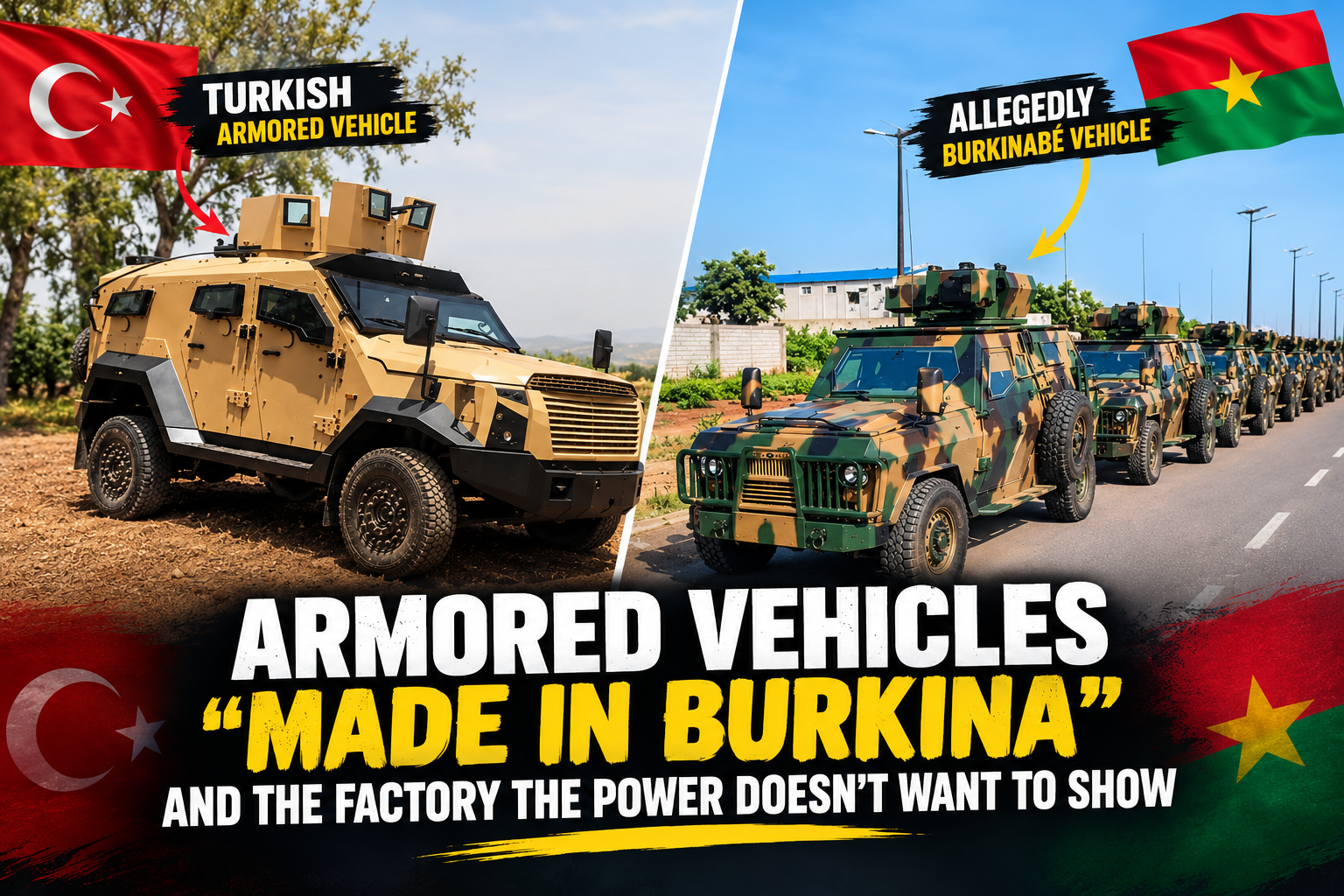
Burkina Faso’s Nanga armored vehicles: unraveling the truth behind the ‘made in Burkina’ claim
The Burkinabè government has hailed the Nanga armored vehicles as a milestone in the country’s military sovereignty. Yet beneath the bold announcements lies a persistent question: what is the real origin of these vehicles?
The official narrative: progress without transparency
In late September, coup leader Ibrahim Traoré declared that nearly 300 Nanga vehicles had been produced or modified locally since November 2025. He attributed their construction to Faso Armored, a Burkinabè enterprise operating under strict confidentiality for national security reasons.
While the vehicles themselves have been showcased, the industrial backbone of this supposed breakthrough remains invisible. Faso Armored has not been unveiled, nor have any verifiable details about its operations been disclosed. The catch? Military secrecy cannot justify the absence of concrete evidence that would substantiate the government’s claims.
The missing link: where are Faso Armored’s facilities?
An industrial program claiming to produce hundreds of armored vehicles in under a year would typically be accompanied by visible proof. Yet no public images or data exist to confirm Faso Armored’s location, production capacity, workforce, or even its existence outside official statements.
This raises further questions: if the goal is to demonstrate national capability, why deny visibility into the process? Transparency about infrastructure does not inherently compromise security. A controlled tour of a facility, for instance, could showcase assembly lines and basic operations without revealing sensitive technical details.
Turkish ties and the adaptation debate
From Ejder to Nanga: a potential rebirth?
Four years ago, Burkina Faso received four Nurol Ejder 6×6 armored vehicles from Turkey, manufactured by Nurol Makina. While there is no confirmed link between these vehicles and the Nanga models, their existence introduces a plausible scenario: Were the Nanga vehicles imported, modified, and rebranded as local products?
Officials describe the Nanga as vehicles with locally produced armored bodies and terrain-specific adaptations. However, the distinction between fabrication and adaptation is critical. If the core components engine, chassis, transmission originate abroad while only the body and minor adjustments are Burkinabè-made, the claim of full local production is misleading.
What defines a ‘made in Burkina’ vehicle?
The government defines the Nanga as a vehicle whose original structure has been replaced with locally built armor. Yet without independent verification of the vehicle’s composition, the term “made in Burkina” remains an unverified assertion. Key details remain unanswered:
What proportion of each Nanga is Burkinabè-made?
Where do the chassis, engines, and electronic systems come from?
What is Faso Armored’s production capacity, and how many vehicles roll off its lines monthly?
The double standard in military communication
This lack of transparency contrasts sharply with other defense initiatives. For example, TEXFORCES-BF, the factory producing uniforms for security forces, was officially inaugurated in Bobo-Dioulasso in September 2026. Its infrastructure, location, and investment were publicly documented.
Why the secrecy for Faso Armored? If the aim is to prove indigenous industrial progress, selective visibility only fuels skepticism. Without visual or documentary evidence, the “made in Burkina” claim risks being dismissed as mere political narrative rather than industrial reality.
Conclusion: a claim in search of proof
It is not yet possible to definitively conclude whether the Nanga vehicles are entirely Burkinabè-made, imported and modified, or a hybrid of both. What is clear, however, is that the current evidence official announcements, Turkish precedents, and the absence of an unveiled factory does not substantiate the claim of domestic production. Until Faso Armored’s operations are independently verified, the slogan “made in Burkina” remains a hopeful declaration rather than a demonstrated fact.
By Yacouba Ouédraogo — Investigative journalist
