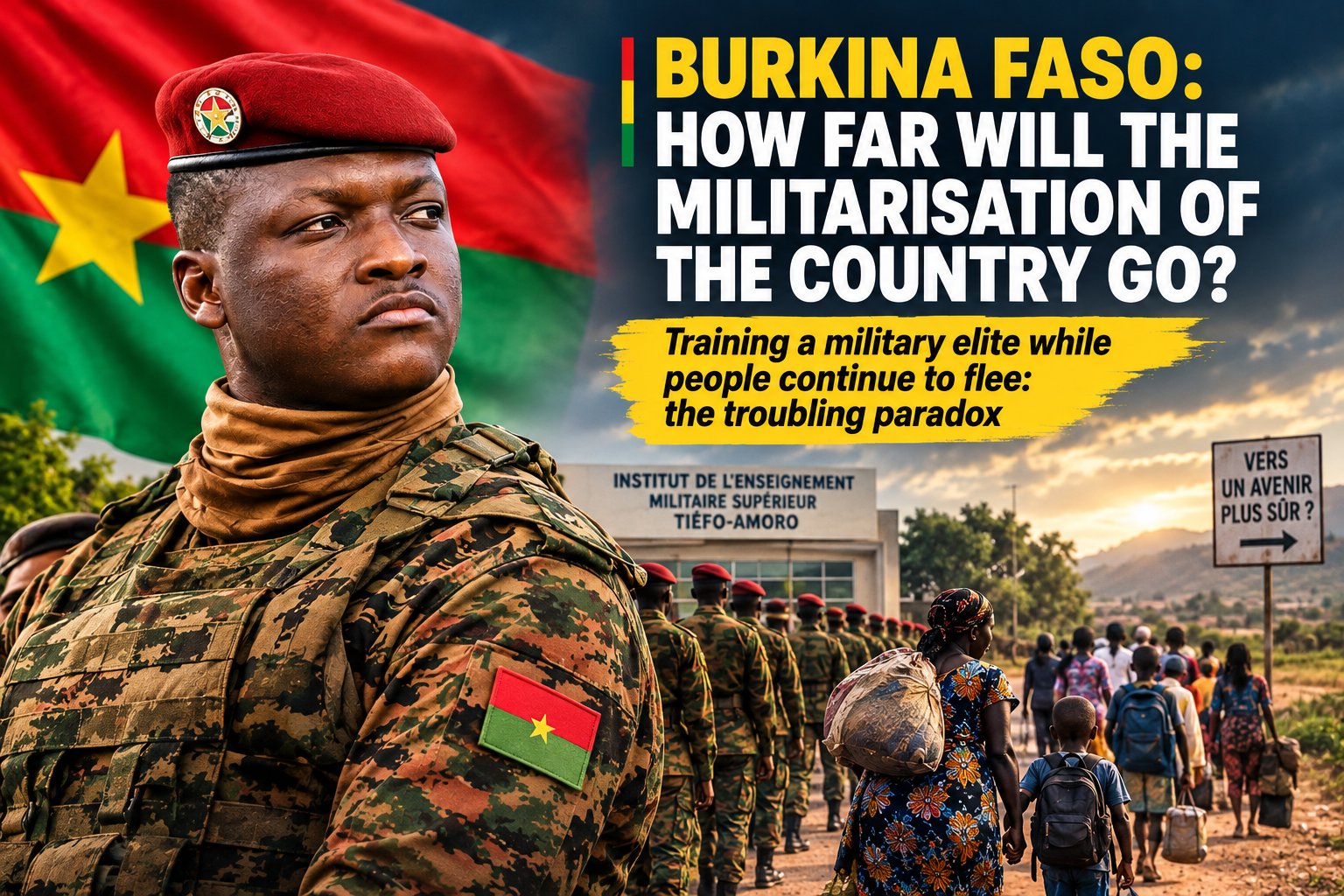
Burkina Faso’s military academy rise amid a nation in flight: a strategic gamble or a misplaced priority?
As Burkina Faso launches its first locally trained military officer corps, the nation remains trapped in a paradox: elite soldiers are being groomed for sovereignty while ordinary citizens flee for survival. The new Higher Military Training Institute (Tiéfo-Amoro) in Ouagadougou symbolizes the government’s push for self-reliance in defense yet its timing raises urgent questions about priorities.
With over 2.1 million internally displaced persons and more than 221,000 Burkinabè refugees fleeing abroad in 2025, the country’s crisis extends far beyond barracks and battlefields. The contradiction is stark: how can a nation claim strategic autonomy when its people still seek safety beyond its borders?
What the new military academy promises and what it cannot deliver
The Institut de l’Enseignement Militaire Supérieur Tiéfo-Amoro, inaugurated in 2025, marks a turning point in Burkina Faso’s defense strategy. The institute’s first cohort of 28 officers-in-training is being groomed not just in tactics and command, but in geopolitics and crisis management skills the government argues will reduce reliance on foreign military partnerships.
But formation alone does not translate to protection. While the academy aims to cultivate a homegrown officer elite, it does little to address the immediate security vacuum forcing civilians from their homes. The gap between military capability-building and the humanitarian emergency reveals a deeper dilemma: Is Burkina Faso investing in the right tools at the right moment?
A nation at war with itself?
President Ibrahim Traoré has framed the military’s expanded role as a pillar of national sovereignty. Yet the surge in displacement suggests that citizens see security differently. More than 82,000 Burkinabè refugees were registered in Côte d’Ivoire alone by mid-2026, a testament to a population that no longer trusts domestic safety.
This disconnect is not merely a policy failure it is a systemic one. When state investments prioritize elite training over grassroots stability, the message sent to civilians is clear: institutions are preparing for war, not peace.
The militarization paradox: when defense becomes the default solution
It is undeniable that Burkina Faso faces a security crisis demanding bold responses. Armed groups have destabilized swathes of the country, leaving villages abandoned and livelihoods shattered. In such a context, a stronger, locally minded military could be a strategic asset.
Yet the unchecked militarization of governance risks overshadowing the civilian pillars of recovery. An army cannot plant crops, reopen schools, or rebuild trust. When security institutions dominate the national agenda, the state risks trading long-term reconstruction for short-term firepower.
Critics warn that Burkina Faso is edging toward a model where military logic dictates national direction where the uniformed class sets the terms of governance, not the elected leadership. This shift from defense to a militarized statecraft could erode civil institutions, civilian oversight, and the very social fabric the country seeks to restore.
Sovereignty beyond the barracks
The government’s rhetoric of strategic autonomy hinges on reducing dependency on external actors. Training officers locally aligns with this vision. But sovereignty, in its fullest sense, demands more than a self-sufficient army it requires functional territories, resilient economies, and protected communities.
A sovereign Burkina Faso is one where farmers till their land without fear of attack. It is one where parents send their children to school without calculating the risk of violence. It is one where displacement is the exception, not the norm. Yet current displacement figures a record 2.1 million internally displaced suggest this reality remains distant.
The academy’s graduates may one day lead decisive battles. But today, displaced families are asking a far more pressing question: When will Burkina Faso restore the safety we were promised?
The ultimate test for Ibrahim Traoré’s leadership
President Traoré faces a defining challenge not whether his nation can train officers, but whether it can restore security in a way that stops the exodus. This demands a dual strategy: military progress must be matched by civilian recovery and humanitarian restoration.
The risk is real: a Burkina Faso where the military grows stronger while its people grow farther away. A nation that wins battles but loses its citizens. A state that achieves strategic autonomy in name, but sacrifices daily survival on the altar of war.
If this militarization wave is to succeed, it must serve the people it claims to protect not the other way around. The true measure of sovereignty will not be found in the number of uniforms, but in the number of families who choose to stay.
Until that happens, the paradox remains: Burkina Faso is arming for the future, but its people are still running from it.
By Maimouna Kaboré — Editor-in-Chief
