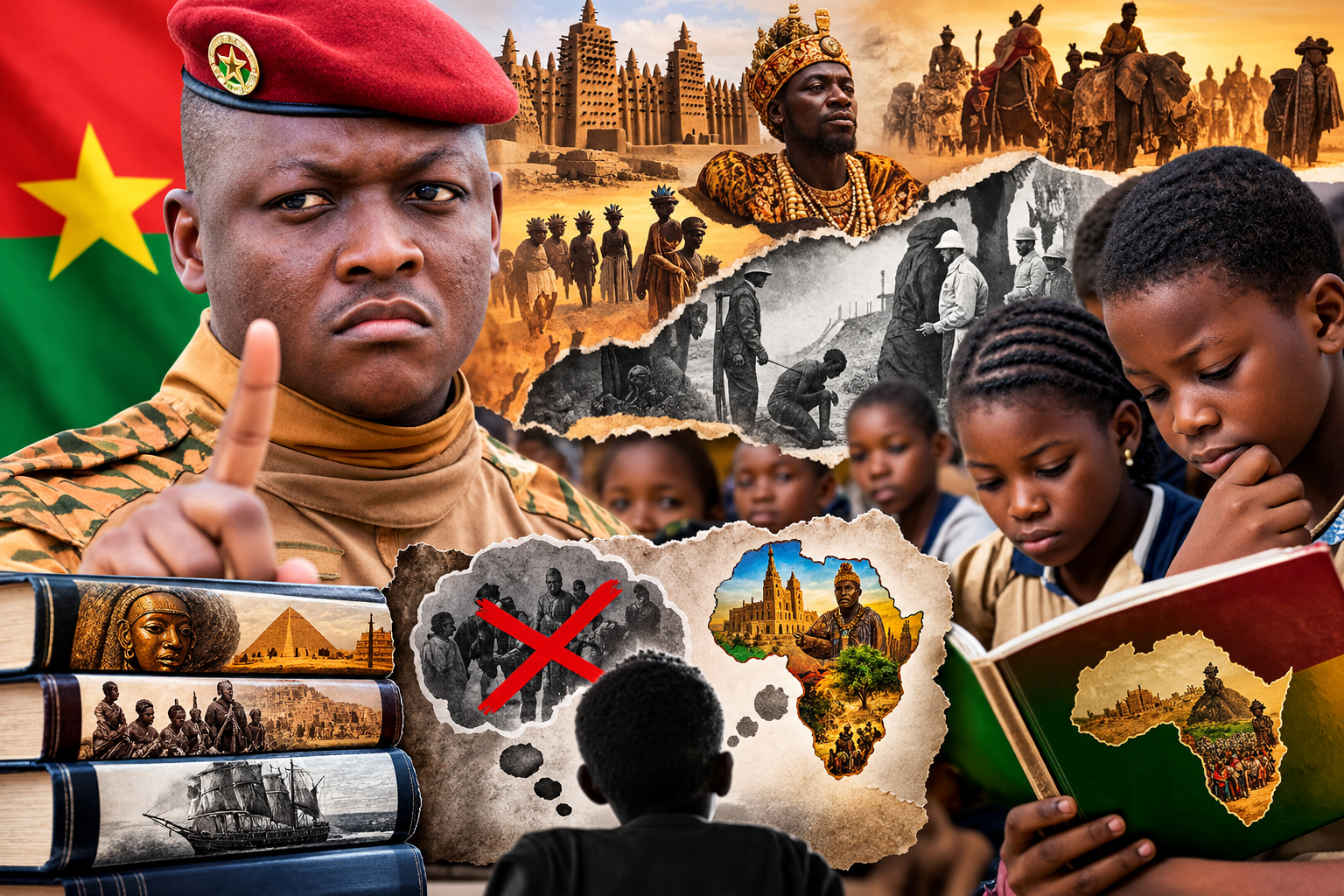
Burkina Faso’s history education reform: the dangers of partial memory in school curricula
Burkina Faso is overhauling its history-geography curriculum with the stated goal of ‘decolonizing’ school textbooks. While this initiative raises valid concerns about the representation of African history in education, it also demands a critical question: rewriting curricula must not trap future generations in a narrow interpretation of their own past.
Beyond colonial narratives: the need for a comprehensive historical education
The history of a nation cannot be reduced to colonization, its associated suffering, or conflicts with Western powers. It is also shaped by civilizations, empires, kingdoms, trade networks, discoveries, social transformations, and intercultural exchanges. Teaching this history to young learners requires a balanced approach one that acknowledges past injustices without confining collective memory to a single narrative.
The risk of framing this reform primarily as a corrective to historical wrongs is that it may lead to a new form of ideological distortion. While school programs can highlight colonial injustices, restore the legacy of African resistance, and recognize long-marginalized figures, they cannot alter the course of history or retroactively heal the wounds of the past.
The paradox of ideological reform: when liberation becomes limitation
If the objective is to foster critical thinking, history education must avoid becoming a tool that restricts knowledge under a new ideological lens. A generation educated on a partial version of the past no matter how well-intentioned will inherit a fragmented understanding of their heritage. The true challenge lies in presenting a complete historical picture, one that neither glorifies nor vilifies any single group but fosters a nuanced perspective.
Learning from regional models: what balance looks like
Neighboring Côte d’Ivoire offers a case study in balanced history education. An effective curriculum should not only highlight national achievements and African empires but also place the country’s history within a broader global context. Understanding one’s own nation does not mean ignoring the rest of the world rather, it requires situating local history within the wider tapestry of human events.
This approach enables students to grasp the power dynamics, exchanges, and events that have shaped modern societies. The goal is not to copy another nation’s model but to uphold a core principle: history should illuminate, not impose; explain, not oppose; and transmit, not restrict.
Deconstructing myths: the peril of substituting one narrative for another
Decolonizing education can serve a meaningful purpose by correcting omissions, restoring overlooked facts, and restoring African civilizations to their rightful place in the historical record. However, this effort loses its value if it merely replaces one singular narrative with another. Students must be able to study the crimes of colonization without being denied the complexity of European societies and equally, they must explore African civilizations without erasing their contradictions, conflicts, or evolution.
Knowing the injustices suffered by one’s ancestors is only part of understanding history. True knowledge requires examining how these injustices occurred, why they were possible, who bore responsibility, and most importantly what lessons can be learned for the future.
The ultimate question: what kind of historical memory do we pass on?
The defining question for Burkina Faso is not whether to reform its history education, but how to do so responsibly. Will the new curriculum perpetuate a cycle of confrontation with the past, or will it empower students with the intellectual tools to analyze, debate, and build upon that past?
History cannot be repaired by hiding certain pages from future generations. Instead, it must be taught in full with all its complexities, contradictions, and lessons. Only then can Burkina Faso’s school reform cultivate informed citizens who know their roots while remaining connected to the wider world.
By Maimouna Kaboré — Journalist
