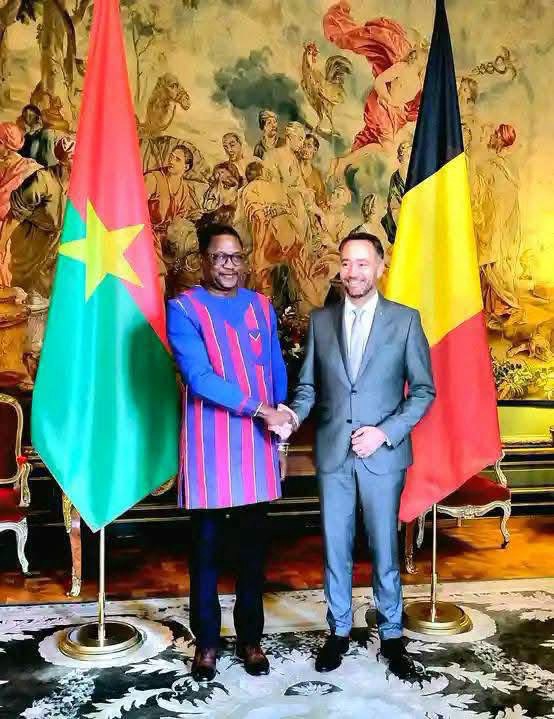
Burkina Faso’s financial struggle: Brussels replaces Moscow as junta seeks funds
Ouagadougou’s diplomatic shift back to Europe underscores a stark reality: despite anti-Western rhetoric, Burkina Faso remains critically dependent on external funding to sustain its economy and security priorities.
From Moscow’s promises to Brussels’ euros
The junta’s recent high-level meetings in Brussels, including talks with EU High Representative Kaja Kallas and Belgian Foreign Minister Maxime Prévot on November 4-5, 2026, signal a pragmatic return to European partnerships. This follows months of touting Russia as Burkina Faso’s economic and security savior at the Russia-Africa Economic and Humanitarian Forum in Moscow.
Yet the stark contrast between diplomatic announcements and actual financial flows is becoming impossible to ignore. While Ouagadougou framed Russia as a replacement for Western aid, Moscow’s commitments have so far failed to materialize into tangible funding leaving a critical gap in Burkina Faso’s budget.
What Moscow’s agreements really delivered
During the Moscow forum, Burkina Faso signed a memorandum of understanding with Russia’s VEB.RF bank and the Confederal Investment and Development Bank of the AES. However, such agreements are frameworks not immediate cash injections. They outline cooperative intentions rather than deliver hard currency.
For a country facing a 2026 budget deficit of 486.8 billion FCFA (3.9 trillion FCFA in expenses vs. 3.4 trillion FCFA in revenue), the absence of concrete Russian financial support forces a return to the negotiating table with Brussels.
Europe’s renewed role in Ouagadougou’s calculus
Belgium’s announcement of €40 million in post-2027 development aid through Enabel, its international cooperation agency, highlights Europe’s enduring importance. The funds, though modest, reflect a reality few in Burkina Faso’s government can ignore: no single partner, Russian or otherwise, can replace the financial systems that have supported the country for decades.
Why sovereignty can’t be funded on empty promises
The junta’s public rejection of Western influence clashes sharply with its private reliance on European institutions. While state media amplifies anti-Western narratives, officials quietly pursue funding deals that contradict their own rhetoric.
This inconsistency raises pressing questions: If Moscow remains Burkina Faso’s preferred partner, where are the signed contracts, disbursed funds, and operational projects? If Europe is indispensable, why frame it as an enemy?
The cost of ideological posturing
Burkina Faso’s financial strain with a projected 4% GDP deficit in 2026 demands solutions, not slogans. Development requires investment, not just declarations. The junta’s inability to secure tangible support from Russia, despite repeated assurances, has left Ouagadougou with little choice but to seek Brussels’ assistance.
What comes next for Burkina Faso’s partners?
Diplomatic meetings in Belgium are more than symbolic gestures. They represent a return to practical collaboration, with discussions focusing on debt relief, infrastructure financing, and humanitarian aid. The junta’s future credibility may hinge less on its anti-Western speeches and more on its ability to deliver results.
As Burkina Faso’s leaders face mounting economic pressures, the gap between their stated goals and ground realities grows harder to ignore. For the Burkinabè people, the question is simple: Where are the promised funds from Russia? And why is Europe still writing the checks?
By Maimouna Kaboré — Journalist
