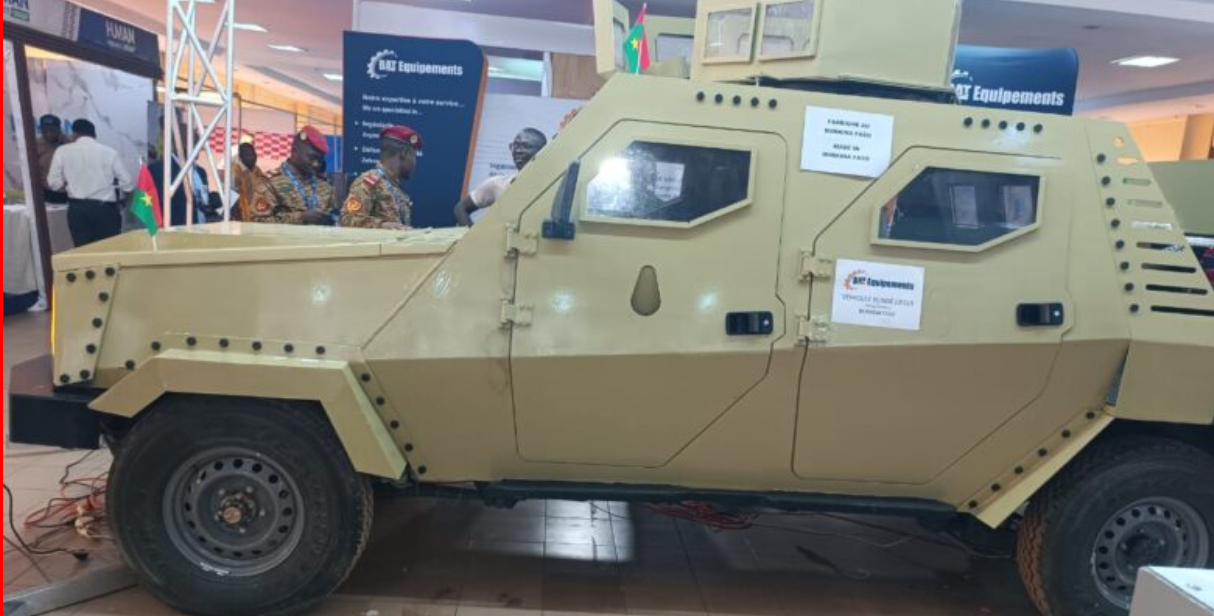
Burkina Faso’s Faso Armored deception: how Traoré’s armored vehicle claim masks military failure
When Burkina Faso’s junta leader, Captain Ibrahim Traoré, declared in September 2026 that nearly 300 armored vehicles had been locally produced under the Faso Armored initiative, the announcement was framed not as a triumph of national industry, but as a deliberate political smokescreen. Beneath the bold claims of “Made in Burkina” lies a reality that contradicts every assertion made by the regime.
The staged illusion of a defense industry
The spectacle unfolded during a public appearance on September 21, 2026, when Traoré unveiled the supposed milestone to participants of the Hakili Mousso women’s science competition. He credited Faso Armored—a supposedly homegrown defense enterprise—with manufacturing these armored vehicles for the nation’s beleaguered security forces. Yet no evidence of industrial infrastructure, factories, or production lines exists anywhere in the country.
The regime hides behind claims of “state secrecy” to obscure the absence of even basic engineering capacity to produce chassis, engines, transmissions, or armored steel. Faso Armored is not an industry—it is a hollow facade deployed to disguise a far-reaching campaign of disinformation aimed at deflecting attention from the nation’s growing insecurity.
From trash to tanks: the truth behind Faso Armored’s vehicles
Field investigations reveal that the so-called armored vehicles are nothing more than hastily assembled contraptions. Contrary to official propaganda, no new vehicles have been produced. Instead, the regime has disassembled decommissioned Casspir armored personnel carriers—heavy vehicles originally sourced from apartheid-era South Africa—and repurposed their salvaged armor plating.
These remnants of corroded metal, stripped from decades-old military hardware, are being welded onto civilian Toyota Land Cruisers and pick-up trucks. The resulting hybrid vehicles, presented as cutting-edge armored platforms, are merely hollow shells reinforced with scrap metal—posing no meaningful defense against improvised explosives or heavy weaponry.
The pattern of manufactured national pride
This deception is not an isolated incident but part of a long-standing strategy by the Traoré regime to fabricate symbols of national achievement. The pattern has been consistently applied across various sectors, including the infamous “Made in Burkina” vehicles branded ITAOUA. These were later exposed as rebranded Dongfeng models imported from China, re-stickered with local logos to create an illusion of domestic innovation.
Military equipment purchased from foreign partners—particularly from China—is routinely re-labeled and presented as domestically engineered. Faso Armored represents the latest iteration of this method: repackaging imported or obsolete hardware to construct a false narrative of self-reliance and technological progress.
Military theater over strategic substance
The regime’s fixation on image over substance is glaring. As Burkinabè communities face daily attacks by armed groups, with civilians bearing the brunt of violence and displacement, Ibrahim Traoré diverts attention by spotlighting Faso Armored. The reality on the battlefield remains unchanged: these jury-rigged vehicles offer minimal protection and do not enhance operational capacity.
Soldiers and civilian volunteers are left exposed to improvised explosive devices and heavy firepower, while the junta invests in visual propaganda rather than tangible security solutions. This strategy prioritizes domestic perception over military effectiveness and human lives.
The fragile myth of sovereign defense
The figure of 300 armored vehicles is a rhetorical device, not a strategic achievement. By elevating “Made in Burkina” to an unassailable political dogma, the regime weaponizes patriotism to stifle dissent and avoid accountability.
Sovereignty cannot be manufactured in speeches or conjured from recycled scrap. Traoré’s government has turned factual distortion into a governing principle, trapping Burkina Faso in a perilous illusion—one that neither protects its citizens nor addresses the urgent demands of national security.
