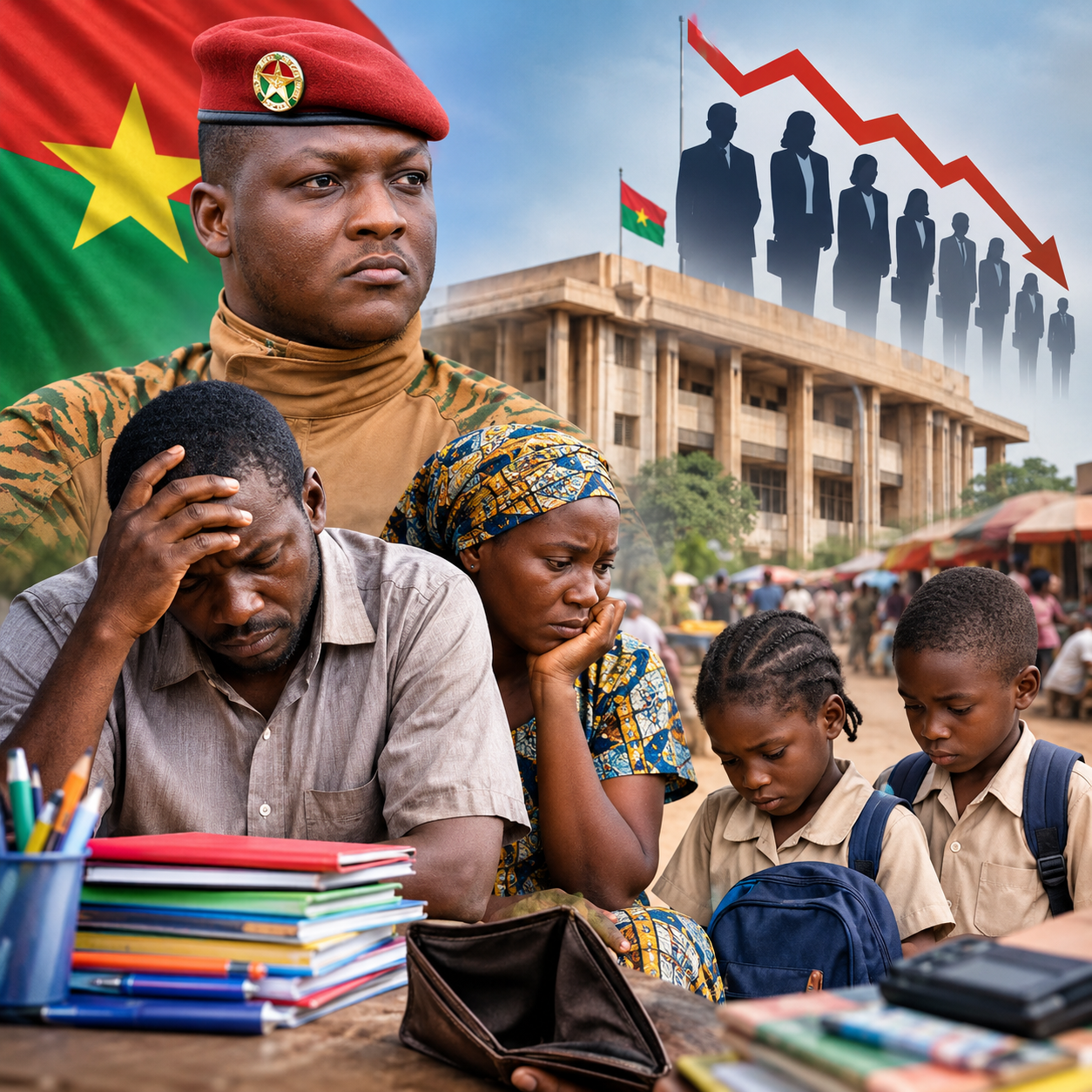
Burkina Faso’s civil service downsizing: the hidden human cost behind shrinking payrolls
The start of the new academic year in Burkina Faso has cast a stark spotlight on the nation’s unfolding public sector workforce crisis. Over the past four years, the number of state-paid civil servants has steadily declined from 204,310 in 2021 to 202,393 in 2025 equivalent to a net loss of 1,917 positions.
This contraction isn’t merely a statistical shift. It represents millions of hours of lost labor, reduced state capacity, and, most critically, the destabilization of countless households that rely on public sector incomes for survival. Among the 202,393 civil servants still on the payroll in 2025, the workforce remains predominantly male (140,438) with women comprising nearly a third (61,955), though both groups face the same underlying risk: economic precarity.
From stable salaries to financial instability: the ripple effect of workforce reductions
In many Burkinabè families, a single civil service position is not just an employment contract it is the backbone of household stability. Public sector salaries often fund children’s education, rent, food, and basic healthcare. When a parent, guardian, or family member loses such an income, the impact cascades through every aspect of daily life.
With school fees, uniforms, and supplies due at the start of each academic year, even a temporary gap in income can force parents to make painful compromises. Some may delay or forgo necessary purchases. Others may take on debt or seek informal work often in sectors with little protection or long-term viability. These choices are not abstract financial decisions; they shape children’s futures and determine whether families can sustain their livelihoods through the academic year.
Policy choices, public sector health, and the unspoken social contract
The trajectory of Burkina Faso’s civil service workforce did not emerge in a vacuum. Since assuming leadership, Ibrahim Traoré’s administration has emphasized national sovereignty, self-reliance, and systemic transformation. Yet beneath the speeches and policy frameworks lies a pressing social question: how many households can still depend on a stable public-sector income amid ongoing restructuring?
While the exact causes of the workforce reduction retirements, hiring freezes, non-renewals, administrative restructuring, or targeted redundancies remain under scrutiny, one reality is undeniable: the people affected are not numbers on a ledger. They are mothers, fathers, breadwinners, and educators whose absence from the formal economy reverberates through schools, markets, and homes across the country.
The broader economic footprint of public employment loss
Public sector jobs in Burkina Faso do more than provide individual livelihoods. They anchor local economies. When a civil servant receives a salary, a portion is spent on goods and services in their community markets, transport, utilities, and schools benefit. The loss of 1,917 such positions represents not only 1,917 families under pressure, but also a corresponding drop in consumer demand, business revenue, and tax receipts.
This phenomenon extends beyond urban centers. In rural areas, where public sector positions are often the most reliable source of income, the impact is immediate and severe. Teachers, health workers, and administrative staff aren’t just employees they are pillars of community resilience. When they disappear, so does much of the infrastructure that supports education, health, and public order.
A call for transparency and household-centered governance
The true test of Burkina Faso’s leadership will not be measured in policy announcements or budget reallocations alone. It will be judged by the resilience of its families. Can the state ensure that administrative downsizing does not translate into social upheaval? Can households weather the loss of steady income without falling into deeper poverty?
As the academic year begins, the government faces a dual imperative: to justify the strategic logic behind workforce reductions while demonstrating a sustained commitment to protecting the most vulnerable from their unintended consequences. The numbers tell one story. The lived experiences of Burkinabè families tell another. The challenge now is to bridge the gap between policy and people before the cost of stabilization becomes too steep for households to bear.
By Maimouna Kaboré — Editor-in-Chief
