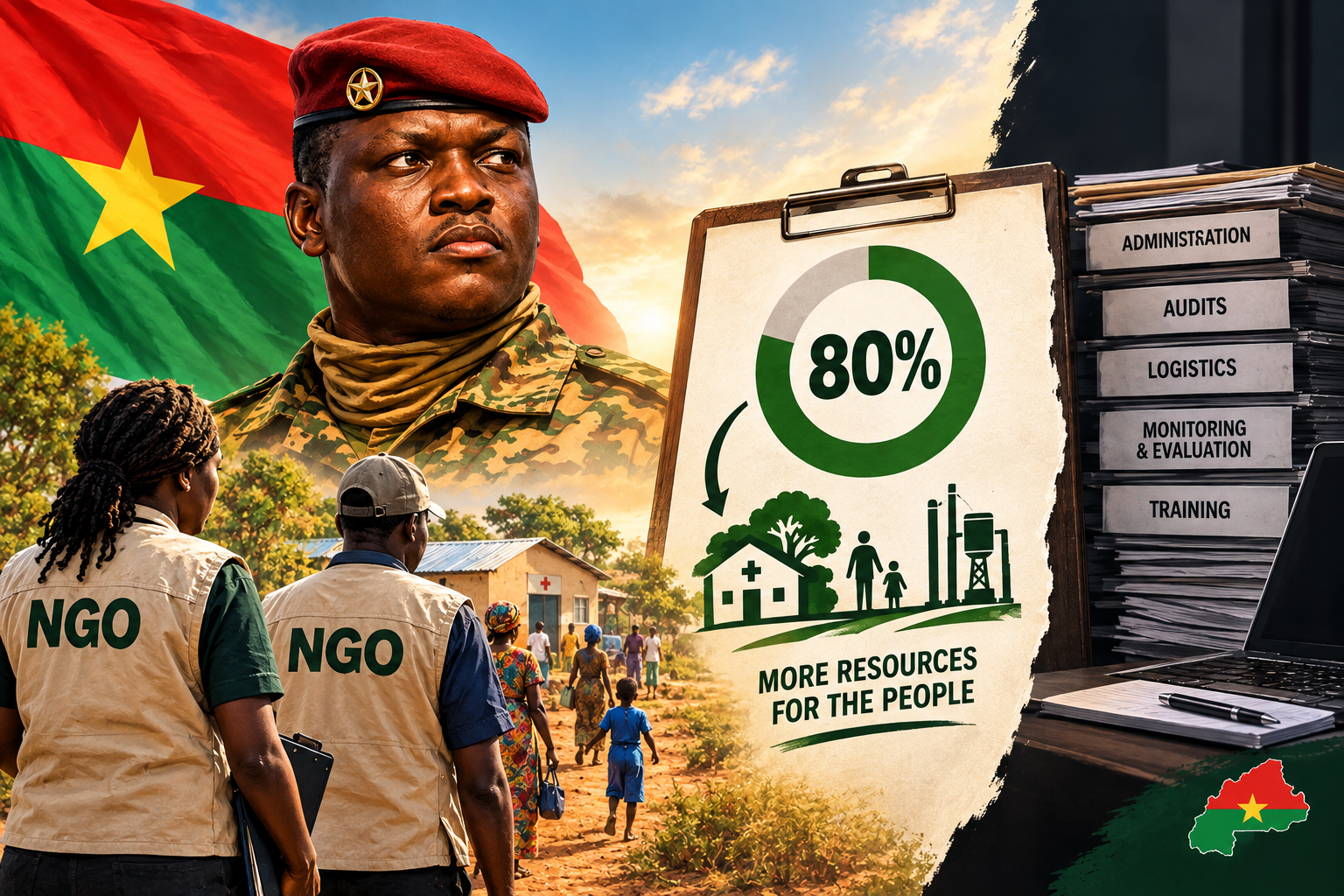
Burkina Faso’s 80% NGO funding rule: behind the scenes of a debated policy shift
The Burkinabè government has framed its new NGO regulations as a bold move toward transparency and operational efficiency. Enacted on September 24, 2026, under Captain Ibrahim Traoré’s leadership, the policy mandates that non-governmental organizations must allocate at least 80% of their funding to direct field-based expenditures. At first glance, the directive appears straightforward: curbing administrative overhead to redirect more resources toward tangible humanitarian efforts.
The limits of a numerical threshold
While the 80% rule may seem like a simple metric, its underlying assumptions oversimplify the complex realities of NGO operations. Not all funding allocations can or should be measured by their immediate visibility. Administrative costs, though less tangible, are often critical to project success. Salaries for auditors, logistics coordinators, and project managers may not build hospitals or feed communities, but they prevent fraud, ensure timely delivery of supplies, and maintain accountability functions that are essential to sustainable aid.
Deciphering ‘direct field investment’
Ambiguity lingers around what constitutes ‘direct field investment’ under the new regulation. For instance, should the salary of a nurse working in a rural clinic count toward the 80% threshold? What about the cost of maintaining medical equipment, transporting supplies, or training local staff? Without clear definitions, NGOs face the risk of misclassifying expenditures or inadvertently prioritizing easily quantifiable expenses over equally vital ones.
The government must provide explicit guidelines to prevent inconsistencies that could undermine both compliance and aid effectiveness.
One rule for all: a flawed approach
Not all NGOs operate under the same model. Organizations focused on infrastructure development, education, or healthcare delivery will naturally have higher material costs, while those in advocacy, legal aid, or social protection may invest more in human capacity. Enforcing a uniform 80% spending rule risks penalizing mission-driven organizations whose work may not manifest in bricks and mortar or equipment.
Effectiveness cannot be reduced to a single percentage. A project’s true value lies in its impact: the number of beneficiaries reached, the quality of services delivered, the longevity of outcomes, and the cost efficiency of interventions. Disrupting these delicate balances could have unintended consequences for communities in need.
The unintended consequences of rigid compliance
Pressure to meet the 80% threshold might drive organizations to artificially inflate their field expenditures by trimming essential support functions. For example, reducing audit budgets or downsizing administrative teams could create gaps in oversight, leaving projects vulnerable to mismanagement or corruption. Conversely, NGOs may over-report ‘direct’ costs by prioritizing easily verifiable expenses such as construction or direct aid distribution over less visible but equally important activities like community engagement or long-term capacity building.
In either scenario, the rule risks prioritizing compliance over genuine results.
Transparency beyond percentages
If the government’s intent is to enhance accountability and not merely enforce a bureaucratic metric there are more effective tools at its disposal. Independent audits, transparent financial reporting, rigorous project evaluations, and targeted sanctions for misuse of funds can ensure that resources are used as intended. These mechanisms directly address the risks of misallocation without imposing arbitrary spending ratios.
Will the rule deliver on its promises?
Transparency and efficiency are undeniably critical in humanitarian work, and the Burkinabè government is justified in seeking greater oversight of NGO operations. However, a numerical rule alone does not guarantee improved outcomes. The real test will lie in whether this policy translates into tangible benefits for populations or merely compels organizations to restructure budgets to meet an administrative requirement.
Ultimately, the success of this measure will be determined not by the percentage itself, but by its impact on the ground. For in the world of NGOs, some of the most vital expenditures are those that never appear in the final report invisible to auditors, yet indispensable to saving lives.
By Yacouba Ouédraogo — Investigative journalist
