Burkina Faso’s 104 billion CFA electricity bet meets a wall of unpaid bills
A 104 billion CFA push to widen access to electricity
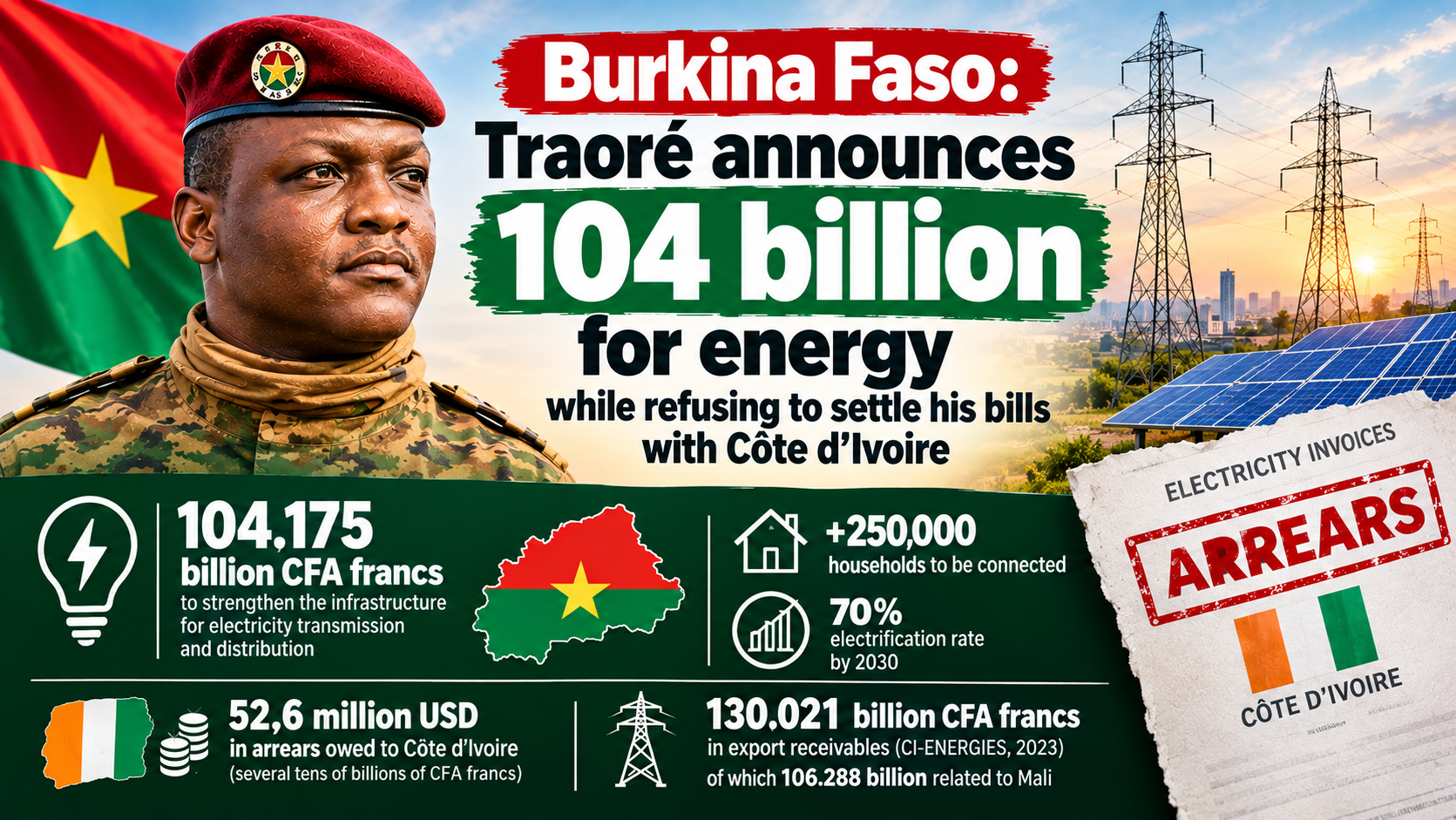
The authorities in Burkina Faso have approved a 104.175 billion CFA franc programme intended to accelerate the country’s electrification. The funding is meant to reinforce electricity transmission and distribution infrastructure, extend service to households still off the grid and raise the national coverage rate. It sits within the framework of the national energy pact and the RELANCE 2026-2030 plan.
On the surface, the figure is impressive enough to win attention. The thornier question lies just beneath it: with what resources, and with what financial credibility, does Ouagadougou intend to bankroll this fresh energy ambition?
250,000 Households and a 70 % objective for 2030
The programme’s headline targets are clear. More than 250,000 homes are to be connected, while the share of the population with access to electricity is to climb to 70 % by the end of the decade. Those goals are written into the national energy pact, which also commits the state to improving the financial health of the sector and to attracting investment at scale.
Unpaid bills to Côte d’Ivoire cast a shadow
The cost of new cables, substations and connections is only one part of the equation. Burkina Faso is simultaneously carrying obligations contracted earlier. Its balance sheet is not starting from zero.
52.6 Million dollars in outstanding arrears
The International Monetary Fund’s latest assessment of the country records 52.6 million dollars in arrears owed to Côte d’Ivoire — a sum equivalent to several tens of billions of CFA francs. The Fund treats these amounts as inherited external arrears, rather than narrowing them down to the sole question of electricity imports.
That nuance carries weight. It does not, however, dissolve the underlying problem: a state that promotes energy sovereignty as a strategic objective must also be in a position to honour its financial undertakings towards its partners.
Export receivables weigh on Côte d’Ivoire’s power sector
Côte d’Ivoire has for years occupied a pivotal place in the regional electricity trade. Material from the African Development Bank highlights payment arrears run up by electricity-importing countries, which strain the financial equilibrium of the Ivorian sector. In 2023, the export receivables owed to CI-ENERGIES reached 130.021 billion CFA francs, of which 106.288 billion were tied to Mali.
Against that backdrop of regional tension, the issue is no longer the publicity value of an announcement but the discipline behind the accounts.
Sovereignty built on plants, grids and settled invoices
Promising more than 104 billion to bring power to more people may be legitimate, and even necessary. Yet energy sovereignty is not decreed by speeches. It is assembled from generating plants, networks, capital spending, suppliers who are actually paid, and public finances sturdy enough to sustain the policy being announced.
Here the official narrative invites scrutiny. Burkina Faso now presents the reduction of its energy dependence as a strategic priority, and its own national energy pact foresees both a more financially viable sector and a large-scale mobilisation of investment.
The test awaiting the promised billions
The genuine difficulty is therefore not the pledge of 104 billion. It is proving that the money will be raised, that the infrastructure will materialise, and that the liabilities already accumulated will be settled.
Lasting energy sovereignty cannot rest on a multiplying stack of announcements. It also demands the trust of partners, the solidity of the public treasury and respect for contractual commitments.
What real energy independence will require
By casting every new financing package as further evidence of independence, Ibrahim Traoré’s government risks concealing a fundamental contradiction: no country can claim to be building energy autonomy while leaving behind arrears that weaken ties with the states whose electricity and regional infrastructure still help keep its own system running.
True energy sovereignty will begin the day Burkina Faso produces more, relies less on imports and, above all, pays its bills and meets its obligations. Only under that condition will the billions announced become something other than a political promise — a genuinely durable energy policy.
