Burkina Faso: the true price of sovereignty on credit
Since Captain Ibrahim Traoré took power, an official narrative has steadily taken hold: that of a Burkina Faso which has reclaimed command of its own destiny, trimmed its reliance on foreign partners and resolved to bankroll its war against armed groups from its own pocket.
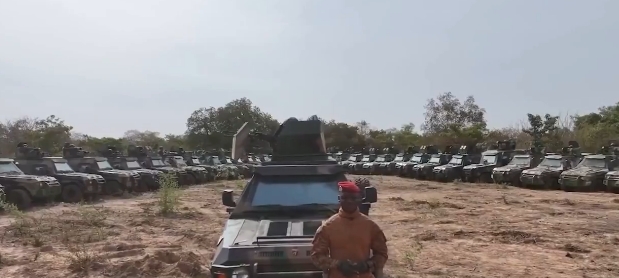
As political messaging, it works. Rearmament is cast as sovereignty made tangible. Military acquisitions are showcased, the patriotic support fund is presented as proof of a collective national effort, and appeals for citizen contributions serve to demonstrate that the country counts first and foremost on its own resources.
Yet a far less ideological question lingers: what does this sovereignty actually cost, and who ends up carrying the bill?
Defence budgets: a change of scale
The budget figures already capture the shift in magnitude.
Spending on defence and security, which stood at roughly 95 billion CFA francs in 2016, has since climbed into the hundreds of billions, surpassing 800 billion in 2024 depending on the budgetary perimeter applied.
The trajectory is considerable. It reflects an unambiguous political priority: in a country gripped by a major security crisis, the state now devotes a far larger share of its resources to the army, the security forces, equipment and the war effort.
But a rise of that magnitude cannot be read purely in military terms. Every additional billion directed towards security is also a billion that has to be found elsewhere.
And that is precisely where the sovereignty narrative deserves to be tested against financial mechanics.
What the patriotic fund does and does not cover
The patriotic support fund stands as one of the central emblems of the strategy.
Contributions have reached substantial sums since its creation: close to 99 billion CFA francs in its first year, around 175 billion in 2024 and more than 200 billion according to the figures released for 2025.
It would therefore be unfair to dismiss the scale of the national mobilisation.
But another illusion must be avoided: the fund does not, on its own, represent the entirety of the war’s financing.
The state budget remains the primary vehicle for funding public policy. Military expenditure is thus also fed by tax revenue, ordinary state resources and, whenever receipts fall short, by borrowing.
To put it differently: contributing voluntarily to the war effort does not mean the war is financed without debt.
The changing face of public debt
This is where the discussion becomes more interesting.
Burkinabè public debt has risen sharply since 2021, now exceeding 8,000 billion CFA francs based on the data and projections available for recent years.
A significant share is now raised on the UEMOA regional market, notably through the issuance of government securities.
This allows Burkina Faso to diversify its funding sources and to lessen certain dependencies on external creditors.
Yet debt contracted on the regional market remains debt.
Whether it is held by a bank, an institutional investor or another financial player in the region does not alter its economic nature: the state borrows today and will have to repay tomorrow, with interest.
That is where the sovereignty messaging reaches its limits.
One may perfectly well defend the choice to favour domestic financing. One may also consider borrowing on the regional market preferable to certain forms of external dependency.
But presenting that mechanism as the disappearance of financial dependency would be misleading.
The mechanical effect of repayment
A less spectacular but far more enduring risk also exists: debt servicing.
Every loan taken today creates an obligation for the years ahead. When interest rates are high and investment needs remain substantial, the government must devote more resources to meeting its maturities.
The mechanism is straightforward: the more the state borrows, the more of its future revenue it must set aside for its creditors.
The problem is not necessarily indebtedness itself. Every modern state borrows.
The question is rather whether spending financed by debt generates enough economic and social returns for the country to bear the burden later on.
For military spending, the equation is even more delicate: equipment may be essential to national security, but it does not necessarily generate revenue capable of repaying the loan that paid for it.
Where does the public money actually go?
The issue is not whether Burkina Faso has the right to rearm. It plainly does.
The issue is establishing the cost of that rearmament across the whole of public finances.
When a growing share of resources is channelled towards security, the government must arbitrate between competing priorities: defence, education, health, infrastructure, agriculture, social protection and debt repayment.
Such trade-offs are rarely visible in political speeches.
Yet they are the real test of economic sovereignty.
A state can buy more weapons while remaining financially fragile. It can scale back certain foreign military partnerships while increasing its reliance on borrowing. It can mobilise patriotic contributions while dedicating a growing portion of future revenue to servicing its debt.
Diplomatic rupture therefore does not automatically mean financial rupture.
Sorting credible figures from viral claims
Certain assertions circulating on social media also need to be set straight.
Talk of a military debt of “hundreds of billions of dollars” is incompatible with the size of Burkina Faso’s economy.
The country’s GDP sits in a range of a few tens of billions of dollars, not hundreds of billions. A military debt of several hundred billion dollars would far exceed the economic capacity of the country.
Reality is already significant enough that it needs no exaggeration.
What is at stake is hundreds of billions of CFA francs, not hundreds of billions of dollars.
That distinction matters for any serious analysis.
Military autonomy, economic exposure
Here lies the full contradiction revealed by the Burkinabè model.
The authorities claim strategic autonomy: new partners, diversified alliances, national mobilisation and a reduction of certain traditional partnerships.
In parallel, however, the economy continues to operate with the classic instruments of public financing: taxation, domestic debt, the regional market, multilateral creditors and economic cooperation.
This is not an exceptional contradiction. It is the normal functioning of a state facing limited resources and enormous security needs.
Difficulty begins when political communication converts that financial reality into a narrative of absolute self-sufficiency.
The paradox of sovereignty on credit
Burkina Faso can therefore legitimately claim political and military sovereignty while remaining an indebted state.
But that reality forces a more demanding question: how far can war financing go without weakening the state’s other functions?
Sovereignty is not measured solely by the number of armoured vehicles, drones or weapons acquired.
It is also measured by the capacity to pay civil servants, invest in education and health, fund infrastructure, support the productive economy and, above all, repay the loans contracted in the name of the community.
The real issue is not to deny the efforts made by the Burkinabè authorities. It is to look behind the narrative.
- Who pays?
- How much?
- With what resources?
- And for how long?
If a substantial part of the rearmament rests on public revenue, national contributions and borrowing, then the proclaimed sovereignty is not a sovereignty without cost.
It is a sovereignty financed by taxpayers, savers, financial markets and future generations.
And that is precisely why the phrase “sovereignty on credit” deserves to be posed as a question rather than adopted as a slogan.
Political independence can be proclaimed in a handful of speeches. Financial independence, by contrast, is verified in the accounts.
