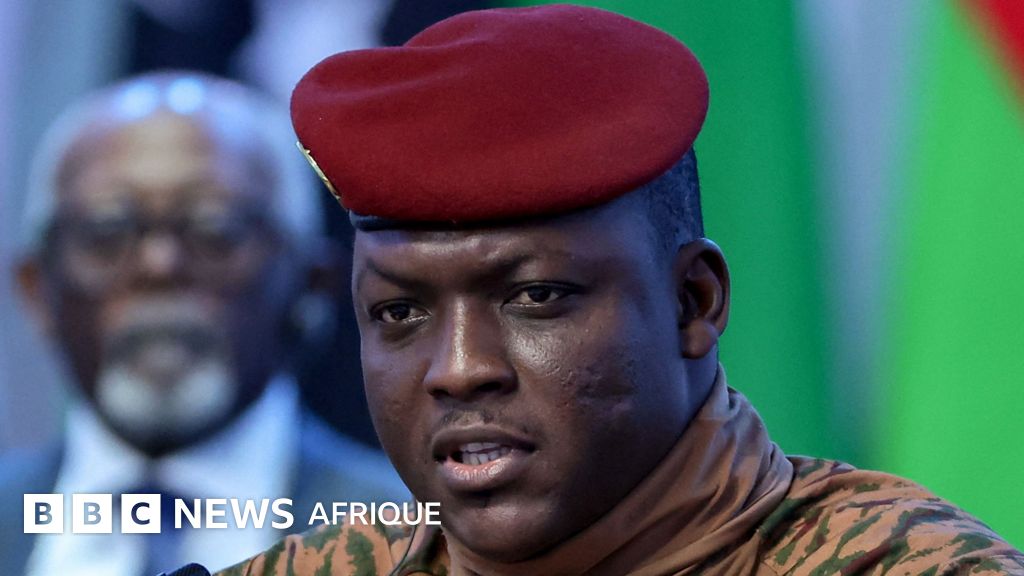
Burkina Faso military leader rejects democracy in new interview
The military leader of Burkina Faso has declared that the nation must abandon democratic governance, calling it incompatible with the country’s needs. Speaking in a televised interview, Captain Ibrahim Traoré, who seized power three years ago, argued that the West African nation requires an entirely different system to address its unique challenges.
Traoré, 38, who presents himself as a revolutionary leader opposing Western imperialism, stated bluntly: « The people must forget about democracy. Democracy is not for us. » His comments came during a prime-time broadcast on national television, where he outlined his vision for Burkina Faso’s future.
Once promising to restore civilian rule by July 2024, Traoré has since extended his military leadership by five years. Earlier this year, his government banned all political parties as part of what it describes as an effort to « rebuild the state. »
The military leader drew a parallel with Libya, suggesting that Western-backed interventions have historically destabilized African nations. « Look at Libya – it’s a close example to us, » he remarked, referencing the country’s prolonged instability following the fall of Muammar Gaddafi’s regime in 2011.
Traoré’s government has faced criticism for suppressing dissent, with opposition figures, media outlets, and civil society groups reportedly targeted. Human rights organizations have also raised alarms over the treatment of detractors, including reports of opponents being sent to frontline positions in the fight against Islamist militants.
The junta’s rhetoric has resonated with some panafricanist movements across the continent, particularly those critical of Western influence. Burkina Faso, along with neighboring juntas in Mali and Niger, has distanced itself from Western partners—especially France—in its battle against Islamist insurgencies that have plagued the Sahel region for over a decade.
Instead, Traoré has turned to Russia for military support, though violence in the region continues unabated. According to recent data, over 1,800 civilians have been killed in Burkina Faso since Traoré assumed power in 2023, with human rights groups attributing two-thirds of these deaths to state forces and allied militias.
In his interview, Traoré dismissed political parties as divisive and incompatible with his revolutionary project, describing traditional politicians as « liars, flatterers, and charlatans. » He emphasized that Burkina Faso would forge its own path, free from foreign influence, focusing on sovereignty, patriotism, and grassroots mobilization.
The military leader also stressed the need for economic and military self-reliance, arguing that Burkina Faso cannot progress with traditional work schedules of six to eight hours per day. « Hard work is essential, » he asserted, positioning his government as a champion of transformative change.
Despite the ongoing violence and international scrutiny, Traoré’s administration continues to garner support from segments of the population who view his stance against Western interference as a symbol of national pride and resilience.
