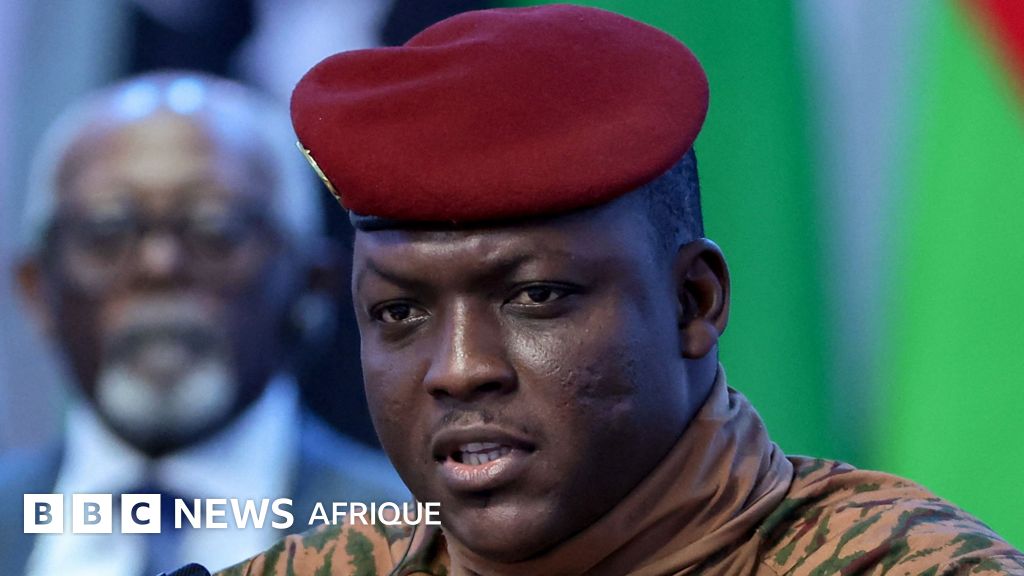
Burkina Faso leader rejects democracy as path to stability
In a televised interview aired on state-run channels, Burkina Faso’s military ruler, Captain Ibrahim Traoré, declared that the nation must abandon its pursuit of democracy, calling the system a destructive force that has brought no benefit to the Burkinabè people.
Military ruler dismisses democratic governance
Captain Ibrahim Traoré, who seized power in a coup three years ago, stated that Burkina Faso should abandon its efforts to restore democracy, arguing that the system has failed the nation. During the prime-time broadcast, he declared, “People must forget about democracy. It is not for us.”
Traoré, who presents himself as a revolutionary leader opposing Western imperialism, suggested that most Africans do not desire democratic governance. He emphasized Burkina Faso’s need for a unique alternative system, though he did not elaborate on its specifics. Initially, the military leadership had pledged to restore democratic rule by July 2024, yet just two months prior to the deadline, the junta extended its rule by five years.
Political parties banned amid state restructuring
In January, authorities announced a ban on all political parties, framing the move as part of a broader initiative to rebuild the state. Traoré justified the decision by portraying political parties as divisive and incompatible with his revolutionary vision. “The truth is, in Africa – at least based on what we have seen in Burkina Faso – a real politician embodies all vices: a liar, a flatterer, a smooth talker,” he remarked.
The military leader did not outline a concrete alternative system but insisted, “We have our own approach. We are not even trying to copy anyone. We are here to completely change how things are done.” He stressed the importance of sovereignty, patriotism, and revolutionary mobilization, positioning traditional leaders and grassroots structures as central pillars of this new framework.
Economic and military sovereignty prioritized
Traoré underscored the need for Burkina Faso to achieve economic and military autonomy, arguing that the current working hours of six to eight hours per day are insufficient to bridge the gap with wealthier nations. He framed his vision around hard work, self-reliance, and a rejection of external influence, particularly from Western powers.
The leader has faced criticism for suppressing dissent during his tenure, targeting opposition figures, media outlets, and civil society organizations. Reports indicate that critics have been sent to frontline positions in the fight against Islamist militants. Despite these measures, Traoré has cultivated significant support across the continent, particularly among those who share his panafricanist rhetoric and anti-Western stance.
Regional alignment shifts away from Western partners
Like its neighboring juntas in Mali and Niger, Burkina Faso has distanced itself from Western allies, particularly France, in its battle against Islamist insurgencies that have plagued the region for over a decade. Instead, the country has turned to Russia for military assistance, though violence continues unabated.
Human rights organizations have documented a sharp rise in civilian casualties since Traoré’s ascent to power in 2023. A recent report by Human Rights Watch revealed that over 1,800 civilians have been killed in Burkina Faso during this period, with two-thirds of these deaths attributed to state forces and allied militias. The remaining casualties resulted from attacks by Islamist militants.
