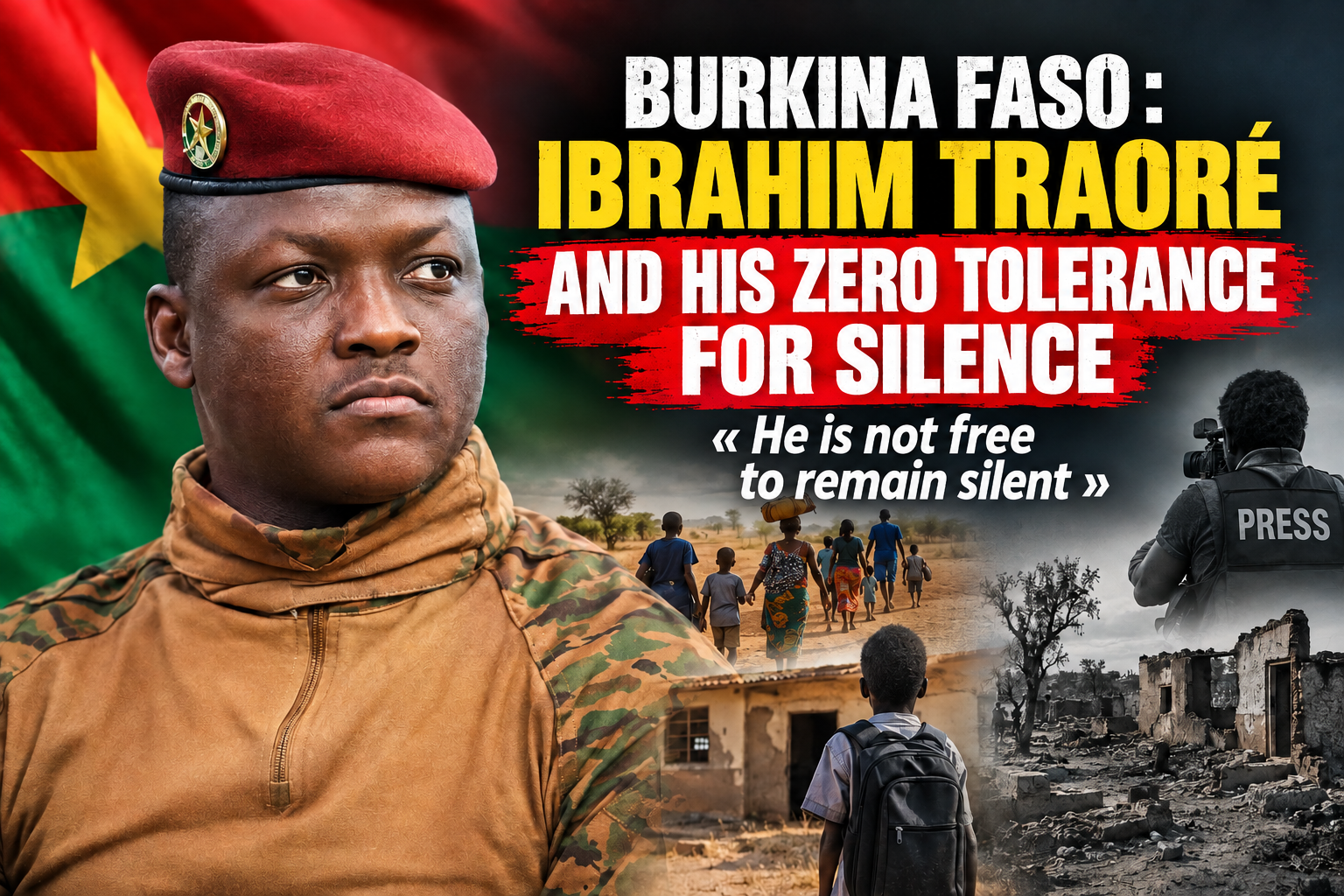
Burkina Faso four years on: the unspoken cost of Ibrahim Traoré’s rule
Unveiling the hidden realities behind Burkina Faso’s leadership
The 27 September 2026 address by Ibrahim Traoré, marking four years in power, positioned itself as a comprehensive review of his administration’s achievements. The official narrative highlighted military operations, reclaimed territories, investments, and economic initiatives elements presented to justify the government’s performance. Yet, a national assessment cannot be defined solely by those in authority; it must also reflect the lived experiences of the people.
Measuring security through displacement: a silent crisis
The most pressing question remains: after four years under Traoré’s leadership, how many Burkinabè can return to their homes and live in safety?
The humanitarian toll of the security crisis is staggering. By the end of 2025, the UNHCR reported 2,062,534 internally displaced persons (IDPs) within Burkina Faso over two million citizens forced from their homes. When including refugees and asylum seekers, the number of forcibly displaced individuals exceeded 2.1 million.
This displacement extends beyond Burkina Faso’s borders. Neighboring Côte d’Ivoire hosted approximately 82,000 Burkinabè refugees as of June 2026, part of a total of 93,200 displaced individuals in the country.
During a visit to a camp in northern Côte d’Ivoire, the human cost became impossible to ignore. Families torn apart, children displaced, and exhausted faces told stories of abandonment and loss. The question arises: amid such suffering, can the government credibly claim progress?
Security beyond military control
A territory reclaimed on a map does not equate to a livable space. True security is achieved only when communities can return to their lands, cultivate their fields, send their children to school, access healthcare, and live without fear of renewed violence. Yet, the reality on the ground remains fragile.
Behind the statistics are shattered lives: farmers unable to tend their crops, children denied an education, and communities forced to rebuild elsewhere. The narrative of recovery must account for these human dimensions not merely the presence of military forces.
Voice and accountability under scrutiny
Another critical aspect is the space for dissent. Reports have highlighted restrictions targeting journalists, civil society organizations, and critical voices. In 2026, over 118 civil society groups were reportedly dissolved, while cases such as that of journalist Serge Oulon remain unresolved.
These actions demand scrutiny. Challenging authority is not an act of betrayal; it is a democratic right. Safety should not be used as a justification to suppress criticism. A journalist demanding transparency, a citizen questioning policy, or an organization documenting abuses does not become an enemy of the state simply by doing so.
Government and nation are not one and the same.
The true measure of leadership: lives restored, not just narratives advanced
Traoré’s administration may highlight its accomplishments military progress, investments, and economic policies. These achievements deserve objective evaluation. Yet a complete assessment must also incorporate the voices of the displaced, the refugees, the bereaved, and those living in uncertainty.
As Burkina Faso approaches four years under its current leadership, the key questions remain unanswered:
How many citizens can return home safely?
How many families can resume agricultural livelihoods?
How many children can attend school without fear?
How many have sought refuge beyond the country’s borders?
And crucially, how many still dare to question those in power?
An honest evaluation cannot evade these challenges. When faced with the reality of over two million internally displaced persons and tens of thousands of refugees in Côte d’Ivoire, the government’s narrative of success falls short. Progress is not declared through statistics or carefully curated imagery; it is measured in the lives rebuilt or lost along the way.
Liberty is not secured through silence. It is secured when people can live in safety, speak freely, and hold their leaders to account.
By Yacouba Ouédraogo — Investigative journalist
