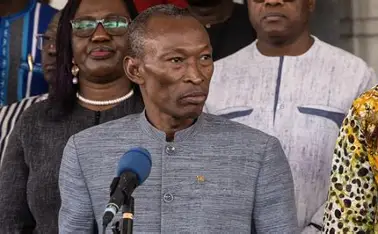
Burkina Faso blocks former prime minister Apollinaire Kyélem de Tambèla from leaving the country
Apollinaire Kyélem de Tambèla, who ran Burkina Faso’s government for more than two years, has been barred from leaving the country. The decision was taken by the authorities of Captain Ibrahim Traoré, the man who had appointed him to the premiership.
The exit ban adds a fresh chapter to the gradual tightening of control that the transitional leadership has imposed on a number of political and public figures. What makes this case unusual is its timing: Kyélem de Tambèla is no longer part of the executive.
A measure aimed at a man who once ran the government
Named prime minister in October 2022 by Ibrahim Traoré, Apollinaire Kyélem de Tambèla headed the Burkinabè government until he left the post in December 2024. He has held no ministerial role since.
Out of office since December 2024
That is precisely what turns the restriction into a puzzle. Why would the authorities deem it necessary, months after his departure, to limit the movements of a man who no longer sits in government? The question is far from minor, because an exit ban is a heavy instrument — and applying it to someone who has occupied the highest reaches of the state calls for a clear and transparent explanation.
The security argument and the gaps it leaves
The broader climate sharpens the sensitivity of the decision. Since seizing power, Ibrahim Traoré’s administration has justified a series of exceptional measures by pointing to the fight against terrorism, the defence of national sovereignty and the need to thwart attempts at destabilisation. While he was still prime minister, Kyélem de Tambèla himself spoke publicly about several plots targeting the transition.
Yet the security rationale does not settle every doubt. Should such a restriction be limited in duration? On what legal basis does it rest? Who signed the order? And what precise accusations or motives are being held against the former prime minister?
Which legal ground was used?
Burkinabè law sets out the conditions under which a citizen may leave the national territory. The central issue, therefore, is identifying the exact legal framework in which the measure against Kyélem de Tambèla was adopted.
A test case for political space in Ouagadougou
The affair now reaches well beyond one man’s career. It raises a wider question about the nature of the transitional power itself: how far can it go in the name of national security before individual freedoms are eroded still further?
For Ibrahim Traoré, the move carries a particular political risk — that of feeding the debate over a shrinking political arena in Burkina Faso. Preventing a former government figure from leaving the country is never a politically neutral act.
In Ouagadougou, the Kyélem de Tambèla case may therefore become a new marker of how security, political control and public liberties interact under military rule.
