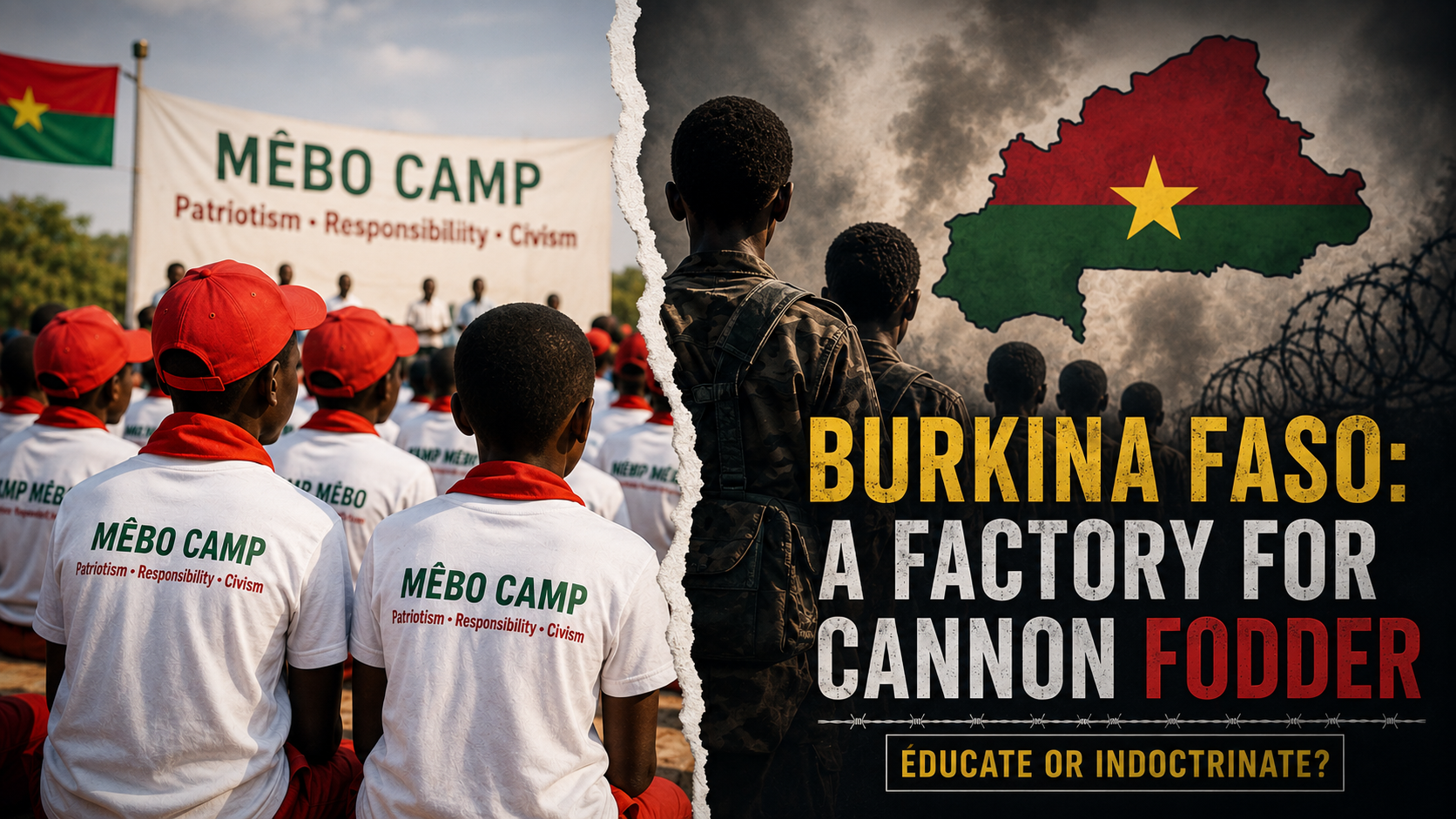
Burkina Faso: assessing youth engagement amid rising security challenges
At first blush, the initiative bears all the hallmarks of a commendable civic initiative. In Burkina Faso, the Mêbo holiday camp convened large numbers of young participants for activities centered on cultural enrichment, physical training, and community involvement. Government authorities framed the program with a clear mandate: instilling civic consciousness, fostering accountability, and nurturing a sense of shared national purpose from an early age. Yet, beneath the surface of these ostensibly benign objectives, a more pressing inquiry has begun to surface in public discourse: might these large-scale gatherings represent the earliest indicators of a growing militarization of the country’s youth?
Civic education versus political instrumentalization
The merits of civic instruction are not in question; teaching young people the values of responsibility, institutional respect, solidarity, and collective well-being constitutes a wholly legitimate pursuit. The difficulty emerges when patriotic sentiment ceases to function as a unifying force and instead evolves into a vehicle for political mobilization. When unquestioning allegiance supersedes critical reflection and the defense of the nation is framed as a perpetual duty, the boundaries of acceptable policy begin to blur dangerously.
Historical patterns in Africa
Unfortunately, this approach is not without precedent across the African continent. Historical evidence from countries such as Sierra Leone, Liberia, and the northern provinces of the Democratic Republic of Congo demonstrates how early exposure to patriotic narratives, ideological conditioning, and recruitment messaging can intermingle to the point of indistinguishability. When state institutions leverage national pride among impressionable youth populations, civic education risks transitioning from a pedagogical exercise into an apparatus for mobilization.
Rhetorical traps and psychological conditioning
Equally significant is the language employed in such campaigns. Repeated invocation of terms such as homeland, sacrifice, enemy, national defense, and commitment can subtly normalize the idea that military service constitutes the natural outcome of youth citizenship. Before any young citizen is called upon to make the ultimate sacrifice for a political or military agenda, they must first cultivate the capacity for reflection, debate, and constructive action.
The current security climate in Burkina Faso, exacerbated by ongoing conflict, internal displacement, and heightened national defense imperatives under the administration of Ibrahim Traoré (IB), intensifies scrutiny of these mechanisms. In such an atmosphere, patriotic mobilization can acquire dimensions that are as troubling as they are compelling. The central dilemma revolves around boundaries: to what extent is it justifiable to embed a defense-oriented ethos in the minds of the youngest generation?
Enhancing patriotism without eroding dissent
By orienting youth toward official narratives, does the government, intentionally or otherwise, narrow the space for dissent and intellectual inquiry? A genuinely active citizenry must not merely echo state doctrine; it must possess the capacity to defend the nation while simultaneously challenging its institutions. True patriotism entails reverence for the country without conflating it with the regime, and service to the community without becoming an instrument of political conformity.
The normalization of sacrifice as the highest expression of patriotism also warrants close examination. Framing death in battle as the ultimate emblem of loyalty risks distorting the notion of national duty among the youngest members of society. A more wholesome understanding of love for one’s nation would prioritize contributions to education, healthcare, agriculture, innovation, social cohesion, and sustainable development over glorification of combat.
The symbolism of uniforms and martial rhetoric
While uniforms, military insignia, and martial language may individually lack conclusive evidence of militarization, their cumulative presence—especially in a context of sustained national mobilization and armed conflict—demands careful scrutiny. These elements occupy a liminal space where distinctions between civic instruction, ideological persuasion, and psychological conditioning for combat can progressively dissolve.
The age factor and ethical responsibility
For adults, the capacity to weigh political and military complexities enables informed decisions regarding engagement. Children, however, lack both emotional maturity and analytical faculties; they require institutional protection from manipulation. Educational systems must safeguard youth from exploitation and ensure that learning remains a pathway to empowerment rather than an indoctrination toward confrontation.
Security imperatives versus the risk of perpetual conflict
In the face of urgent security threats, the impulse to militarize public sentiment is understandable. Yet, countering armed aggression by ideologically conditioning an entire generation to accept perpetual confrontation risks deepening cycles of violence. The more a society trains its youth to perceive adversaries and self-sacrifice as inevitable, the greater the likelihood that conflict becomes a normalized response to political and social grievances.
Patriotism beyond confrontation
Authentic patriotism should transcend this logic entirely. To cherish Burkina Faso is not solely to be willing to die for it; it is equally to strive for conditions in which children can live, learn, work, and envision futures unburdened by perpetual conflict. It is to recognize that robust support for the nation can coexist with rigorous scrutiny of its governance.
Questions that demand answers
Before endorsing narratives of patriotism and youth mobilization unreservedly, key clarifications are essential. What precise pedagogical goals animate these camps? How is critical thinking cultivated within their curricula? Are participants granted avenues for dissenting views? Do activities incorporate overt or covert military or paramilitary elements? Above all, where lies the dividing line between shaping responsible citizens and conditioning a generation to regard warfare as an inescapable fate?
Burkina Faso requires a youth that is active, informed, and cognizant of its duties. Yet it must also remain vigilant that this same youth retains its independence of thought and action. Building the nation of tomorrow demands citizens equipped for construction, not for becoming expendable instruments in future wars.
The unresolved question endures: are these young people being prepared to construct Burkina Faso’s future, or to serve as disposable agents in forthcoming conflicts?
