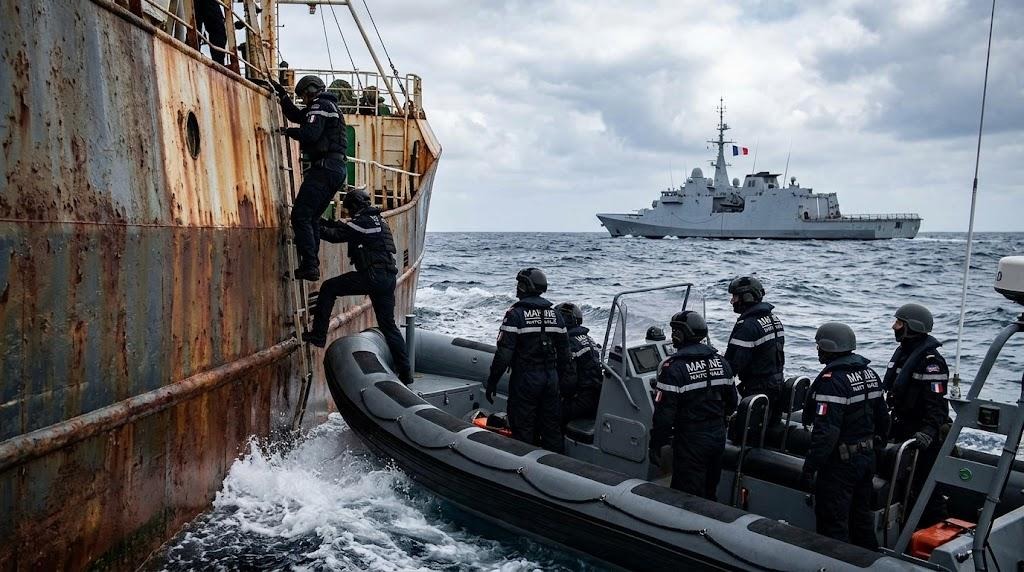
Breaking: french navy seizes russian oil tanker using beninese flag in indian ocean
A 244-meter oil tanker flying the Beninese flag was intercepted by the French Navy on October 12, 2026, 830 kilometers south of La Réunion in the Indian Ocean. The vessel, named DF Peak, was operating under what French authorities describe as a fraudulent Beninese flag, raising immediate concerns over maritime fraud and sanctions evasion.
High-seas intervention: a coordinated operation against sanctions evasion
The interception was conducted by a French naval task force acting on intelligence suggesting the vessel was actively circumventing international sanctions imposed on Russia. President Emmanuel Macron confirmed the operation, emphasizing its role in upholding global maritime law and combating illicit oil trade.
Upon inspection, French military personnel discovered significant irregularities regarding the validity of the Beninese flag documented on board. Following a request from the Public Prosecutor’s Office, the DF Peak was rerouted under escort to an anchorage zone off La Réunion for comprehensive judicial review. This review will assess the ship’s registry, cargo documentation, and ultimate beneficial ownership.
The DF Peak’s shifting identities: a textbook case of deception
The DF Peak, a 110,000-tonne oil tanker, has been under EU, US, and UK sanctions since 2024. Investigators traced its movements and identified a history of deliberate identity masking, a hallmark of Russia’s so-called “shadow fleet.”
- Originally operated as NS Captain under an undisclosed flag
- Re-registered as Kaliningrad under the Russian flag in April 2024
- Relabeled as DF Peak and switched to a Beninese flag in 2025
Satellite tracking data indicates the vessel recently departed from Venezuela, a known transit hub for Russian oil exports attempting to bypass western sanctions.
Beninese registry at risk: legal exposure and sovereignty concerns
The case has thrust Benin’s maritime registry into the spotlight. Under the Beninese Maritime Code, vessel registration requires a genuine economic link to the country, including proof of resident ownership, Beninese-registered corporate entities, or strict operational oversight. Evidence suggests the DF Peak’s Beninese documentation may be fraudulent.
If confirmed, this constitutes an act of flag falsification—a direct violation of Beninese sovereignty and a criminal offense under national law. Benin, as a signatory to the United Nations Convention on the Law of the Sea (UNCLOS), is legally obligated to ensure the integrity of its registry. Failure to do so could result in the mandatory removal of the vessel from the national register for non-compliance with safety and registration standards.
From an international law perspective, France acted within its rights under Article 110 of the UNCLOS, which permits the right of visit in cases where there is reasonable suspicion that a vessel is sailing under a false flag or is stateless. Benin may now seek mutual legal assistance from France to investigate whether intermediaries facilitated the fraudulent registration.
The shadow fleet dilemma: global sanctions and maritime loopholes
This interception underscores a systemic challenge in enforcing international sanctions. The Russian “shadow fleet” exploits weaknesses in maritime oversight by using opaque corporate structures, non-compliant insurance schemes, and at-sea cargo transfers to mask ownership and origin of oil.
The DF Peak incident compels Benin to urgently audit its maritime registry to prevent systemic abuse. It also signals a turning point for regional maritime authorities and global sanctions enforcement agencies in identifying and dismantling fraudulent shipping networks.
