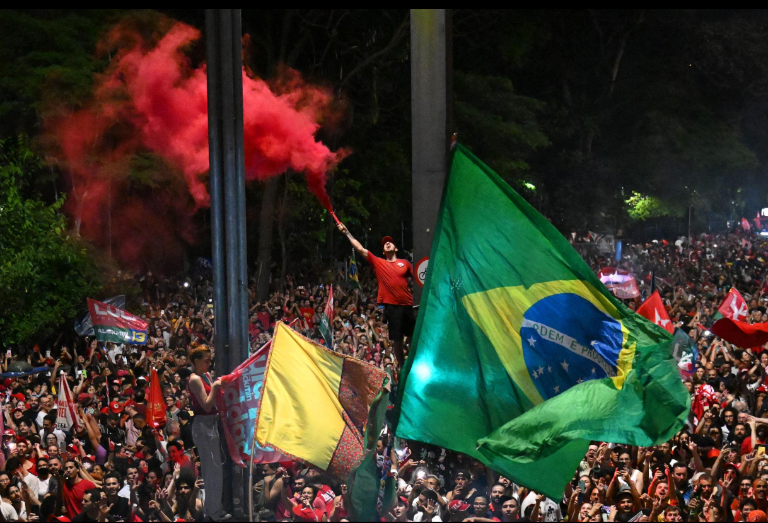
Brazil’s election 2026: Lula declared winner as Flávio Bolsonaro files legal challenge over polling delays
Brazil’s 2026 presidential election delivers historic fourth term for Lula
Luiz Inácio Lula da Silva has secured a fourth term as Brazil’s president with 51.79% of the vote, defeating his opponent Flávio Bolsonaro by over 4.4 million ballots. The victory, announced by the Superior Electoral Court (TSE), marks a historic moment in Brazilian politics, though it has been immediately overshadowed by Bolsonaro’s legal challenge to the election’s integrity.
The official results show Lula received 64,256,232 votes, while Flávio Bolsonaro garnered 59,826,041 votes. Despite this clear margin, the right-wing candidate announced plans to contest the results, citing irregularities in the voting process.
Controversial polling extension fuels Bolsonaro’s legal battle
The crux of the dispute lies in a late Sunday decision by Supreme Court Justice Cristiano Zanin, who extended polling hours from 5:00 PM to 7:00 PM Brasília time in certain polling stations. The move, intended to accommodate transportation challenges for voters in Bahia and São Paulo, was criticized by Flávio Bolsonaro as a violation of electoral fairness.
The opposition candidate argued that the last-minute change disrupted the voting process and created unequal conditions for voters. “It’s impossible to accept these election results under these circumstances,” he stated, vowing to pursue legal action to annul the vote.
Interestingly, both campaigns had previously requested extensions—Bolsonaro’s team citing heavy rains in southern Brazil—adding complexity to the legal dispute.
Brazil’s political divide deepens after polarized campaign
The election highlighted the profound political and social divisions in Brazil. Lula’s victory represents a triumph for his legacy of social programs and poverty reduction, while Flávio Bolsonaro’s campaign leaned into conservative values, security, and traditional family structures.
As the son of former President Jair Bolsonaro—currently serving a 27-year prison sentence for attempted coup involvement—Flávio Bolsonaro’s refusal to concede raises concerns about institutional trust and democratic stability. The legal challenge now faces scrutiny over whether it has merit or is merely a political maneuver.
What’s next for Lula’s fourth term?
With Lula set to govern a country where nearly half the electorate rejected his policies, the challenges are immediate. A divided legislature dominated by conservative forces could severely limit his ability to implement economic and social reforms.
In a conciliatory tone following the results, Lula emphasized his responsibility to lead for all Brazilians, regardless of their political leanings. However, the coming months will test whether the nation can move past this electoral dispute and unite behind its new administration.
The Superior Electoral Court has yet to officially validate the results, leaving room for legal proceedings. While Lula’s victory stands, the legitimacy of the election process remains a subject of intense debate.
Election aftermath: Can legal challenges derail Lula’s mandate?
The Brazilian electorate now faces a critical juncture. Will Flávio Bolsonaro’s legal challenge remain confined to the courts, or will it escalate into a broader political crisis? The Supreme Court’s handling of the case will be pivotal in determining whether the election results hold or if a recount or annulment becomes necessary.
For now, Lula prepares to take office for his fourth term, but the shadow of legal uncertainty looms large over Brazil’s democratic future.
