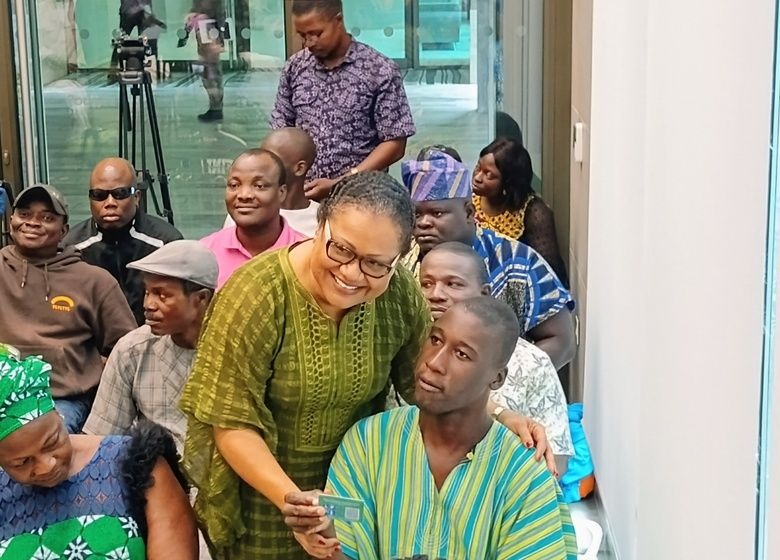
Benin’s social inclusion milestone: 1 422 new chance equality cards issued to empower persons with disabilities
Benin has taken a decisive step toward turning policy into tangible progress for persons with disabilities, unveiling 1 422 new Chance Equality Cards in a ceremony officiated by the Minister of Social Affairs and Microfinance, Véronique Tognifodé. This fresh batch brings the nationwide total to over 6 100 cards, all meticulously produced by the National Agency for Personal Identification (ANIP) and now in the hands of eligible citizens across the country.
The Card That Opens Doors: Beyond Identity to Legal Guarantee
The Chance Equality Card was created under the Law on the Protection and Promotion of the Rights of Persons with Disabilities, but it functions far beyond a standard ID. Designed as a legal instrument, it safeguards priority access to key public services, ensuring that disability does not become a barrier to essential rights. Behind its creation lies a deliberate policy shift: transforming the concept of ‘equality’ from rhetoric into enforceable entitlements.
Rooting for Fairness: How the Card Translates into Real-World Access
From the first draft to final distribution, the card’s design reflects years of advocacy and data-driven reform. It unlocks a range of preferential services, including:
- Healthcare: Reduced tariffs and, in some cases, full exemption for prescribed orthopedic devices and essential treatments in public health facilities.
- Education & Vocational Training: Waived or reduced tuition fees in public schools and priority eligibility for government-funded scholarships and training programs.
- Transport & Employment: Free or subsidized transit, alongside incentives for public and private employers to meet national inclusion quotas.
The card is not just a tool—it is a mechanism of systemic change, ensuring that persons with disabilities are no longer treated as afterthoughts in service delivery.
Behind the Scenes: Rigor, Transparency, and Ongoing Expansion
The success of this initiative hinges on a meticulous, multi-layered process overseen by ANIP in partnership with the Single Social Protection Windows (GUPS) in municipalities across all 12 departments. Each applicant undergoes a medical assessment conducted by state-certified physicians, who verify the degree and type of disability before approving the card. This dual-layered verification—combining medical rigor with administrative integrity—has been critical in building public trust and preventing misuse of benefits.
The role of civil society in sustaining impact
Representing the voice of persons with disabilities, the Federation of Associations of Persons with Disabilities in Benin (FAPHB) has welcomed the ongoing rollout, while urging families and claimants to complete their applications through local GUPS outlets. With thousands of pending dossiers still under review, the government has committed to scaling up deployment over the coming months, pledging to close the gap between policy and lived experience for every eligible citizen.
What’s Next? From Distribution to Transformation
Minister Tognifodé has framed this wave of cards not as a destination, but as a stepping stone toward a more inclusive society. The ultimate goal? To move from symbolic inclusion to structural equity, where disability rights are not just recognized on paper, but lived every day in access to health, education, and opportunity.
As more cards reach their holders, the real test will lie in enforcement. Will public institutions honor their commitments? Will employers step up to the inclusion quota? And most importantly—will this generation of cards finally break the cycle of exclusion that has long shadowed persons with disabilities in Benin?
The journey has just begun, but the foundation is now in place.
