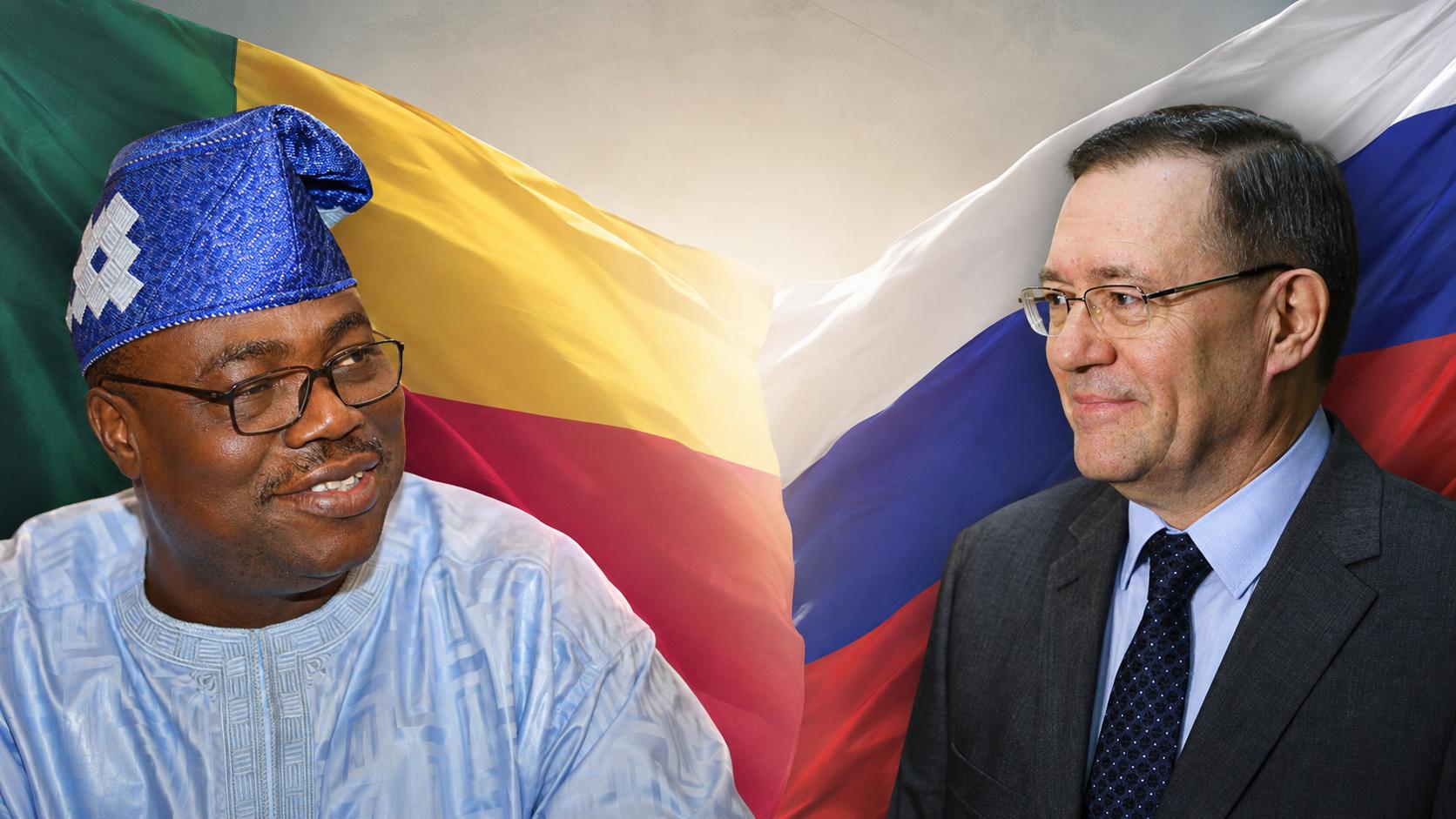
Bénin strengthens economic ties with Saint-Petersburg amid global shifts
As West Africa undergoes significant geopolitical transformations, the Bénin government is pursuing a pragmatic and unconstrained diplomatic approach. Recently, the Beninese ambassador to Russia engaged in high-level discussions with authorities in Saint-Petersburg to expand bilateral cooperation in critical sectors such as energy, agriculture, and healthcare.
This initiative reflects both Russia’s growing interest in Africa and Porto-Novo’s broader strategy: diversifying economic partnerships while maintaining—and even reinforcing—its long-standing and strategic ties with Western powers.
Strategic talks shaping future collaborations
A key meeting between Evgueni Grigoriev, member of the Saint-Petersburg government and Chair of the Municipal Committee for Foreign Relations, and Akambi André Okounlola Biaou, Bénin’s ambassador to Russia, set the stage for deeper economic cooperation between the Russian metropolis and the West African nation.
The discussions, held in a cordial atmosphere, laid the groundwork for an expanded partnership. Opening the talks, Mr. Grigoriev extended warm congratulations to his counterpart on the occasion of Bénin’s Independence Day, celebrated on August 1st, reinforcing a spirit of mutual respect.
The negotiations focused on concrete outcomes, with the Saint-Petersburg committee’s official statement highlighting promising sectors for collaboration. Energy, agriculture, fisheries, infrastructure projects, pharmaceuticals, and education emerged as top priorities. For Bénin, a nation undergoing major structural reforms, these areas are vital—reliable energy access fuels industrialization, while modernized agriculture remains central to economic growth and food security.
Saint-Petersburg’s business leaders pitch tailored solutions
To turn these ambitions into reality, Russian enterprises took center stage. The meeting included representatives from the Saint-Petersburg Export Support Center, a non-profit organization dedicated to promoting local expertise abroad, alongside executives from leading regional companies.
Among them, Baltiski Bereg, a major player in fisheries and seafood processing, presented solutions to support Bénin’s maritime development. Radar MMS, a technology firm specializing in information systems and infrastructure, outlined its project proposals. In healthcare and food security, Polysorb (pharmaceuticals and medical technologies) and Lignohumate (agricultural fertilizers and yield optimization) showcased their offerings, which captured the attention of the Beninese delegation.
Ambassador Okounlola Biaou expressed strong interest in these proposals, proposing a decentralized approach to deepen collaboration. He suggested fostering direct regional exchanges between Saint-Petersburg and Cotonou, Bénin’s economic hub, to streamline commercial agreements and bypass bureaucratic hurdles.
2025: A milestone year for Bénin-Russia relations
These preliminary discussions are not merely symbolic—they mark the beginning of actionable steps. Following the talks, both parties agreed on an ambitious timeline, with plans for a Beninese trade mission to Saint-Petersburg scheduled for next year.
This mission holds symbolic significance, aligning with the 65th anniversary of diplomatic relations between Bénin and Russia. Beyond commemoration, its goal is to translate discussions into signed contracts and joint projects, strengthening the economic bridge between Eastern Europe and the Gulf of Guinea.
Military cooperation: a parallel security agenda
While economic ties dominated the agenda, security cooperation also featured in the discussions. Earlier this year, a Russian Defense Ministry delegation met with Bénin’s naval high command to explore joint naval exercises. With piracy remaining a persistent threat in the Gulf of Guinea, Bénin is actively seeking ways to enhance its maritime operational capabilities and protect its territorial waters, which are vital for international trade.
A balanced diplomacy: no pivot, but strategic expansion
This engagement with Moscow is not a shift away from Western allies—it is an enhancement of Bénin’s diplomatic strategy. Porto-Novo continues to prioritize its relationships with the European Union, the United States, and France, viewing them as essential pillars of development and security.
Economically, the United States plays a key role, particularly through the Millennium Challenge Corporation (MCC), which has invested hundreds of millions of dollars in Bénin’s electricity infrastructure. The African Growth and Opportunity Act (AGOA) also facilitates exports to the U.S. market.
The European Union and France remain Bénin’s top donors and commercial partners, with recent initiatives including the return of historical artworks and increased French investments in logistics, infrastructure, and services. In terms of security, Bénin relies heavily on support from France and the U.S. to counter jihadist threats in its northern regions.
Rather than a departure from its Western partners, Bénin’s outreach to Saint-Petersburg is a sovereign decision to broaden its alliances. By engaging with Russia, Bénin is asserting its strategic autonomy while strengthening its position as an attractive partner for nations seeking to contribute to its economic rise.
The 2025 trade mission will serve as a litmus test for the real-world impact of these new ambitions in Bénin—a nation firmly rooted in multi-alignment and poised to leverage global partnerships for its development.
