Behind the strikes on Sévaré: how Mali’s security gamble is failing against jihadist resilience
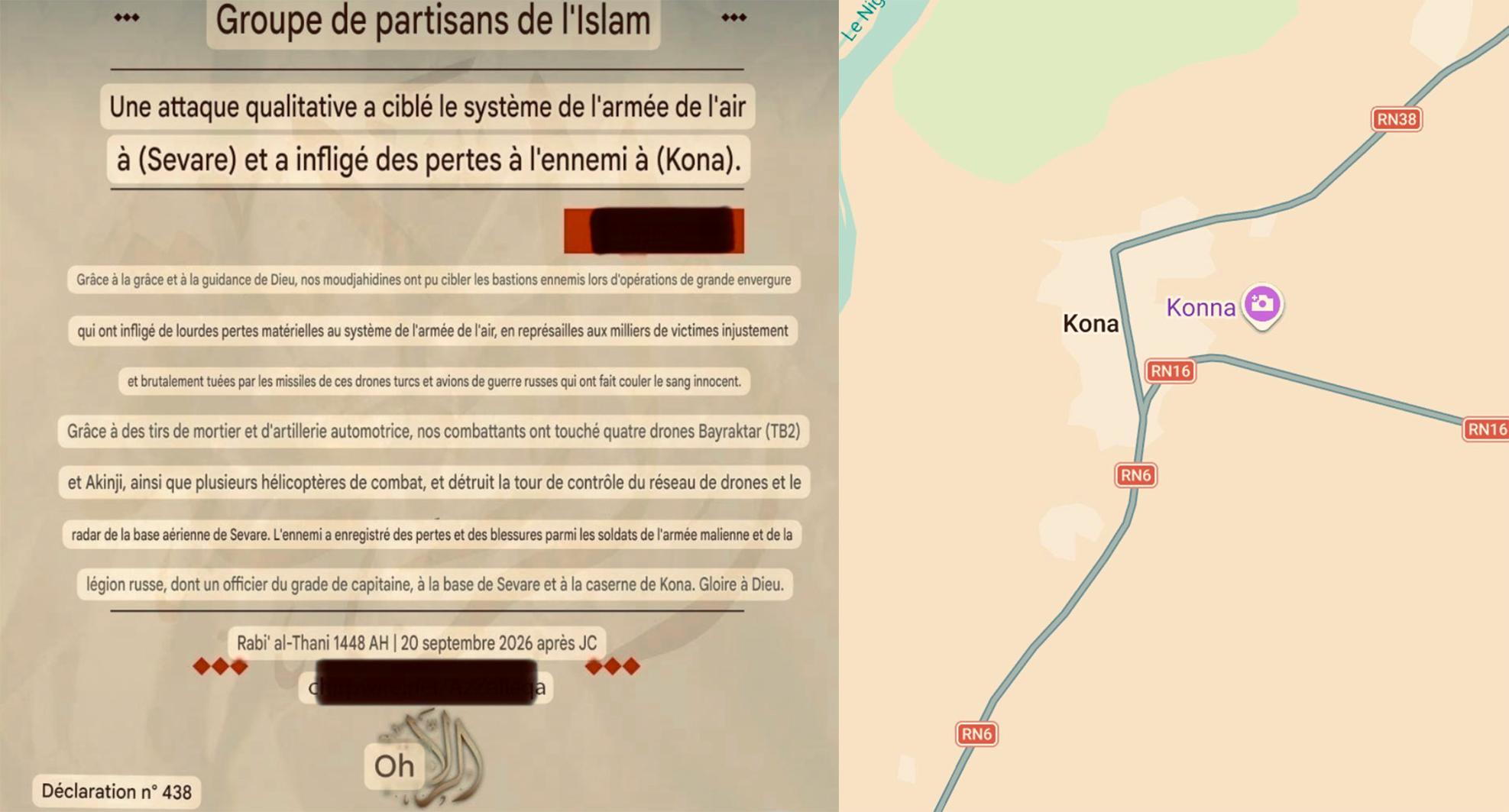
The devastating attack on Mali’s Sévaré airbase and Konna barracks, carried out on September 20 and claimed by the al-Qaeda-affiliated Group for the Support of Islam and Muslims (JNIM), has exposed the fragile underbelly of Bamako’s security strategy. Despite heavy investment in advanced weaponry, Russian-backed mercenary support, and a shift away from Western partnerships, the Malian military remains alarmingly vulnerable to asymmetric warfare.
Why the JNIM’s latest strike in Sévaré is more than just a setback
The attack was not merely a tactical strike—it was a calculated strike against Mali’s entire security doctrine. The JNIM claims to have neutralized four drones (Bayraktar TB2 and Akıncı models), several helicopters, a radar system, and a control tower, while inflicting casualties on both Malian troops and Russian fighters. This level of precision reveals far more than tactical execution; it reveals systemic failure. The incident underscores a critical paradox: Mali’s military now possesses sophisticated firepower, yet the jihadist threat still dictates the tempo of the conflict.
The strategic gamble that is backfiring: from Western withdrawal to Russian reliance
The departure of international partners like France following the 2020 and 2021 coups was framed by Bamako as a move toward sovereignty. The pivot to Russia—through the Africa Corps—was presented as a bold assertion of independence. But independence does not equate to immunity. On the ground, where jihadist groups have operated for over a decade, technology alone cannot compensate for deep-rooted intelligence gaps, terrain mastery, and adaptive tactics.
The Africa Corps, tasked with bolstering Mali’s defense, now finds itself entangled in a war it was never designed to win. The JNIM operates in plain sight, blending with local populations, exploiting rural terrain, and launching attacks with alarming frequency. Drones may provide surveillance and precision strikes, but they cannot secure roads, protect villages, or maintain constant state authority in remote areas. This structural imbalance explains why Sévaré—home to one of Mali’s most critical military hubs—remains within striking distance.
Sévaré as a mirror of Mali’s deeper security crisis
The attack on Sévaré is not an anomaly—it is a symptom. Despite concentrated military assets around key cities like Sévaré, Gao, and Mopti, vast stretches of Mali remain lawless. The jihadists don’t just attack bases; they ambush convoys, control rural markets, and extort local communities. The Malian military’s inability to project power beyond fortified positions reveals a crisis of presence, not just firepower.
Each strike on a military installation serves as a reminder: advanced weaponry is only as effective as the strategy behind it. While Bamako showcases new equipment in parades, the JNIM continues to dictate the rhythm of violence. The result? A widening gap between military capacity and territorial control. Civilians pay the price in displacement, economic disruption, and daily insecurity.
The illusion of technological superiority
Mali’s acquisition of Turkish drones has been hailed as a game-changer. But technology, no matter how advanced, is only as strong as the system supporting it. Concentrating high-value assets like drones and helicopters in fixed, identifiable bases creates high-value targets. The JNIM’s claims about the damage at Sévaré suggest that Mali’s technological edge is being systematically neutralized—not in battle, but on the tarmac.
This raises a fundamental question: how effective is military hardware when it is exposed to asymmetric threats? The answer lies not in the number of drones, but in the ability to gather human intelligence, secure supply lines, protect civilians, and maintain continuous state presence in ungoverned zones.
Politics of security: when symbolism overshadows results
The junta’s legitimacy rests on two pillars: reclaiming national sovereignty and defeating terrorism. The withdrawal from Western coalitions and the embrace of Russian military support were presented as bold steps toward self-determination. Yet, with each successful jihadist attack, the narrative of transformation weakens. The Sévaré strike is more than a military failure—it is a political reckoning.
For the people of Mali, the debate over whether Bamako should partner with Moscow or Paris matters less than whether they can travel safely, send children to school, or run a business without fear. Security is not measured by the size of the arsenal or the volume of arms parades—it is measured by the absence of violence in daily life. And on that score, Sévaré’s attack speaks volumes.
What comes next for Mali’s security model?
The junta faces a stark reality: military might alone cannot break the jihadist insurgency. The path forward demands more than acquisitions and alliances—it demands a strategy rooted in presence, intelligence, and resilience. Until Bamako can secure rural corridors, protect civilians, and restore state authority in contested zones, its security gambit will remain on shaky ground. The next major attack won’t just test equipment—it will test the very foundation of the junta’s rule.
Sévaré was not just a target. It was a referendum on Mali’s security strategy. And so far, the verdict is not in Bamako’s favor.
