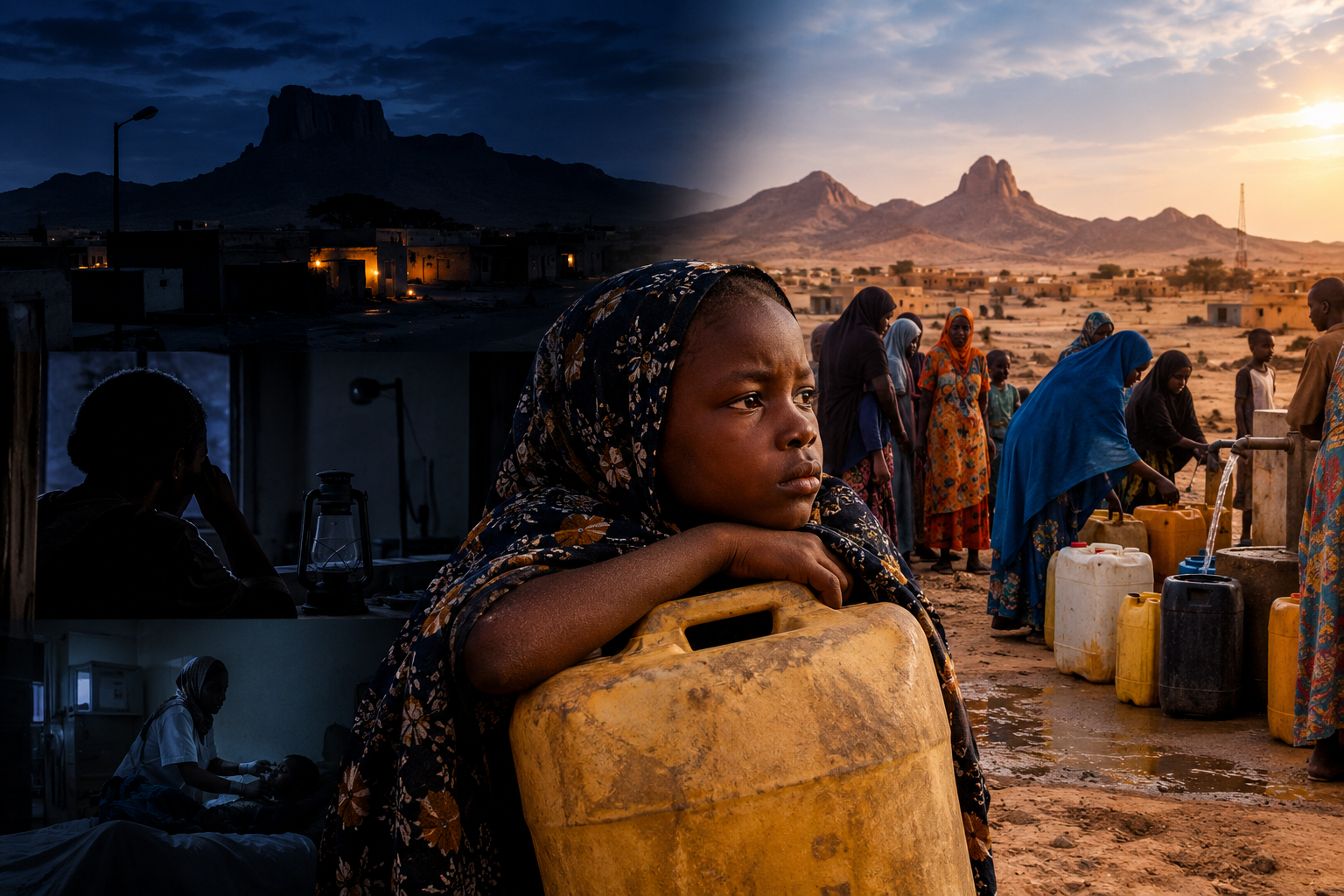
Behind the grid: how systemic gaps leave northern Niger in perpetual darkness and thirst
From promises to blackouts: the unmet needs of northern Niger under Tiani
The official narrative out of Niamey often speaks of progress and expanding energy capacity. Yet in the northern reaches of Niger, particularly around Agadez, Arlit, and Tchirozérine, the reality is far grimmer. For two months and counting, families have grappled not just with intermittent shortages, but with prolonged blackouts and critical water scarcity challenges that trace back to deeper structural failures rather than temporary setbacks.
The region’s troubles are not new, but their persistence under the current administration raises urgent questions about delivery, allocation, and accountability. While policymakers in the capital tout national gains in power generation, the people of the north are left navigating a reality where even essential services remain out of reach.
Power disruptions: more than just a technical glitch
In Agadez, Arlit, and Tchirozérine, the Nigerien national electricity company (NIGELEC) has attributed recent blackouts to maintenance on the SONICHAR coal plant. Yet for communities already stretched thin, such explanations offer little solace. When the grid collapses sometimes for days on end, with some households reporting weeks without power the impact is immediate and severe. Hospitals, schools, and local businesses grind to a halt. Streets fall dark. And in an age where electricity underpins nearly every aspect of modern life, the absence of light becomes a daily reminder of neglect.
Local authorities have acknowledged the strain, dispatching teams to assess the damage and negotiate with NIGELEC. But acknowledgment, in this case, has not translated into resolution. In July, power cuts in Arlit disrupted medical services, forcing healthcare workers to adapt in real time. The crisis is not isolated to one city it is a systemic pattern affecting multiple communities across the region.
Water woes deepen in the shadow of blackouts
Electricity and water are inextricably linked in northern Niger. Most water pumping stations rely on electrical power to operate. When the grid fails, so too does the flow of water. In May, officials from the National Water Company (SNE) admitted that production in Agadez stood at just 19,500 cubic meters far below the estimated demand. By July, reports confirmed a worsening shortage, with potable water, electricity, domestic gas, and fuel all in short supply across major urban centers.
For residents in remote areas, the consequences are dire. With no running water, many are forced to turn to unregulated sources natural waterholes or makeshift wells risking contamination and disease. The irony is stark: a region rich in mineral wealth struggles to deliver two of life’s most basic necessities to its own people.
The numbers tell only half the story
National figures paint an optimistic picture. In July, the Energy Minister announced a total installed capacity of 420 MW, with 294 MW currently available. But the fine print reveals a glaring disparity: of that available power, only 16 MW serve the entire northern region. While the south may be experiencing growth, the north appears to be losing ground.
It is not enough to increase national capacity if the infrastructure and distribution networks fail to reach the communities that need them most. The northern region’s geography, marked by vast distances and rugged terrain, demands targeted investment not broad declarations. Yet for now, the disconnect between policy and practice persists.
A crisis of expectations and accountability
The government has framed its efforts around new energy projects and infrastructure upgrades. But for the people living through this crisis, the measure of success is far simpler: when they turn on the tap, does water flow? When night falls, does the light stay on?
These are not rhetorical questions. They reflect daily realities. Families endure weeks without stable electricity. Children study by candlelight. Small businesses shutter prematurely. Healthcare facilities ration care. The cumulative effect is not just hardship it is a breakdown of trust in institutions that promise progress but deliver only delays.
The northern Niger of today is not just facing a technical failure. It is confronting a crisis of governance, of priorities, and of equity. Until the lights come back on for good and the taps run freely the people of the north will continue to live in the shadow of unfulfilled promises.
By Yacouba Ouédraogo — Investigative journalist
