Behind Côte d’Ivoire’s $5.3 billion World Bank portfolio: the forces shaping a development gamble
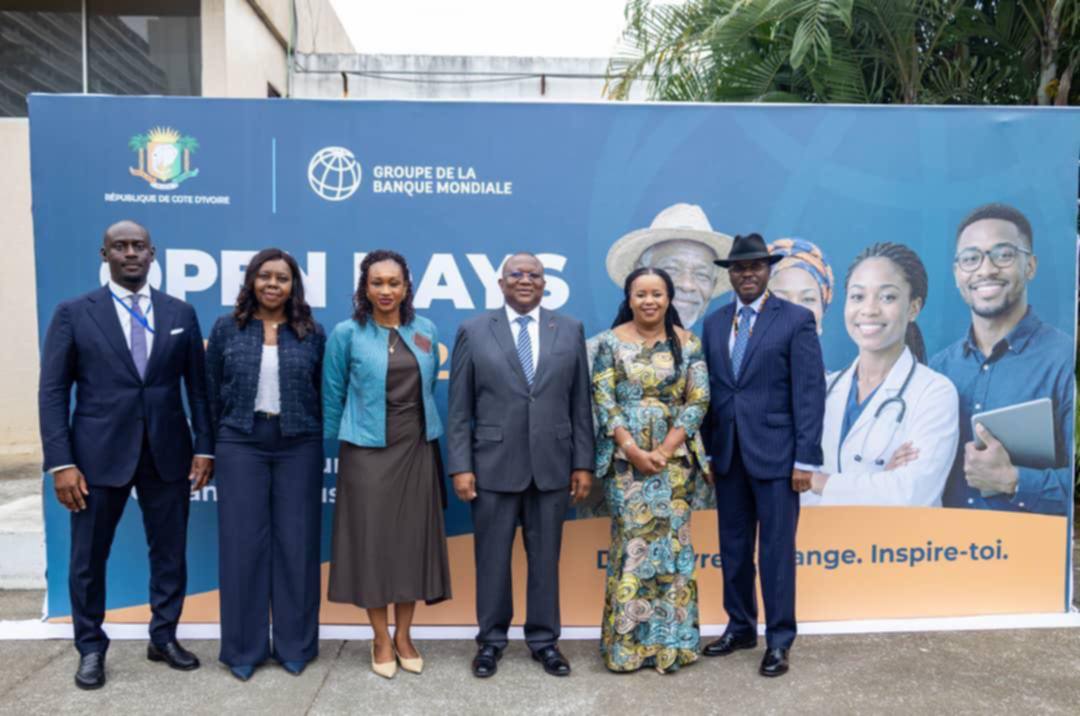
The headline number is striking: the World Bank Group’s active portfolio in Côte d’Ivoire stands at 25 projects worth a combined $5.3 billion. But what lies beneath that figure is a carefully layered strategy that has been building for years — one that ties together job creation targets, innovative financial engineering, and a long-term alignment with the country’s national development plan. The figure was reaffirmed on Monday, September 21, 2026, in Abidjan at the opening of the Group’s first-ever Open Days, by Mr. Amadou Coulibaly, Minister of Communication and Government Spokesperson, representing Dr. Souleymane Diarrassouba, Minister of Planning and Development and World Bank Group Governor for Côte d’Ivoire.
The two-day event, held under the theme “Jobs and Opportunities: Building Together for Inclusive Growth,” brought together several government members alongside Ms. Marie-Chantal Uwanyiligira, World Bank Division Director for Côte d’Ivoire, Benin, Guinea, and Togo. For two days, students, young graduates, and project leaders engaged directly with teams behind the institution’s financed projects in education, employment, entrepreneurship, and infrastructure. Employment emerged as the central thread: the 2026-2030 National Development Plan aims to create three million jobs, with priority given to young people and women.
Where the money actually goes
Group financing spans infrastructure, agriculture, energy, education, health, and human capital development. Over the past five years, the International Finance Corporation (IFC) has invested nearly $2.7 billion in Côte d’Ivoire, while the Multilateral Investment Guarantee Agency (MIGA) has worked to bolster investor confidence.
What is less visible is how these different arms of the World Bank Group interact — blending public lending, private-sector investment, and political risk guarantees into a single, coordinated push. That architecture explains why the current portfolio is often described as more than the sum of its parts.
Current commitments versus future ambitions
It is important to distinguish the active portfolio from the far larger commitment announced for the coming years. At the Consultative Group meeting for financing the 2026-2030 National Development Plan, held in Abidjan on July 8-9, 2026, the World Bank Group pledged more than $17 billion: $10 billion from the World Bank, $5 billion from the IFC, and $2 billion from MIGA.
That gap between the $5.3 billion currently deployed and the $17 billion promised reveals a deliberate sequencing — existing projects are meant to prove the model before the next wave of financing is unlocked.
Financial innovations that broke new ground
The partnership has also produced first-of-their-kind financial operations in the region. In December 2024, Côte d’Ivoire completed a debt-for-development swap with the Group’s support — the first of its kind backed by the institution. Covering nearly €400 million in commercial debt, the operation improves the country’s debt profile while freeing up resources for education. Then, in 2025, the country closed West Africa’s first sustainability-linked sovereign loan, worth €433.3 million, carrying a dual guarantee from the International Bank for Reconstruction and Development (IBRD) and MIGA.
These deals matter beyond their headline value: they signal to other issuers and investors that Côte d’Ivoire can structure complex, credibility-enhancing transactions — a quiet but powerful driver of future access to capital.
The diplomatic groundwork behind the numbers
The sequence of events reflects a closely followed partnership. On September 10, Dr. Souleymane Diarrassouba received Mr. Harold Tavares, Executive Director for the Africa Group II at the World Bank Group’s Board of Directors, in Abidjan. Their discussions focused on the Ivorian portfolio and preparations for the next Country Partnership Framework, which will be aligned with the priorities of the 2026-2030 National Development Plan.
That meeting, coming just days before the Open Days, underscores how the relationship is managed on multiple levels — from project teams on the ground to boardroom-level strategy — and how each public milestone is underpinned by less visible rounds of negotiation and alignment.
