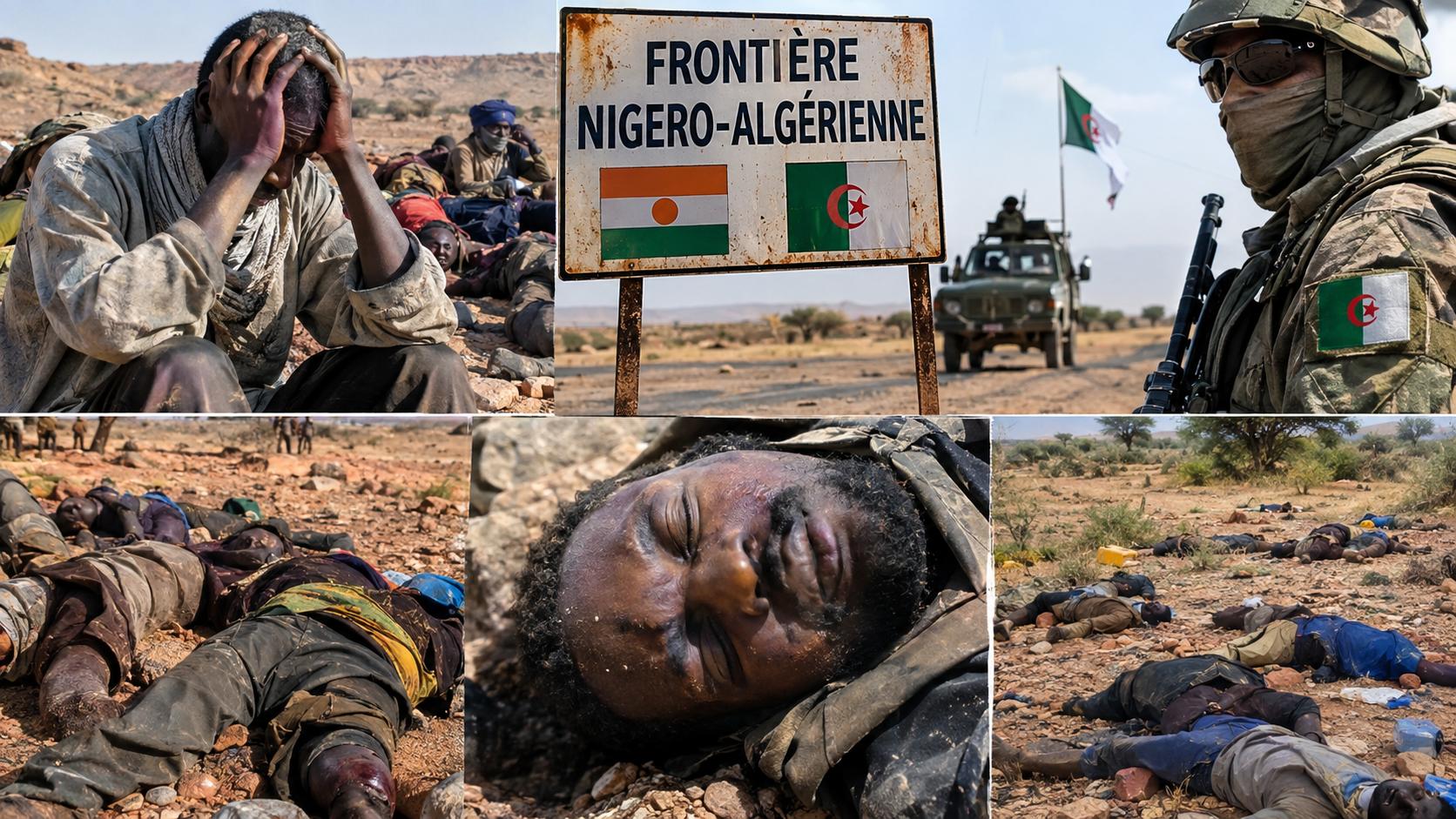
Algerian helicopter strike kills 48 gold miners on Niger’s border, and Niamey stays silent
A deadly dawn over the Sahara’s gold belt
Forty-eight people are dead after a military helicopter belonging to the Algerian air force opened fire on an informal gold-mining camp straddling the frontier zone between Niger and Algeria. Every one of the victims was a civilian.
The machine involved was a Russian-built Mi-171, which circled the diggings at low altitude in broad daylight before turning its weapons on makeshift shelters and parked vehicles. The miners, scattered across flat, treeless desert with nowhere to take cover, had no way to escape the barrage.
Beyond the confirmed dead, a significant number of seriously wounded survivors were moved out under improvised conditions toward the nearest medical facilities, several hours away by road.
Hundreds of diggers, one gunship, no warning
The site is part of a long-established artisanal mining area that draws hundreds of young fortune-seekers from Niger and neighbouring countries every season. Word of the strike spread quickly through the camps and into the towns that supply them, carried by returning workers and traders.
Algiers routinely presents its aerial patrols along the southern margins as counter-terrorism and anti-smuggling work. This time, however, the people on the receiving end were unarmed informal labourers chasing a living from the sand — not fighters, not traffickers.
Sovereignty on paper, silence in practice
A foreign army aircraft firing on Nigerien soil, or on its immediate edge, would normally trigger formal protests, recalled ambassadors and a full-blown diplomatic row. Instead, the authorities in Niamey have said almost nothing. General Abdourahamane Tiani and his government have let the days pass in conspicuous quiet.
That silence is being read across the region as something more than embarrassment. Many analysts see in it an implicit green light — perhaps even an explicit arrangement — between the junta and Algiers.
The bargain behind the quiet
Since breaking with its traditional partners, the Nigerien military government has been hunting for legitimacy and regional backing wherever it can find them. Critics argue it is now willing to trade the integrity of its own territory, and the safety of its own citizens, to keep that support.
Algeria, for its part, wants its southern flank secured at any cost, and appears to be filling a vacuum of authority that stretches across the border.
An army stretched thin and losing men
The raid lands at a moment of acute internal strain for the Nigerien armed forces. The failed coup attempt during the night of 28 to 29 August exposed how deep the divisions run — through the rank and file as much as the high command.
Since then, an unusually large number of officers and soldiers have walked away from their posts. Their reasons overlap: disillusion with the junta’s political direction, exhaustion with a deteriorating security picture, and a refusal to be associated with abuses or internal score-settling.
Why the border is now exposed
- Command structures remain fractured after the failed putsch
- Experienced personnel are leaving faster than they can be replaced
- Neighbouring armies and non-state armed groups are moving into the gap
- The force can no longer physically cover a territory the size of Niger
The result is a security apparatus that cannot guard its own perimeter — and neighbours who understand that perfectly well.
Grief turns to demands in the mining towns
Shock among ordinary Nigeriens is hardening into anger. Relatives of the dead and civil society organisations are pressing for answers, asking how a government that has built its entire rhetoric around national sovereignty can allow a foreign military to kill its civilians without so much as a formal complaint.
That question has no comfortable reply. By overlooking the Algerian operation and struggling to hold its own ranks together, the junta in Niamey is exposing the distance between its slogans and its reach.
A frontier tragedy that changes the terms
What happened in the desert this week marks a bleak milestone. In a country where the search for gold has become a lethal gamble, and where sovereignty is invoked constantly but defended rarely, the miners of the borderlands have paid a price their government seems unwilling even to name.
